绍兴新昌地区流量计异常检测数据
收藏资源简介:
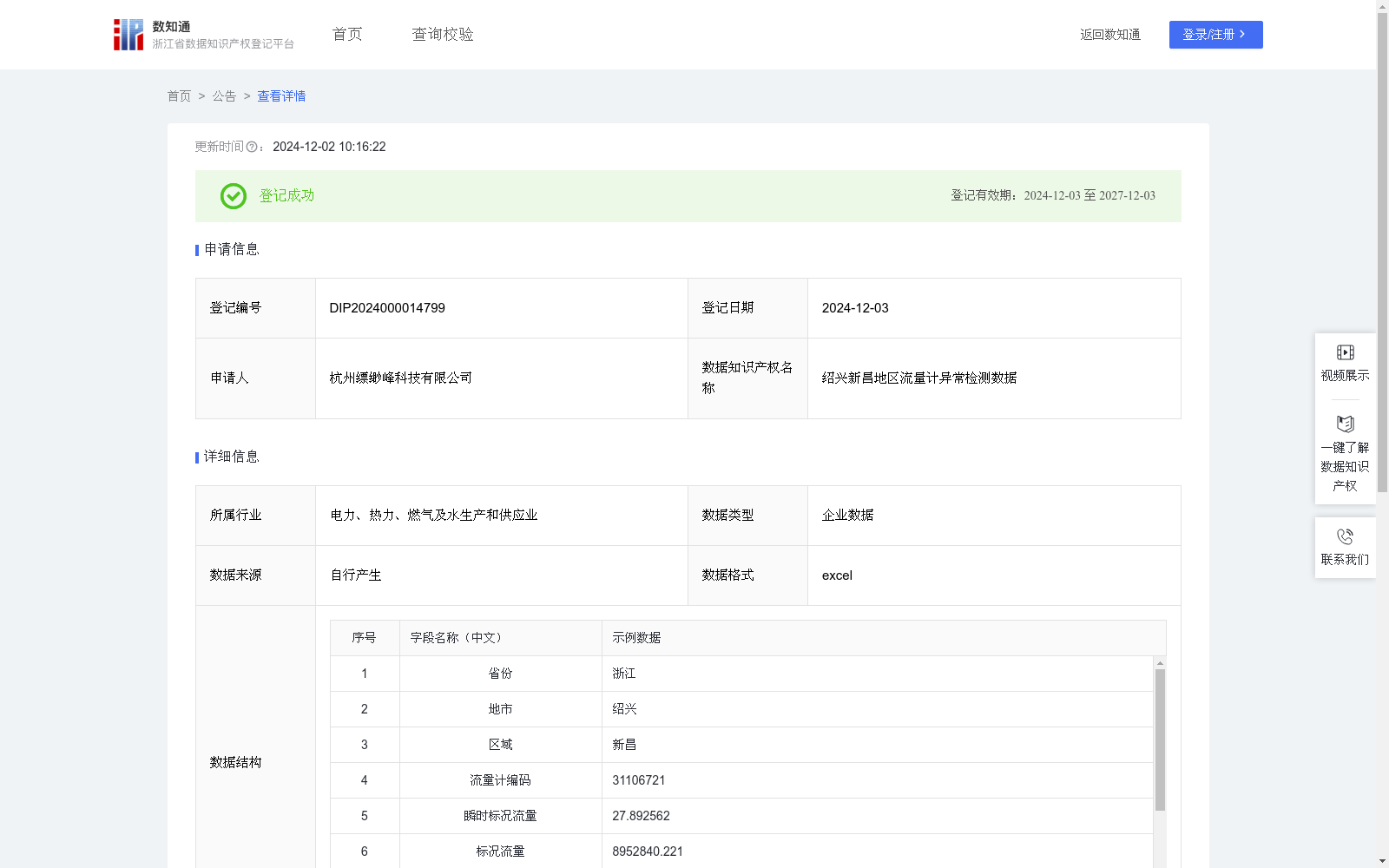
流量计的异常检测预警系统旨在提升系统安全性、降低维护成本,并确保设备的稳定运行。通过结合DBSCAN聚类算法和高斯混合模型(GMM),该算法能够有效分析流量、压力、温度等数据,识别设备的常规工作模式,并发现偏离常规的数据点。这有助于及时发现系统中的潜在异常,如设备故障、传感器异常或外部干扰,实现更科学和系统化的监控和维护预警,为决策者提供精准的维护策略支持。1. 数据采集:通过流量计采集系统获取关键字段,包括:省份、地市、区域、流量计编码、瞬时标况流量、标况流量、温度、出口压力(kPa)、以及采集时间。 2. 数据预处理:在指定区域内,按照流量计类型对数据进行分类,并对瞬时标况流量、标况流量、温度、出口压力数据进行标准化处理。 3. 聚类分析:使用DBSCAN识别各流量计在不同温度和流量条件下的工作模式。通过合理设置邻域最大距离和簇内所需的最小样本数,将数据划分为多个簇,同时将无法归类为任何簇的数据点标记为噪声。 4. 模型训练:对DBSCAN识别出的非噪声数据,进行GMM模型训练。通过合理设置GMM的簇数量、协方差类型、初始化方法、收敛阈值、先验权重等,进行模型调优训练。 5. 异常检测:对每个数据点应用GMM计算出其在各个簇中的概率,并取最大概率值。设定一个概率阈值0.93,如果该数据点最大概率值小于概率阈值0.93,则标记为异常。
The anomaly detection and early warning system for flow meters aims to enhance system safety, reduce maintenance costs, and ensure stable operation of equipment. By combining the DBSCAN clustering algorithm and Gaussian Mixture Model (GMM), this system can effectively analyze data such as flow rate, pressure and temperature, identify the normal operating modes of equipment, and detect data points that deviate from the norm. This helps timely detect potential anomalies in the system, such as equipment failures, sensor abnormalities or external disturbances, realize more scientific and systematic monitoring, maintenance and early warning, and provide accurate maintenance strategy support for decision-makers. 1. Data Collection: Obtain key fields through the flow meter acquisition system, including: province, city, region, flow meter code, instantaneous standard condition flow rate, standard condition flow rate, temperature, outlet pressure (kPa), and collection time. 2. Data Preprocessing: Classify the data according to the flow meter type within the specified region, and perform standardization processing on the data of instantaneous standard condition flow rate, standard condition flow rate, temperature and outlet pressure. 3. Clustering Analysis: Use DBSCAN to identify the operating modes of each flow meter under different temperature and flow conditions. By appropriately setting the maximum neighborhood distance and the minimum number of samples required within a cluster, the data is divided into multiple clusters, while data points that cannot be classified into any cluster are marked as noise. 4. Model Training: Train the GMM model on the non-noise data identified by DBSCAN. Perform model tuning training by appropriately setting the number of clusters, covariance type, initialization method, convergence threshold, prior weights and other parameters of GMM. 5. Anomaly Detection: Apply GMM to each data point to calculate its probability in each cluster, and take the maximum probability value. Set a probability threshold of 0.93; if the maximum probability value of the data point is less than 0.93, it is marked as an anomaly.