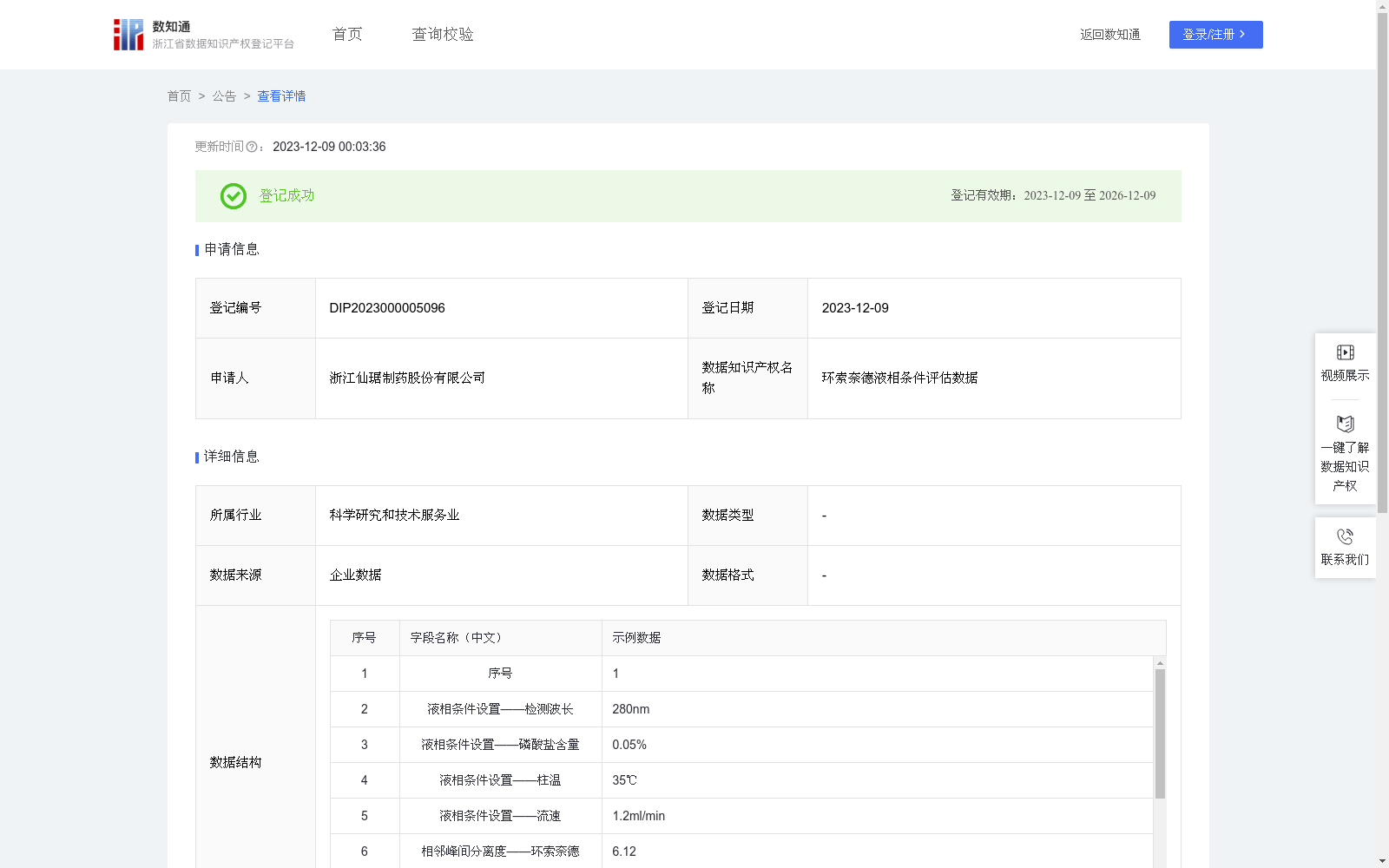
环索奈德液相条件评估数据
收藏资源简介:
环索奈德液相检测方法改进。现有药典中环索奈德相关物质的测定方法,有一个很大的缺陷,杂质D与杂质E分离度不高,在目前的市场环境下,客户购买环索奈德原料药往往会要求严格限定这两个杂质的含量。流动相中少量添加磷酸盐可以有效分离上述两种杂质,但对色谱柱会产生腐蚀,减低色谱柱使用寿命。因此在筛选液相条件时必须降低柱温和流动速度,对流动相、柱温、流速、检测波长四个条件设计不同数值进行平行试验,借助大数据分析技术,对相关结果进行全面评估,筛选出不同普遍有效的液相条件,为环索奈德杂质液相检测提供精准数据。第一,条件设置:流动相为乙腈:磷酸氢二钠溶液,磷酸盐含量为0.05%、0.1%、0.15%。柱温分别为25℃、30℃、35℃;流速为0.8ml/min、1.0ml/min、1.2ml/min;检测波长220nm、254nm、280nm。以分离度为指标,考察不同条件下的杂质分离效能; 第二,数据算法:环索奈德分离度大于等于5.0得1分,低于于5.0不得分,并将分数填入环索奈德右边的得分列中;杂质D分离度大于2得2分,1.5~2.0之间得1分,小于1.5及未分离不得分,并将得分填入杂质D右边的得分列中。杂质E分离度大于2得2分,1.5~2.0之间得1分,小于1.5及未分离不得分,并将得分填入杂质E右边的得分列中。最终将上述得分相加算出总分,填入总和评分一列中。总和评分高者,作为液相条件优选。
Improved Liquid Chromatographic Detection Method for Ciclesonide Currently, the determination method for ciclesonide-related substances in existing pharmacopeias has a major drawback: the resolution between impurity D and impurity E is insufficient. In the current market environment, customers purchasing ciclesonide active pharmaceutical ingredients (APIs) often require strict limits on the contents of these two impurities. Adding a small amount of phosphate to the mobile phase can effectively separate the two impurities, but it will corrode the chromatographic column and shorten its service life. Therefore, when screening liquid chromatographic conditions, it is necessary to reduce the column temperature and flow rate. Parallel experiments were conducted by designing different values for four parameters: mobile phase composition, column temperature, flow rate, and detection wavelength. Big data analysis technology was used to comprehensively evaluate the experimental results, and universally applicable liquid chromatographic conditions were screened out to provide accurate data for the liquid chromatographic detection of ciclesonide impurities. 1. Parameter Settings: The mobile phase is composed of acetonitrile and disodium hydrogen phosphate solution, with phosphate mass fractions of 0.05%, 0.1%, and 0.15% respectively. Column temperatures are set at 25℃, 30℃, and 35℃; flow rates are 0.8 ml/min, 1.0 ml/min, and 1.2 ml/min; detection wavelengths are 220nm, 254nm, and 280nm. Taking resolution as the evaluation indicator, the impurity separation efficiency under different conditions was investigated. 2. Data Scoring Algorithm: Scores are assigned according to the following rules: - Award 1 point if the resolution of ciclesonide is greater than or equal to 5.0, otherwise 0 points, and fill the score into the scoring column to the right of ciclesonide; - Award 2 points if the resolution of impurity D is greater than 2, 1 point if the resolution is between 1.5 and 2.0, and 0 points if the resolution is less than 1.5 or no separation occurs, then fill the score into the scoring column to the right of impurity D; - Award 2 points if the resolution of impurity E is greater than 2, 1 point if the resolution is between 1.5 and 2.0, and 0 points if the resolution is less than 1.5 or no separation occurs, then fill the score into the scoring column to the right of impurity E. Finally, sum the above scores to calculate the total score, which is filled into the total scoring column. The condition with the highest total score is selected as the optimal liquid chromatographic detection condition.