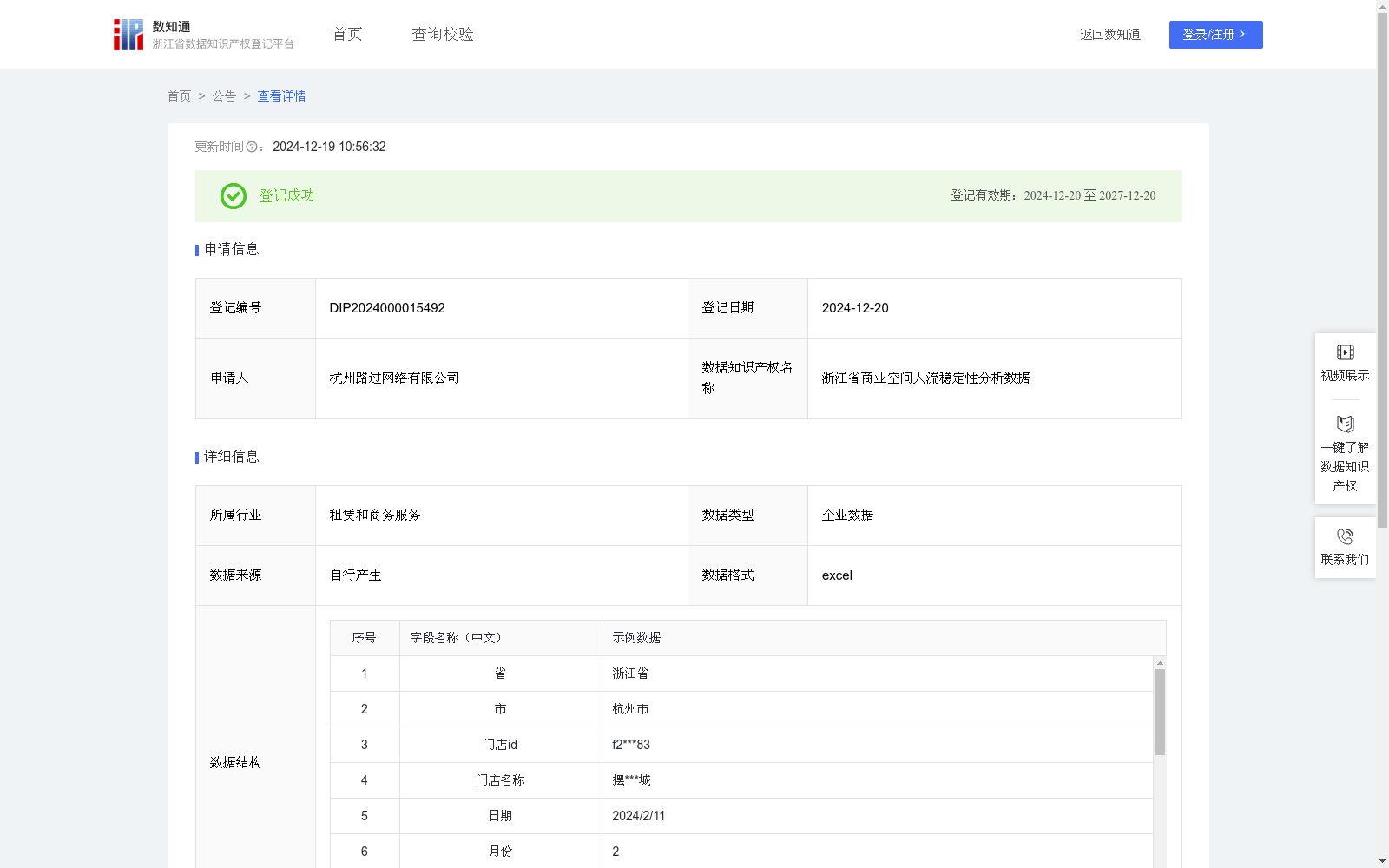
浙江省商业空间人流稳定性分析数据
收藏资源简介:
人流是衡量门店吸引力和运营效果的重要指标。通过分析进店人数稳定性,可以直观地了解不同门店在不同时间段内的运营状况和营销效果。通过分析进店人数的稳定性,可以了解哪些门店价值更高、哪些营销策略对吸引顾客有效、哪些策略效果不佳。稳定的人流数据还可以为门店提供预测未来趋势的依据,通过对历史数据的分析,可以识别出进店人数的季节性变化、周期性波动或长期增长趋势。在为本企业商业空间定价、营销方案优化等提供数据依据的同时,也为商业空间租赁行业数字化转型、创新业务模式、优化服务体验等提供参考。1、数据收集:从公司的数据库中查找商业空间各门店的相关字段,包含省份、城市、门店名称、日期、进店客流、过店客流等。 2、数据处理:以门店id为唯一标识,对数据进行归纳、清洗。 3、数据加工:用SUM函数分别计算1、2、3月的进店客流M1、M2、M3,得到第一季度进店客流总数M=M1+M2+M3、月均进店客流A=M/3,再根据公式得到月进店人流方差S、月进店人流标准差Q,计算人流稳定系数K=Q/A,K在(+∞,0.3]为不稳定,K在(0.3,0.1]为一般稳定,K在(0.1,0]为稳定。
Foot traffic is a critical metric for measuring store attractiveness and operational effectiveness. Analyzing the stability of in-store customer counts enables intuitive insights into the operational status and marketing performance of different stores across various time periods. By examining the stability of in-store foot traffic, one can identify which stores hold higher value, which marketing strategies effectively attract customers, and which strategies yield poor results. Stable foot traffic data also provides a basis for stores to forecast future trends; through analysis of historical data, seasonal variations, cyclical fluctuations, or long-term growth trends in in-store customer counts can be identified. This dataset not only provides data support for our enterprise's commercial space pricing, marketing plan optimization and other initiatives, but also offers references for the digital transformation, innovative business model development, and service experience optimization of the commercial space leasing industry. 1. Data Collection: Retrieve relevant fields for each commercial space store from the company's database, including province, city, store name, date, in-store customer traffic, passing-by customer traffic, and other related items. 2. Data Processing: Organize and clean the data using store ID as the unique identifier. 3. Data Enrichment: Use the SUM function to calculate the in-store customer traffic for January, February, and March as M1, M2, and M3 respectively, then derive the total in-store customer traffic for the first quarter M = M1 + M2 + M3 and the monthly average in-store customer traffic A = M/3. Next, obtain the monthly in-store foot traffic variance S and standard deviation Q using the corresponding formulas, and calculate the foot traffic stability coefficient K = Q/A. The classification criteria are: K ∈ (0.3, +∞) indicates unstable foot traffic; K ∈ (0.1, 0.3] indicates generally stable foot traffic; K ∈ [0, 0.1] indicates stable foot traffic.