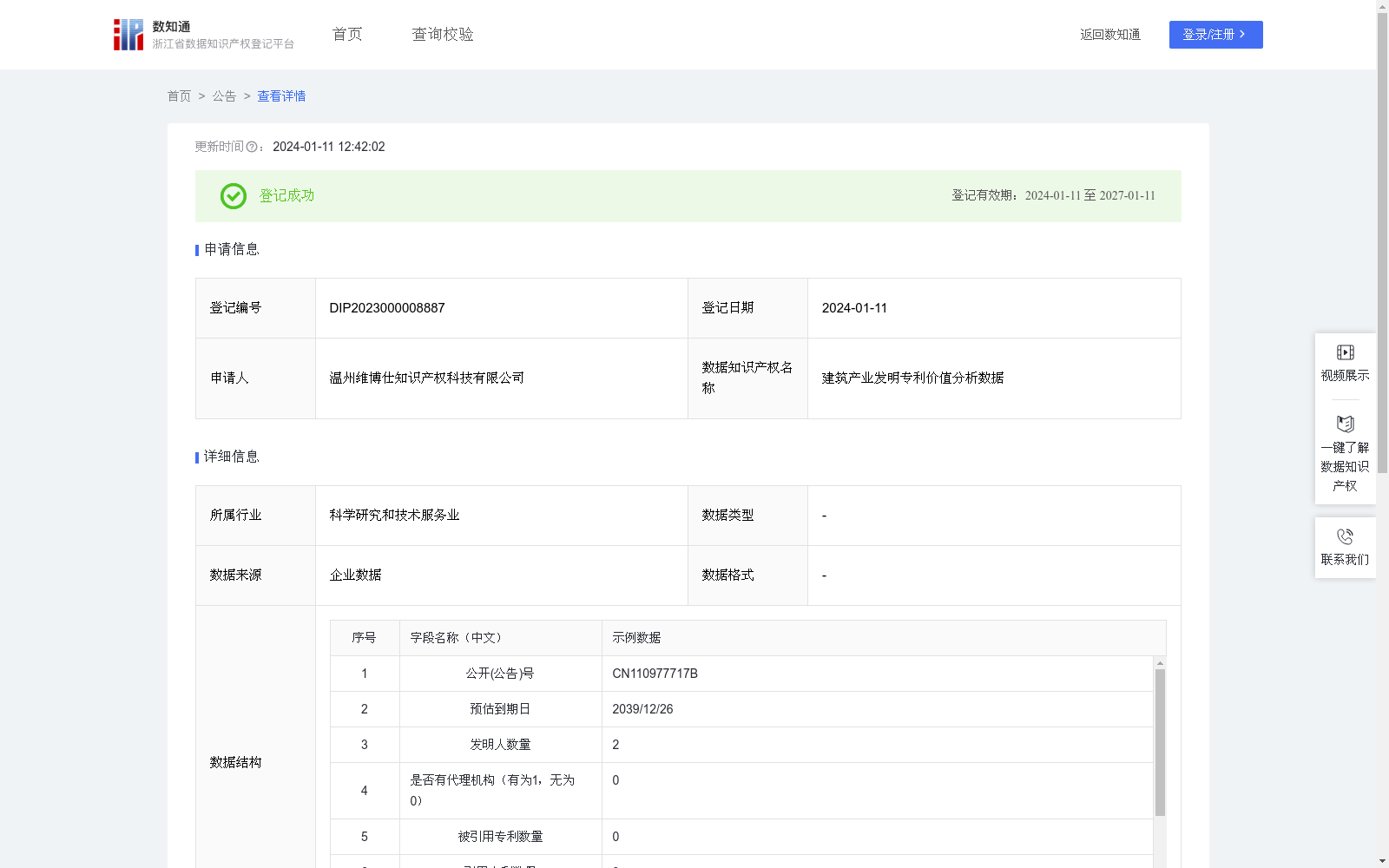
建筑产业发明专利价值分析数据
收藏资源简介:
根据自定规则对建筑产业专利数据进行检索分析,了解建筑产业发明专利情况,有助于建筑产业成果转化,也有利于了解建筑产业技术发展趋势及核心技术,有助于企业避免重复研发及侵犯他人的知识产权。数据来源:中国专利数据库中有关建筑产业发明的专利数据。算法规则:本数据基于 AHP 模型,从专利有效期、发明人数量、代理机构情况、被引用次数、引用次数、同族专利数、权利要求数以及诉讼案件数八大价值维度,赋予相应的系数,并将八类价值之和定义为专利综合价值,利用IFS函数对专利进行价值判定,用于评价现有专利价值,为本领域技术人员、市场主体、成果转化机构提供技术支撑。算法规则包括:1.专利有效期得分为今日(数据下载当天即2023年12月27日)至预估到期日(预估到期日在今日之前的,仍以原公式计算,虽然可能此项分数为负分,但是专利到期后仍具有价值)年份数,每年算1分; 2.发明人数量得分为发明人人数,每有1人算1分; 3.代理机构情况得分,有为5分,没有为0分; 4.被引用次数得分,每被引用1次+10分; 5.引用次数,每引用1次+2分; 6.同族专利数,每多一个其他同族专利+1分,以1个为基准,基准分为1分; 7.权利要求数,以5条权利要求为基准,基准分为1分,每少1条-1分,每多1条+1分; 8.诉讼案件数,每有一次诉讼案件+50分。 最后得出来的分数取整,即四舍五入。
Retrieving and analyzing patent data of the construction industry based on custom-defined rules helps understand the status of invention patents in the construction industry, which facilitates the commercialization of construction industry achievements, enables awareness of technological development trends and core technologies in the sector, and assists enterprises in avoiding redundant R&D and intellectual property infringement. Data Source: Patent data related to construction industry inventions sourced from the China Patent Database. Algorithm Rules: This work adopts the Analytic Hierarchy Process (AHP) model to assign corresponding coefficients to eight value dimensions, namely patent validity period, number of inventors, existence of patent agency, number of received citations, number of citations made by the patent, number of patent family members, number of claims, and number of litigation cases. The sum of the scores of these eight dimensions is defined as the comprehensive patent value. The IFS function is then utilized to determine the patent value, which serves to evaluate the value of existing patents and provide technical support for domain technicians, market entities, and achievement commercialization institutions. Detailed algorithm rules are as follows: 1. Patent Validity Period Score: The score is calculated as the number of years from the data download date (December 27, 2023) to the estimated expiration date of the patent. If the estimated expiration date precedes the data download date, the original calculation formula is still applied. Although this score may be negative, expired patents still hold inherent value, with 1 point awarded per year. 2. Number of Inventors Score: The score equals the total number of inventors listed in the patent, with 1 point granted per inventor. 3. Patent Agency Score: A score of 5 is awarded if a patent agency is involved, otherwise 0 points are given. 4. Received Citations Score: +10 points are added for each time the patent has been cited by other documents. 5. Citations Made Score: +2 points are added for each time the patent cites other patent documents. 6. Patent Family Score: Taking 1 patent family as the benchmark with a base score of 1, an additional +1 point is granted for each extra patent family member. 7. Number of Claims Score: Taking 5 claims as the benchmark with a base score of 1, -1 point is deducted for each fewer claim than the benchmark, and +1 point is added for each additional claim beyond the benchmark. 8. Litigation Cases Score: +50 points are added for each litigation case related to the patent. Finally, the resulting comprehensive score is rounded to the nearest integer.