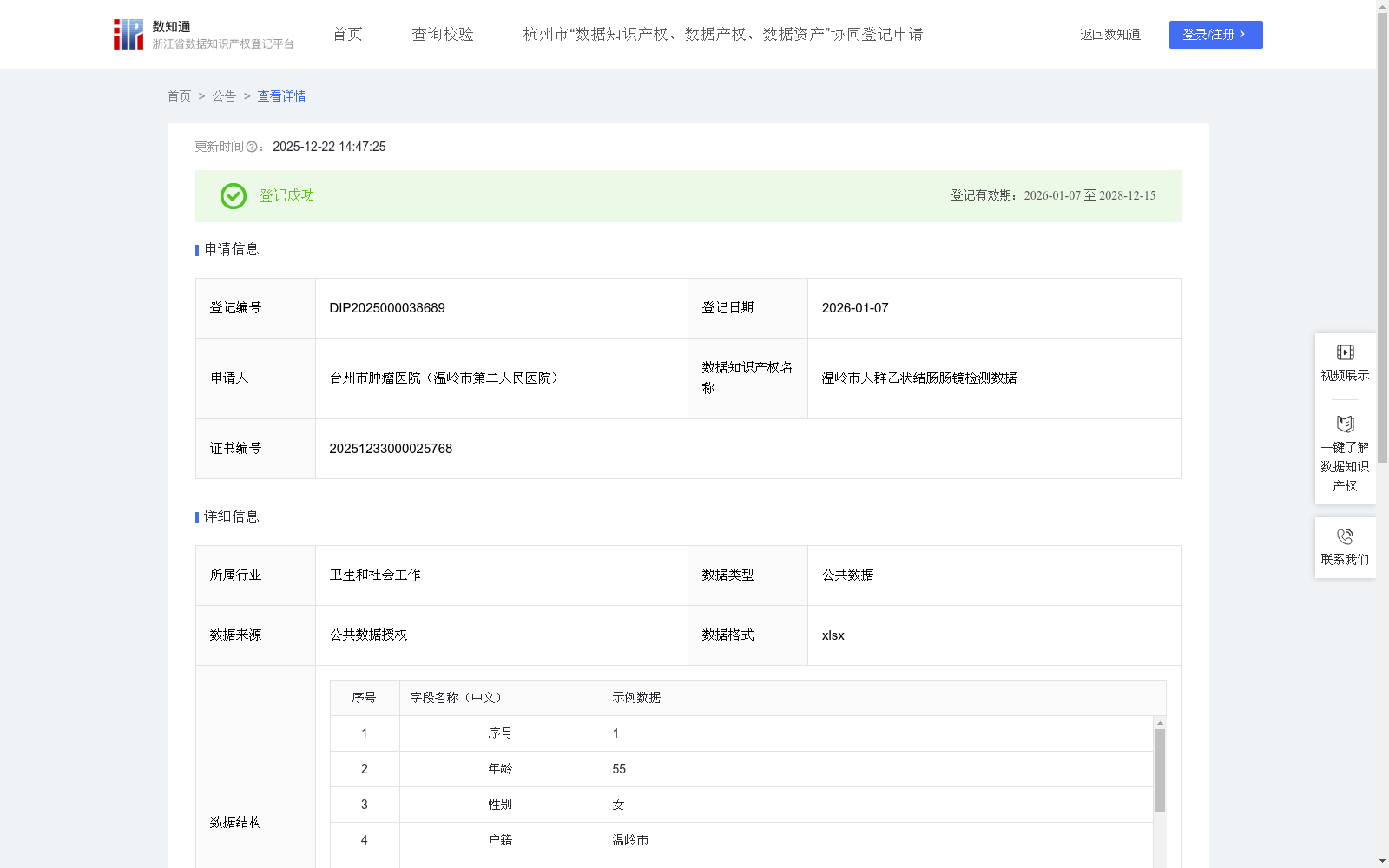
温岭市人群乙状结肠肠镜检测数据
收藏资源简介:
乙状结肠肠镜检测是结直肠癌筛查与早期诊断的关键手段,其核心价值在于通过直观影像识别肠道病变,为临床干预提供依据。然而,传统肠镜报告多依赖定性描述,缺乏统一量化标准,导致医生对病变风险评估存在主观差异。这种局限性在乙状结肠等特定肠段尤为突出,因其解剖结构复杂,病变特征(如腺瘤性息肉的绒毛状结构比例)与恶性转化风险密切相关,但现有技术难以精准量化这些关联。通过对各项病理指标数据的统计与计算,让医生对其他该类患者病灶的发展(如倍增时间等)有一个直观的认识;同时根据不同危险度自动给出诊断意见并生成清晰的结构化诊断报告,最终形成一个集风险量化评估、临床决策支持、标准化报告生成于一体的数据集,全面提升乙状结肠病变的诊疗管理水平。1.数据来源:收集来到本院进行乙状结肠肠镜检测的人群并收集相关数据。2.数据采集:本数据目标层为乙状结肠肠镜相关性,指标层将肠镜相关性指标体系分为病变部位、病理诊断编码、腺瘤性息肉绒毛状结构比例(%)、最大径四大评价指标。算法规则包括:1.病变部位,检测出则加10分,未检测出则加0分,2. 病理诊断编码,患者检测完成后并标注病理编码,每有一项病理编码则加5分,未标注病理编码则加0分, 3. 最大径,最大径单位为毫米,检测处最大径大于3的则加10分,检测出最大径小于等于3的则加5分,未检测出则加0分, 4. 腺瘤性息肉绒毛状结构比例(%),当比例大于5%小于等于15%时则加5分,当比例大于15%小于等于30%时则加15分,当比例大于30%小于等于60%时则加25分,当比例大于60%则加40分,当比例小于等于5%则加0分。3数据分析:本数据基于AHP层次法,采用定量与定性相结合,将肠镜按评分按从高到低分为(A、B、C),A为高危险、B为中危险、C为低危险。A≥50、50>B≥35、C<35采用综合分值法。
Sigmoid colonoscopy is a key method for colorectal cancer screening and early diagnosis, whose core value lies in identifying intestinal lesions through intuitive images to provide evidence for clinical intervention. However, traditional colonoscopy reports mostly rely on qualitative descriptions and lack unified quantitative standards, leading to subjective differences in physicians' assessment of lesion risk. This limitation is particularly prominent in specific intestinal segments such as the sigmoid colon, due to its complex anatomical structure. Lesion characteristics, such as the proportion of villous structure in adenomatous polyps, are closely correlated with the risk of malignant transformation, but existing technologies struggle to accurately quantify these correlations. By statistically calculating various pathological indicator data, physicians can gain intuitive insights into the progression of lesions in other similar patients (e.g., doubling time, etc.). Meanwhile, it can automatically generate diagnostic opinions and clear structured diagnostic reports based on different risk levels, eventually forming a dataset integrating risk quantitative assessment, clinical decision support, and standardized report generation, so as to comprehensively improve the diagnosis, treatment and management level of sigmoid colon lesions. 1. Data Source: Data is collected from individuals who underwent sigmoid colonoscopy at our hospital. 2. Data Collection: The target layer of this dataset is sigmoid colonoscopy-related. The indicator layer divides the colonoscopy-related indicator system into four evaluation indicators: lesion location, pathological diagnosis code, proportion of villous structure in adenomatous polyps (%), and maximum diameter. The algorithmic rules are as follows: 1. Lesion location: 10 points will be awarded if a lesion is detected, and 0 points if no lesion is detected. 2. Pathological diagnosis code: After the patient's examination, the pathological code is annotated. 5 points will be awarded for each pathological code, and 0 points if no pathological code is annotated. 3. Maximum diameter: The unit is millimeter. 10 points will be awarded if the maximum diameter is greater than 3 mm, 5 points if the maximum diameter is greater than 0 and less than or equal to 3 mm, and 0 points if no lesion is detected. 4. Proportion of villous structure in adenomatous polyps (%): 5 points will be awarded when the proportion is greater than 5% and less than or equal to 15%; 15 points when greater than 15% and less than or equal to 30%; 25 points when greater than 30% and less than or equal to 60%; 40 points when greater than 60%; and 0 points when the proportion is less than or equal to 5%. 3. Data Analysis: This dataset adopts the Analytic Hierarchy Process (AHP) method, combining quantitative and qualitative analysis. Colonoscopies are classified into three risk levels (A, B, C) from highest to lowest based on scores: A is high risk, B is medium risk, and C is low risk. The comprehensive scoring method is applied for the ranges A≥50, 50>B≥35, and C<35.