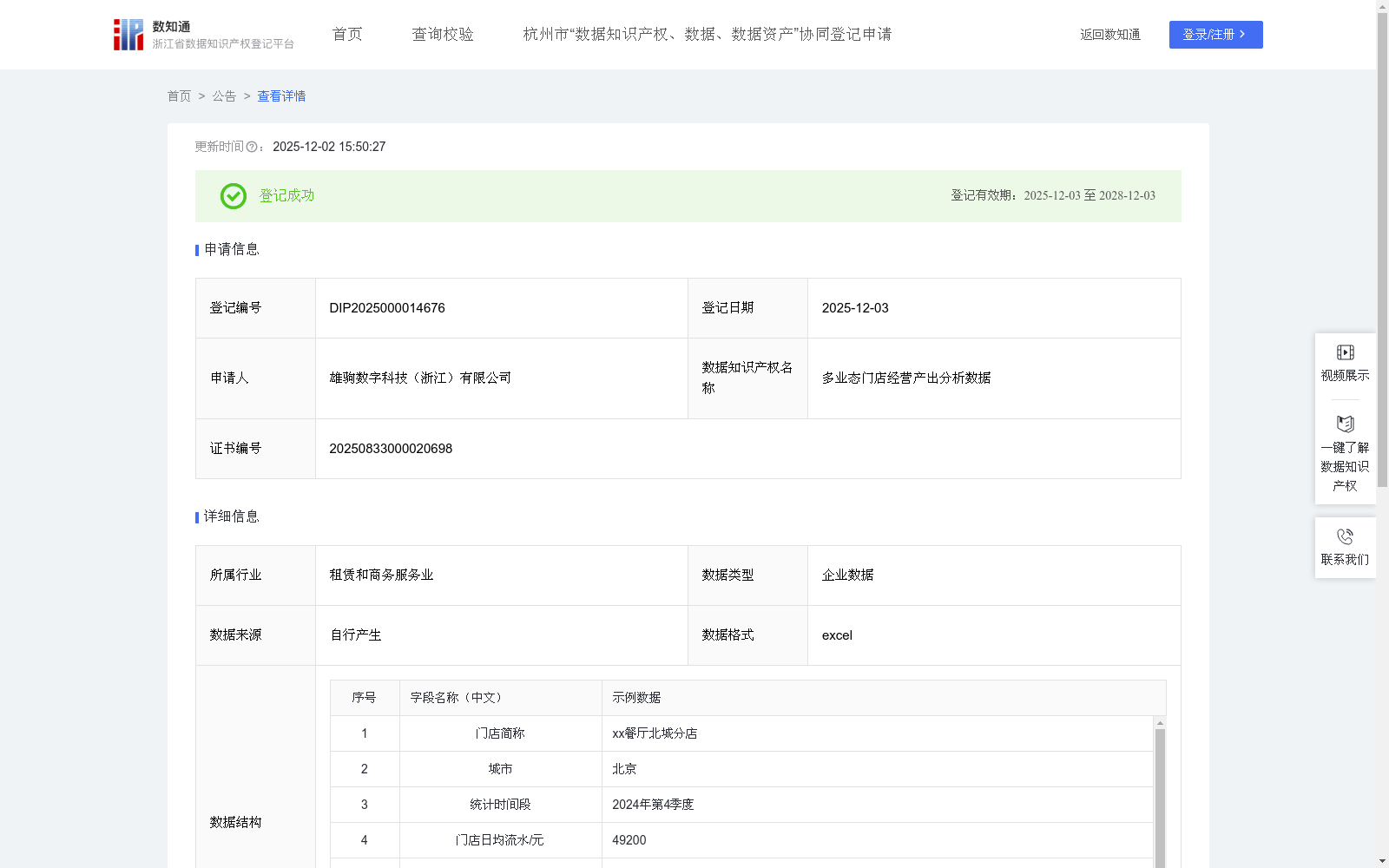
多业态门店经营产出分析数据
收藏资源简介:
该数据为多业态实体门店的经营数据,涵盖餐饮、零售、服务、美容等多个行业,其应用场景主要包括以下几个方面: 1.门店经营分析与优化:可通过对比同行业不同门店的日均流水、人均每日产出数据值等指标,分析各门店的经营效率和盈利能力,找出表现优异的门店的成功经验,如某某门店在餐饮行业中人均产出较高,其经营模式可被同行业借鉴;对于表现不佳的门店,可针对性地调整经营策略,提升员工效率或优化产品服务。 2.市场趋势与行业洞察:按城市和行业分类统计数据,能了解不同地区各行业的发展态势,如广州、深圳等一线城市的零售和服务行业部分门店流水较高,反映出这些地区相关行业的市场需求较为旺盛,可为企业拓展市场提供参考,判断哪些城市和行业具有较大的发展潜力。1)数据采集:通过系统采集数据; 2)数据处理:对采集到的数据进行清洗,去除重复、错误和无效数据标准化处理:将不同类型、不同数据进行标准化处理,统一数据格式。 3)算法加工:根据算法:人均每日产出数据值=门店日均流水/员工人数。 4)数据分类分级:根据计算出的人均每日产出数据值,将门店等级划分为“高等级、中等级、低等级”不同的类别和级别(4000分及以上标记为“高等级”,1000-3999分(含1000和3999)区间内标记为“中等级”,1000分(不含1000)以下标记为“低等级”)。
This dataset contains operational data of multi-format physical stores, covering multiple industries such as catering, retail, services and beauty. Its main application scenarios are as follows: 1. Store operation analysis and optimization: By comparing indicators including average daily revenue and per capita daily output of different stores in the same industry, we can analyze the operational efficiency and profitability of each store, and identify the successful experiences of high-performing stores. For example, a certain catering store has a relatively high per capita output, and its business model can be used as a reference for peers. For underperforming stores, targeted adjustments to business strategies can be made to improve employee efficiency or optimize products and services. 2. Market trends and industry insights: By statistically classifying data by city and industry, we can understand the development trends of various industries in different regions. For instance, some stores in the retail and service industries in first-tier cities such as Guangzhou and Shenzhen have relatively high revenues, reflecting relatively strong market demand for related industries in these regions, which can provide references for enterprises to expand their markets and judge which cities and industries have greater development potential. The data processing workflow is as follows: 1) Data collection: Data is collected through the system; 2) Data processing: Clean the collected data, remove duplicate, erroneous and invalid data, and conduct standardization processing: unify the data format by standardizing different types of data; 3) Algorithm processing: Calculate per capita daily output using the formula: Per capita daily output = Average daily store revenue / Number of employees; 4) Data classification and grading: Classify stores into "high-grade", "medium-grade" and "low-grade" categories based on the calculated per capita daily output: Stores with a score of 4000 or above are marked as "high-grade", those with a score in the range of 1000-3999 (including both 1000 and 3999) are marked as "medium-grade", and those with a score below 1000 (excluding 1000) are marked as "low-grade".