象山县农村产业融合度评估数据
收藏资源简介:
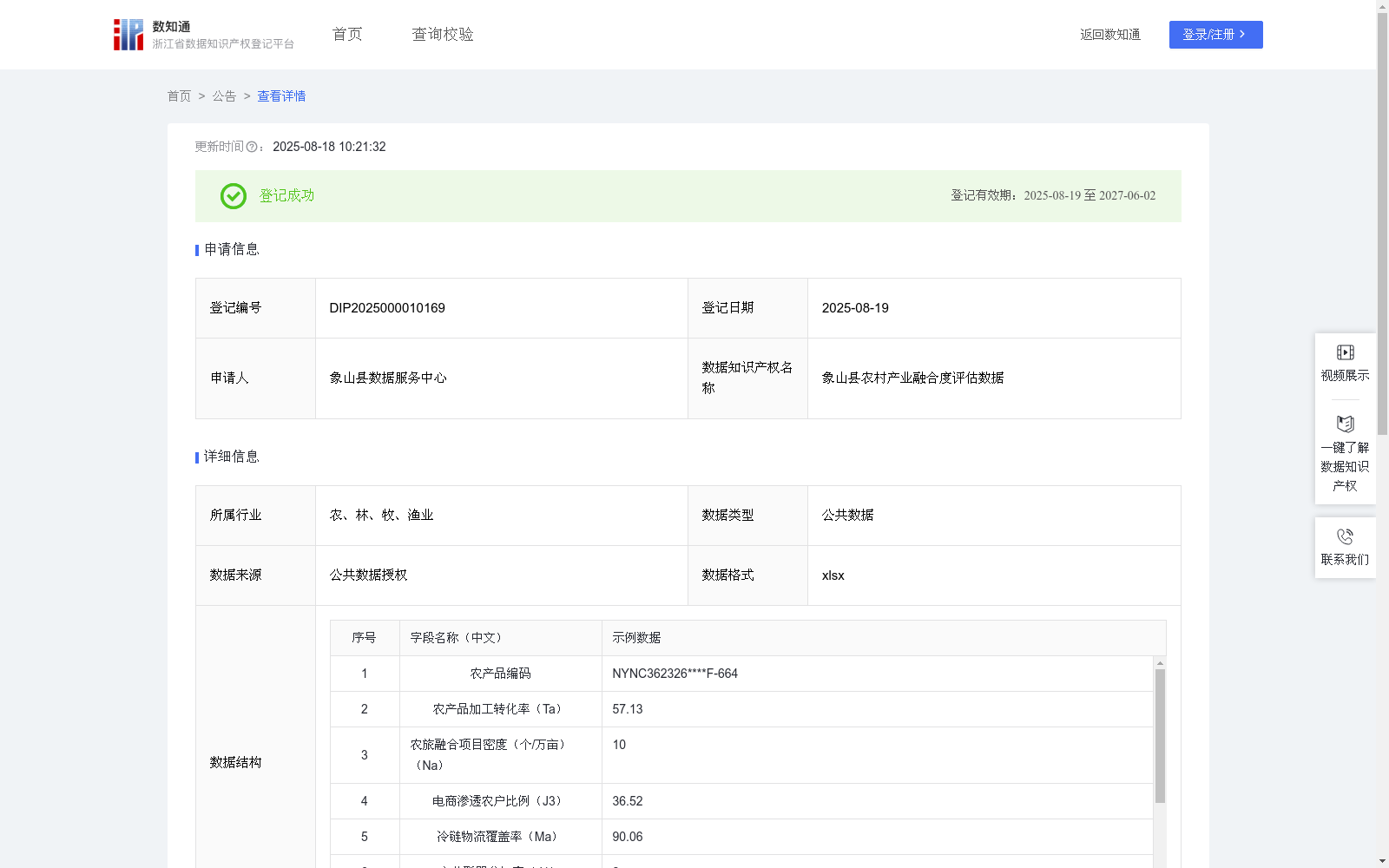
象山县农村产业融合度评估数据能够系统分析县域内农业与加工、文旅、电商等产业的协同发展水平,帮助农业农村局精准识别产业融合的薄弱环节与发展潜力。通过量化评估加工转化、农旅联动、科技赋能等关键维度,该模型可为政策制定者提供决策依据,优化资源配置,引导资金、技术等要素向高潜力领域倾斜。同时,模型能强化产业链各环节的协同效应,推动形成"生产-加工-销售-服务"一体化发展模式,提升农产品附加值和农民收益。最终,该工具将助力构建更具韧性和竞争力的农村产业体系,为乡村振兴提供可持续的内生动力。根据农产品唯一性经过特殊处理后获得农产品编码;根据农业产业化龙头企业报表与农产品加工统计获得农产品加工转化率(%)Ta;根据文旅项目GIS数据与工商注册信息获得农旅融合项目密度(个/万亩)Na;根据电商平台交易数据与村级服务站台账获得电商渗透农户比例(%)J3;根据冷链设施普查与物流企业调度信息情况获得冷链物流覆盖率(%)Ma;根据产业联盟成员清单信息获得产业联盟参与度J1;根据使用科技赋能覆盖率与总使用率比值获得科技赋能项目占比(%)S;根据农产品价格监测数据与区域品牌评估报告获得品牌溢价率(%)J2;根据新型经营主体台账与农户抽样调查获得联农带农系数Ht;所有采集汇总数据通过多因子归一化处理,最终通过线性加权法进行计算:Y=Tax0.2+Nax2x0.15+J3x0.15+Max0.1+J1x20x0.1+Sx0.1+J2x0.1+Htx10x0.1,最终获得象山县农村产业融合度评估融合指数,>=85分:标杆级(深化引领),核心措施:可优先申报国家级现代农业产业园,推广“加工+文旅+电商”全链条模式(如农产品区域品牌溢价体系);70-84分:优化级(补强短板),核心措施:定向提升冷链物流覆盖率(重点补建产地集配中心),降低农产品腐损率至合理阈值,开展电商技能全覆盖培训,孵化本地农产品电商主播团队;60-69分:达标级(攻坚整改),核心措施:县级专班督办产业链断点(如加工转化率不足),强制龙头企业签订原料本地化采购协议;<60分:预警级(重构体系),核心措施:省级挂牌督办,重组产业链主体,每日上报进度,对连续3个月无改善的主体取消政策资质。
The data for evaluating the rural industrial integration level in Xiangshan County can systematically analyze the coordinated development level of agriculture and industries such as processing, cultural tourism, and e-commerce within the county, helping the Agricultural and Rural Affairs Bureau accurately identify the weak links and development potential of industrial integration. Through the quantitative evaluation of key dimensions including processing conversion, rural-tourism linkage, and technology empowerment, this model can provide decision-making basis for policy makers, optimize resource allocation, and guide factors such as funds and technologies to tilt towards high-potential fields. Meanwhile, the model can strengthen the synergy of all links in the industrial chain, promote the formation of an integrated development model of production-processing-marketing-service, and increase the added value of agricultural products and farmers' income. Ultimately, this tool will help build a more resilient and competitive rural industrial system, providing sustainable endogenous momentum for rural revitalization. Special processed agricultural product codes are obtained based on the uniqueness of agricultural products; the processing conversion rate of agricultural products (%) Ta is obtained from the reports of leading agricultural industrialization enterprises and agricultural product processing statistics; the rural-tourism integration project density (units/ten thousand mu) Na is obtained from GIS data of cultural tourism projects and industrial and commercial registration information; the proportion of farmers covered by e-commerce (%) J3 is obtained from e-commerce platform transaction data and the ledger of village-level service stations; the cold chain logistics coverage rate (%) Ma is obtained from the cold chain facility census and the scheduling information of logistics enterprises; the industrial alliance participation rate J1 is obtained from the list of industrial alliance members; the proportion of technology-enabled projects (%) S is obtained from the ratio of the coverage rate of technology empowerment to the total utilization rate; the brand premium rate (%) J2 is obtained from agricultural product price monitoring data and regional brand assessment reports; the farmers' linking and benefiting coefficient Ht is obtained from the ledger of new business entities and farmer sampling surveys. All collected and aggregated data are processed through multi-factor normalization, and finally calculated via the linear weighting method: Y = Ta × 0.2 + Na × 2 × 0.15 + J3 × 0.15 + Ma × 0.1 + J1 × 20 × 0.1 + S × 0.1 + J2 × 0.1 + Ht × 10 × 0.1. The final rural industrial integration evaluation index of Xiangshan County is obtained, with the following grading standards: 1. ≥85 points: Benchmark Level (Deepening and Leading). Core measures: Prioritize applying for national modern agricultural industrial parks, and promote the full-chain model of processing + cultural tourism + e-commerce (such as the agricultural product regional brand premium system); 2. 70-84 points: Optimization Level (Complementing Weaknesses). Core measures: Directionally improve the cold chain logistics coverage rate (focus on constructing production area collection and distribution centers), reduce the agricultural product spoilage rate to a reasonable threshold, carry out full-coverage e-commerce skills training, and incubate local agricultural product e-commerce anchor teams; 3. 60-69 points: Compliance Level (Tackling and Rectifying). Core measures: Supervise the breakpoints in the industrial chain by county-level special classes (such as insufficient processing conversion rate), and force leading enterprises to sign raw material local procurement agreements; 4. <60 points: Early Warning Level (Restructuring System). Core measures: Implement provincial-level listed supervision, restructure industrial chain entities, report progress daily, and revoke policy qualifications for entities that have no improvement for 3 consecutive months.