<i>In vitro</i> and <i>in silico</i> computational methods for assessing vaginal permeability
收藏资源简介:
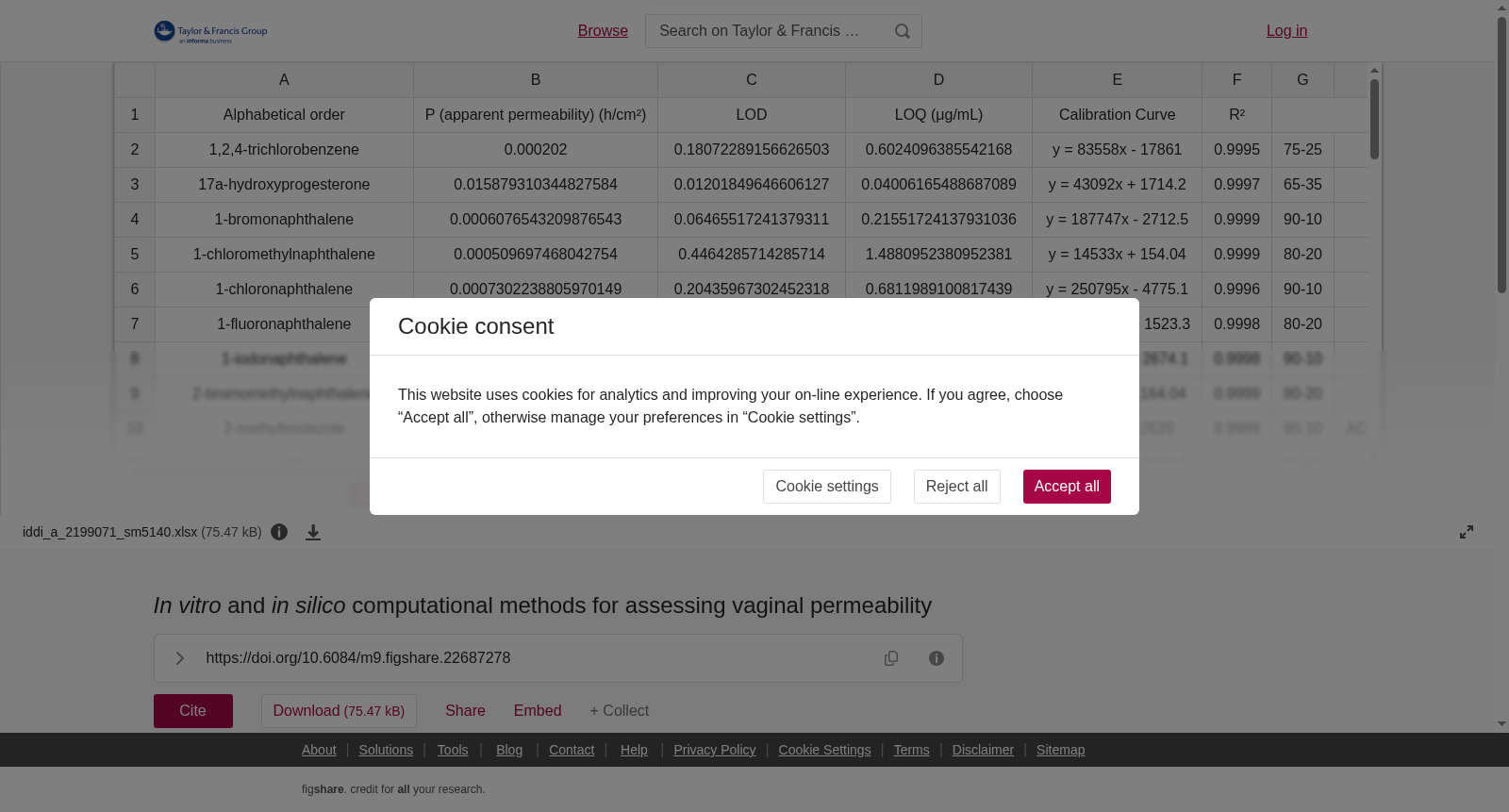
Vaginal administration is an important alternative to the oral route for both topical and systemic use. Therefore, the development of reliable in silico methods for the study of drugs permeability is becoming popular in order to avoid time-consuming and costly experiments. In the current study, Franz cells and appropriate HPLC or ESI-Q/MS analytical methods were used to experimentally measure the apparent permeability coefficient (<i>P</i><sub>app</sub>) of 108 compounds (drugs and non-drugs). <i>P</i><sub>app</sub> values were then correlate with 75 molecular descriptors (physicochemical, structural, and pharmacokinetic) by developing two Quantitative Structure Permeability Relationship (QSPR) models, a Partial Least Square (PLS) and a Support Vector Machine (SVM). Both were validated by internal, external and cross-validation. Based on the calculated statistical parameters (PLS model A: <i>R</i><sup>2</sup> = 0.673 and <i>Q</i><sup>2</sup> = 0.594, PLS model B: <i>R</i><sup>2</sup> = 0.902 and <i>Q</i><sup>2</sup> = 0.631, SVM: <i>R</i><sup>2</sup> = 0.708 and <i>Q</i><sup>2</sup> = 0.758). SVM presents higher predictability while PLS adequately interprets the theory of permeability. The most important parameters for vaginal permeability were found to be the relative PSA, logP, logD, water solubility and fraction unbound (FU). Respectively, the combination of both models could be a useful tool for understanding and predicting the vaginal permeability of drug candidates.
阴道给药(Vaginal administration)是口服给药途径的重要替代方案,可应用于局部与全身给药场景。为规避耗时且成本高昂的实验操作,开发可靠的计算机模拟(in silico)药物渗透研究方法正逐渐成为主流趋势。本研究采用弗兰兹扩散池(Franz cells)及适配的高效液相色谱(High Performance Liquid Chromatography, HPLC)或电喷雾四极杆质谱(Electrospray Ionization Quadrupole Mass Spectrometry, ESI-Q/MS)分析手段,实验测定了108种化合物(药物与非药物)的表观渗透系数(apparent permeability coefficient, P_app)。随后,通过构建两类定量结构渗透关系(Quantitative Structure Permeability Relationship, QSPR)模型——偏最小二乘(Partial Least Square, PLS)模型与支持向量机(Support Vector Machine, SVM)模型,将P_app值与75项涵盖理化性质、结构特征与药代动力学属性的分子描述符进行关联。两类模型均通过内部验证、外部验证与交叉验证完成性能校验。基于计算得到的统计参数:PLS模型A的决定系数(R²)为0.673、交叉验证相关系数(Q²)为0.594;PLS模型B的R²为0.902、Q²为0.631;SVM模型的R²为0.708、Q²为0.758。其中SVM模型展现出更优异的预测性能,而PLS模型则可较好地阐释药物渗透的内在机制。研究发现,影响阴道黏膜渗透的核心参数依次为相对极性表面积(relative PSA)、脂水分配系数(logP)、表观油水分配系数(logD)、水溶性及游离药物分数(fraction unbound, FU)。相应地,联合应用两类模型可成为理解并预测候选药物阴道渗透特性的实用工具。