
The identification of metabolites from gut microbiota in coronary heart disease via network pharmacology
收藏DataCite Commons2024-12-06 更新2024-08-19 收录
下载链接:
https://tandf.figshare.com/articles/dataset/The_identification_of_metabolites_from_gut_microbiota_in_coronary_heart_disease_via_network_pharmacology/25299415/1
下载链接
链接失效反馈官方服务:
资源简介:
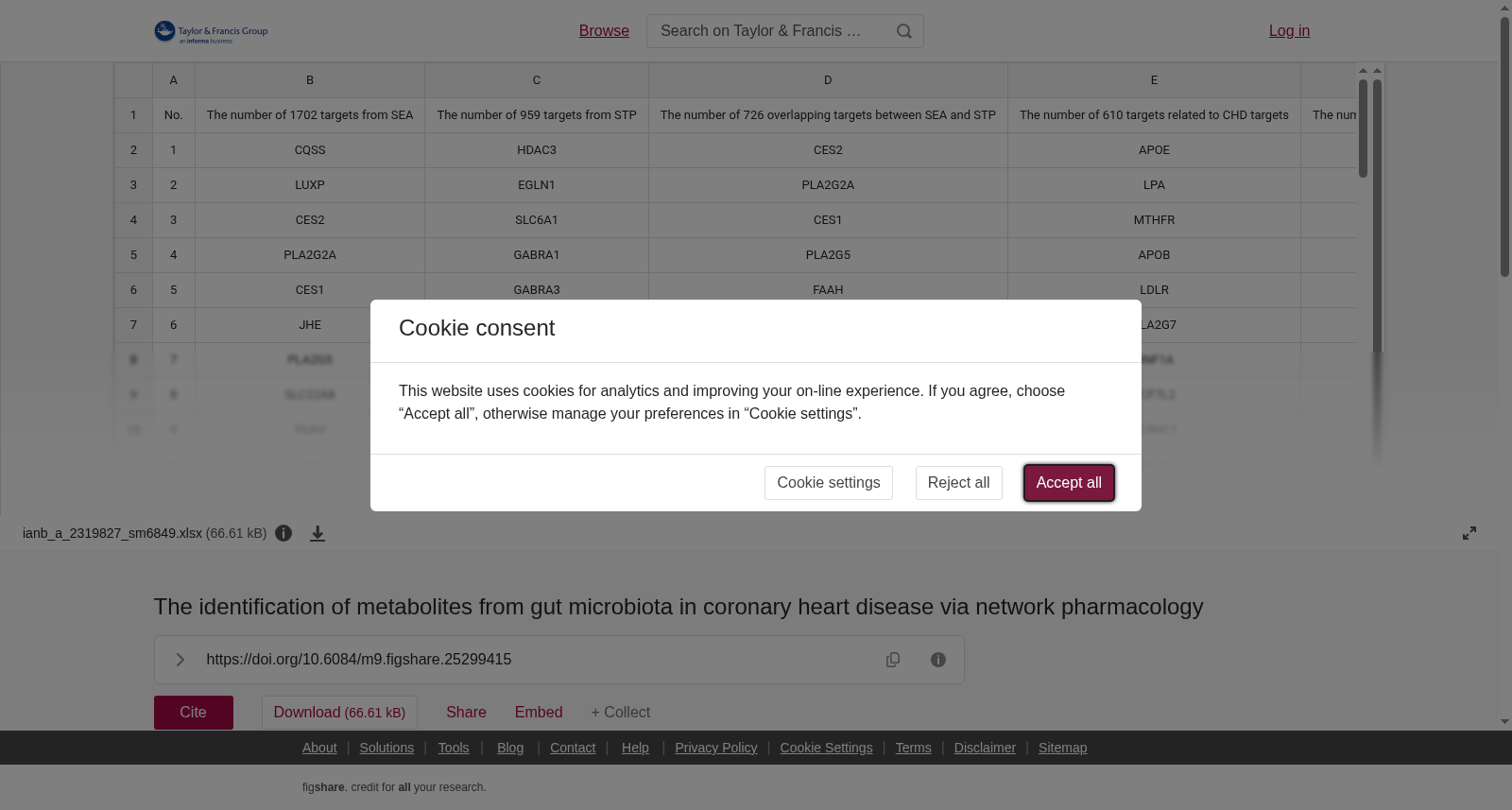
Although the gut microbial metabolites exhibit potential effects on coronary heart disease (CHD), the underlying mechanism remains unclear. In this study, the active gut microbial metabolites acting on CHD and their potential mechanisms of action were explored through a network pharmacological approach. We collected a total of 208 metabolites from the gutMgene database and 726 overlapping targets from the similarity ensemble approach (SEA) and SwissTargetPrediction (STP) database, and ultimately identified 610 targets relevant to CHD. In conjunction with the gutMGene database, we identified 12 key targets. The targets of exogenous substances were removed, and 10 core targets involved in CHD were eventually retained. The microbiota–metabolites–targets–signalling pathways network analysis revealed that C-type lectin receptor signalling pathway, Lachnospiraceae, Escherichia, mitogen-activated protein kinase 1, prostaglandin-endoperoxidase synthase 2, phenylacetylglutamine and alcoholic acid are notable components of CHD and play important roles in the development of CHD. The results of molecular docking experiments demonstrated that AKT1-glycocholic acid and PTGS2-phenylacetylglutamine complexes may act on C-type lectin receptor signalling pathways. In this study, the key substances and potential mechanisms of gut microbial metabolites were analysed via network pharmacological methods, and a scientific basis and comprehensive idea were provided for the effects of gut microbial metabolites on CHD.
尽管肠道微生物代谢物对冠心病(coronary heart disease, CHD)存在潜在调控作用,但其具体分子机制仍未阐明。本研究通过网络药理学方法(network pharmacological approach),探究了作用于冠心病的活性肠道微生物代谢物及其潜在作用机制。本研究从gutMgene数据库(gutMgene database)中获取了共计208种代谢物,同时通过相似集合法(similarity ensemble approach, SEA)与瑞士靶点预测(SwissTargetPrediction, STP)数据库筛选得到726个重叠靶点,最终鉴定出610个与冠心病相关的靶点。结合gutMgene数据库,我们共鉴定出12个关键靶点。移除外源性物质对应的靶点后,最终保留了10个参与冠心病发生发展的核心靶点。微生物群-代谢物-靶点-信号通路网络分析结果显示,C型凝集素受体信号通路(C-type lectin receptor signalling pathway)、毛螺菌科(Lachnospiraceae)、埃希氏菌属(Escherichia)、丝裂原活化蛋白激酶1(mitogen-activated protein kinase 1)、前列腺素内过氧化物合酶2(prostaglandin-endoperoxidase synthase 2)、苯乙酰谷氨酰胺(phenylacetylglutamine)以及乙醇酸(alcoholic acid)是冠心病相关的关键组分,在冠心病的发生发展中发挥重要作用。分子对接实验(molecular docking experiments)结果显示,AKT1-甘胆酸复合物与PTGS2-苯乙酰谷氨酰胺复合物可能通过靶向C型凝集素受体信号通路发挥调控功能。本研究通过网络药理学方法分析了肠道微生物代谢物的关键活性物质与潜在作用机制,为肠道微生物代谢物影响冠心病进程的相关研究提供了科学依据与系统性研究思路。
提供机构:
Taylor & Francis创建时间:
2024-02-27
搜集汇总
数据集介绍
以上内容由遇见数据集搜集并总结生成

暂无相关数据集


