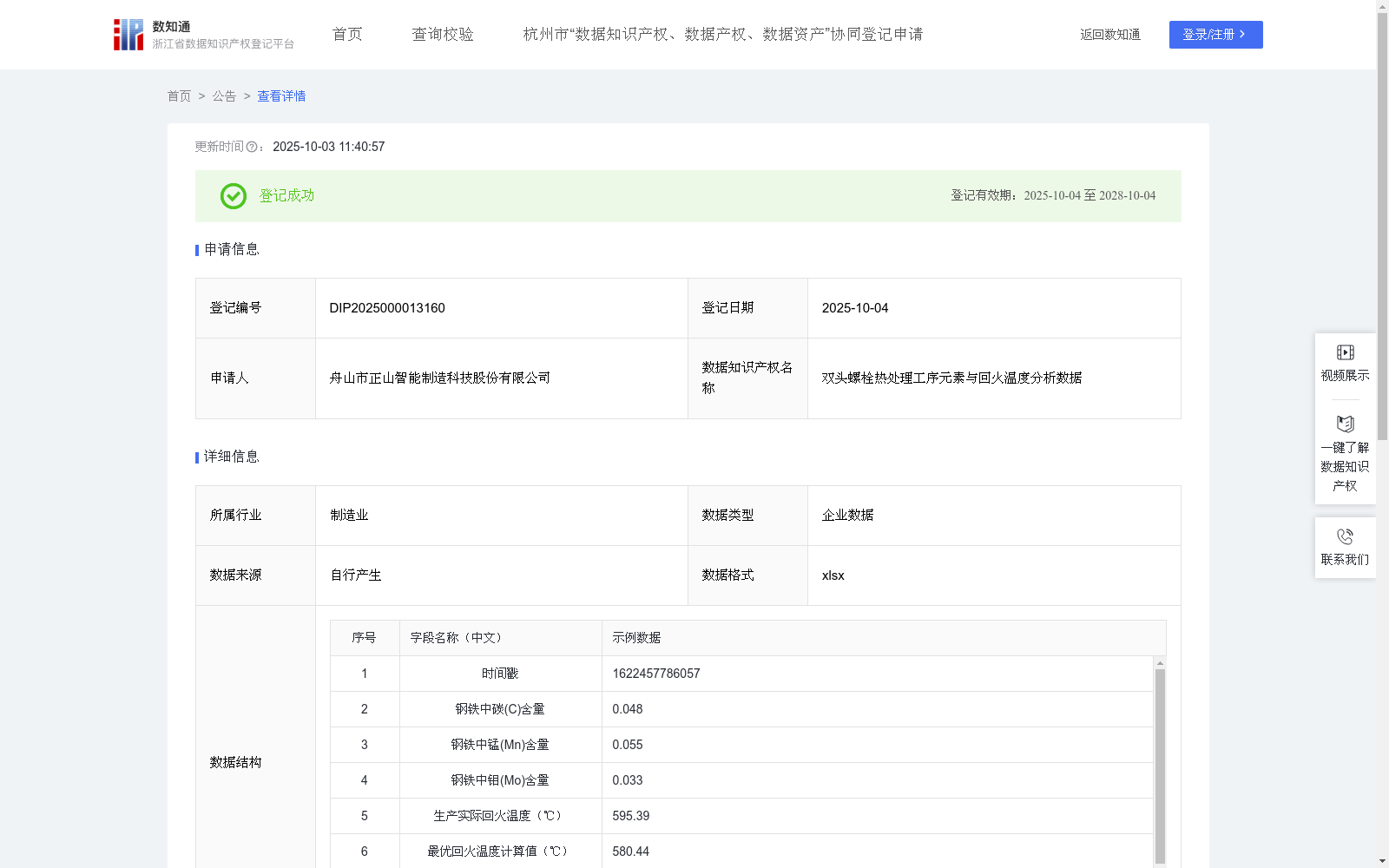
双头螺栓热处理工序元素与回火温度分析数据
收藏资源简介:
适用条件/范围:适用于使用合金钢棒(含C、Mn、Mo等元素)制造双头螺栓,并需进行热处理(回火)工序的制造企业。 适用对象:双头螺栓热处理工序的操作人员、工艺工程师。 解决的核心问题:如何基于原材料元素含量(C, Mn, Mo)科学设定最优回火温度,避免因温度不当导致产品开裂或性能不达标等不合格问题。 数据应用与解决方案:利用历史生产数据(原材料元素含量、回火温度、生产合格率)建立的模型,根据每批钢棒检测报告中的具体元素含量,推荐最优回火温度参数。 有益效果/外部复用价值:显著提升双头螺栓产品合格率,降低废品损失。该模型方法可推广至任何需依据特定元素含量优化热处理温度的相似合金零件生产场景,实现工艺参数的精准、高效设定,减少对人工经验的过度依赖。(1)钢棒入厂后需进行原材料检验,碳(C)含量,锰(Mn)含量,钼(Mo)通过实验室化学成分检验后上传到大数据平台。(2)数据采集系统会将带时序的热处理数据收集到大数据平台(3)最终检验合格率会上传到大数据中心,大数据中心将数据整合在一起,发送给模型进行训练,找到合格率最高的回火温度。(4)采用深度学习技术,为了后期数据可调,模型框架选用 PyTorch ,使用3个月的带时序的数据进行初步训练,设置test_size=0.2使测试量和训练量2/8分来划分数据集,模型初始化使用nn.BatchNorm1d(128)对模型进行批标准化,nn.Dropout(0.3)防止过拟合等,用for epoch in range循环对模型进行训练,用model.eval()对模型进行评估。最优回火温度会被大数据平台记录。模型参数:输入:(钢棒的元素含量、热处理生产温度、QMS质检数据),输出参数,最优回火淬火温度。算法构建:使用帕累托前沿搜索算法解决多目标平衡问题(包含冲击韧性、硬度、抗拉强度、屈服强度,检验指标见佐证材料),热处理生产出的钢材各项指标符合国家标准的温度中的最低温度+8%(最低为了能耗最低,+8%为了增加容错,防止生产因温度不足产品不达标),即为最优回火、淬火温度。(5)每次生产并检验完成后,大数据平台完成数据整合并喂给模型,进行最优回火温度的更新。 (6)合格率计算:通过检测数据,根据国家标准对检测数据逐项进行比对,全部指标符合标准则为合格,合格重量(吨)钢棒/总重量(吨)钢棒=合格率,参照数据来源证明第三项。
Applicable Conditions/Scope: This applies to manufacturing enterprises that produce double-ended studs using alloy steel bars (containing elements such as C, Mn, Mo) and require the tempering heat treatment process. Applicable Objects: Operators and process engineers in the tempering heat treatment process of double-ended studs. Core Problems Solved: How to scientifically set the optimal tempering temperature based on the elemental content of raw materials (C, Mn, Mo), so as to avoid unqualified products such as cracking or non-compliant performance caused by improper temperature. Data Application and Solutions: A model established using historical production data (raw material elemental content, tempering temperature, production qualification rate) is used to recommend the optimal tempering temperature parameters based on the specific elemental content in the inspection report of each batch of steel bars. Beneficial Effects/External Reusability Value: This method significantly improves the qualification rate of double-ended stud products and reduces scrap losses. The model approach can be generalized to any production scenario of similar alloy parts that need to optimize heat treatment temperature based on specific elemental content, achieving accurate and efficient setting of process parameters and reducing excessive dependence on manual experience. (1) After the steel bars enter the factory, raw material inspection shall be carried out. The carbon (C) content, manganese (Mn) content, and molybdenum (Mo) content shall be tested via laboratory chemical composition analysis and uploaded to the big data platform. (2) The data collection system collects time-series heat treatment data to the big data platform. (3) The final inspection qualification rate will be uploaded to the big data center, which integrates all the data and sends it to the model for training to find the tempering temperature with the highest qualification rate. (4) Deep learning technology is adopted. To enable subsequent data adjustability, the PyTorch framework is selected for the model. Preliminary training is conducted using 3 months of time-series data, and the dataset is split into training and test sets with a ratio of 8:2 by setting test_size=0.2. The model is initialized with nn.BatchNorm1d(128) for batch normalization, and nn.Dropout(0.3) is used to prevent overfitting. The model is trained via the loop `for epoch in range(...)`, and evaluated using `model.eval()`. The optimal tempering temperature will be recorded by the big data platform. Model Parameters: Input: (elemental content of steel bars, heat treatment production temperature, QMS quality inspection data), Output Parameter: optimal tempering and quenching temperature. Algorithm Construction: The Pareto front search algorithm is used to solve the multi-objective balance problem (including impact toughness, hardness, tensile strength, yield strength; the inspection indicators are shown in the supporting materials). The optimal tempering and quenching temperature is determined as the temperature at which all indicators of the steel produced by heat treatment meet the national standards plus 8% (the minimum temperature is for the lowest energy consumption, and the +8% is to increase fault tolerance and prevent products from failing to meet standards due to insufficient temperature). (5) After each production and inspection is completed, the big data platform completes data integration and feeds it to the model to update the optimal tempering temperature. (6) Qualification Rate Calculation: Compare the test data item by item against the national standards based on the detected data. A product is qualified only if all indicators meet the standards. The qualification rate = qualified weight (tons) of steel bars / total weight (tons) of steel bars. Refer to Item 3 of the supporting data source certification documents.