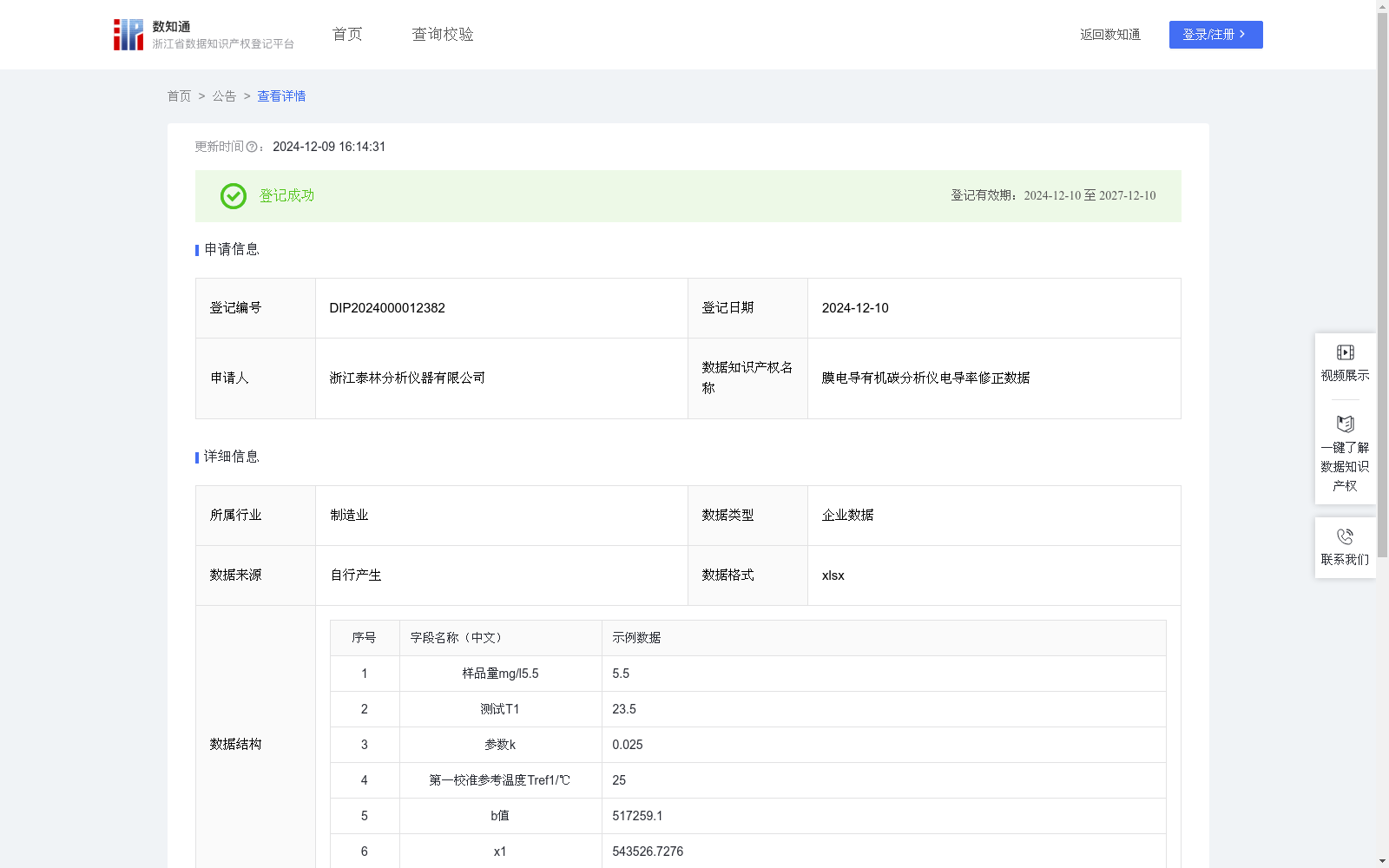
膜电导有机碳分析仪电导率修正数据
收藏资源简介:
膜电导法有机碳分析仪器使用时需要对电导率测试池进行实时测温,电导率测试池会受到温度变化的影响,因此需要结合材料不同和在系统的响应特性建立电导率温度补偿数学模型,通过运用这种补偿模型,修正电导率测试池电极受温度影响的偏差测试结果,从而得出一个较为准确且稳定的电导率检测结果,指导本行业在进行有机碳分析时对电极电导率进行修正。 "一种膜电导法有机碳分析仪温度修正数据,对电导率测试池进行实时测温,并将其结合以其材料不同和系统的响应特性进行数学模型的建立,形成一个复合的补偿算法,然后对实际测试数据进行修正:具体步骤如下, 步骤1,根据以下公式修正电极受温度影响的偏差,得到修正后的结果x1; 公式,x1=b/((1+k)*(T1-Tref1 ) ) 式中b为电导率测试池电导率测量结果值,k为电导率测试池补偿系数,T1为在电导率测试池上测得的温度,Tref1为第一校准温度参考点。"
Membrane conductivity-based organic carbon analyzers require real-time temperature measurement of the conductivity cell, as the conductivity cell is susceptible to temperature variations. Therefore, it is necessary to establish a mathematical model for conductivity temperature compensation based on different materials and the system's response characteristics. By applying this compensation model, the deviation in the test results of the conductivity cell electrodes caused by temperature can be corrected, thereby obtaining more accurate and stable conductivity detection results, which can guide the industry in correcting electrode conductivity during organic carbon analysis. This is a temperature correction dataset for membrane conductivity-based organic carbon analyzers. It performs real-time temperature measurement on the conductivity cell, establishes a mathematical model combined with different materials and the system's response characteristics to form a composite compensation algorithm, and then corrects the actual test data. The specific steps are as follows: Step 1: Correct the temperature-induced deviation of the electrode using the following formula to obtain the corrected result x1; Formula: x1 = b / [(1 + k) * (T1 - Tref1)] Where b is the measured conductivity value of the conductivity cell, k is the compensation coefficient of the conductivity cell, T1 is the temperature measured on the conductivity cell, and Tref1 is the first calibration temperature reference point.