健康险客户风险评级分析数据
收藏资源简介:
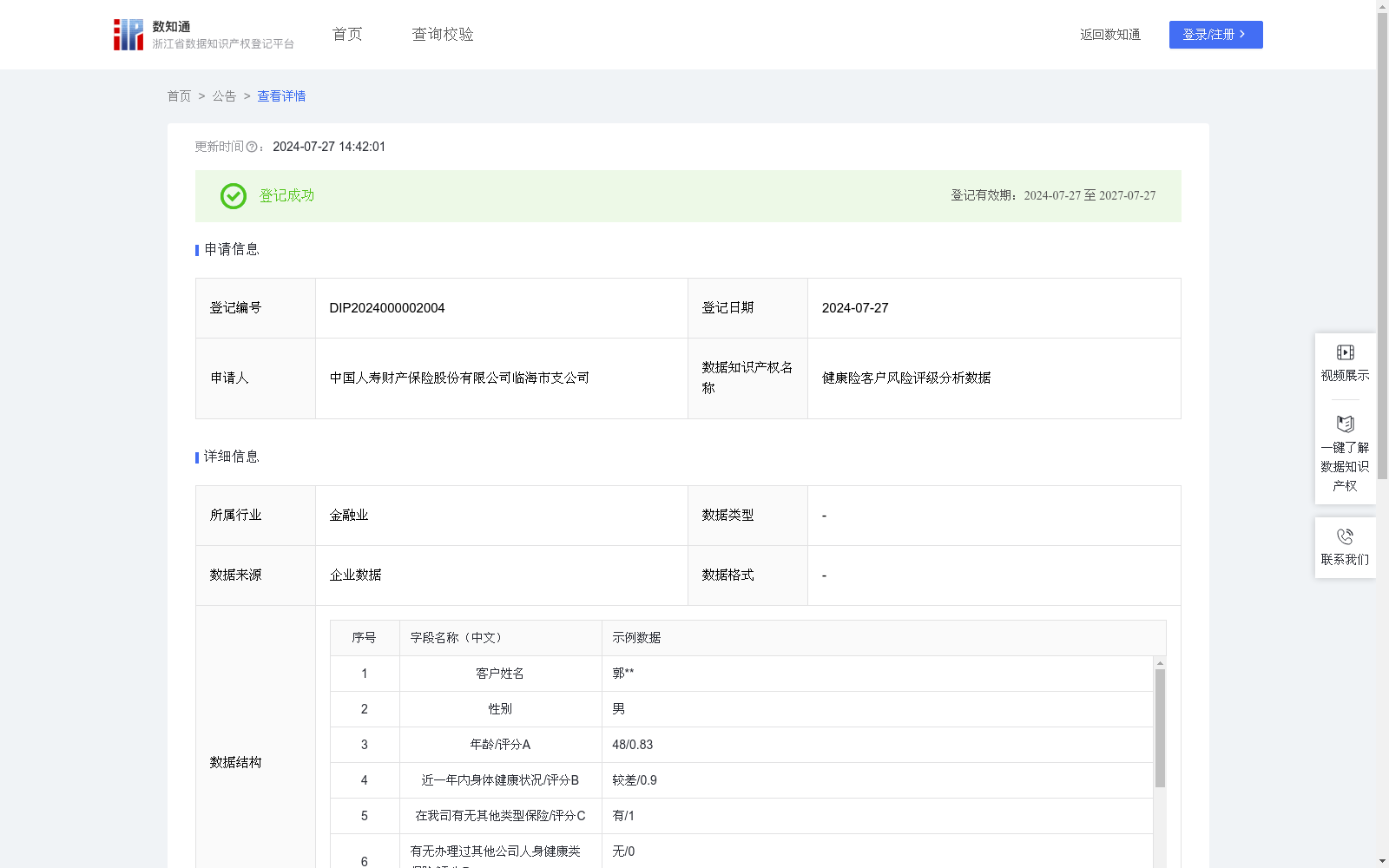
保险公司在客户购买健康险产品之前,要根据客户的各种相关条件的数据,对客户的自身健康状况进行预警分析。分析结果是健康险合同的具体条款签订的主要依据,并为政府主管部门了解该地区主要的健康险客户群体的基本健康情况提供数据支撑。一、统计健康险的客户相关资料并导入数据库,共有以下评分项目:客户年龄/评分A、近一年内身体健康状况/评分B、在我司有无健康类保险/评分C、有无办理过其他公司人身健康类保险/评分D、家族遗传病史情况/评分E、个人既往病史/评分F、既往理赔情况/评分G、是否属于保险公司优质客户/评分H。 二、算法分析:以上项目每项1分,计算分数时采取两种计分方式。其中在我司有无健康类保险/评分C、有无办理过其他公司人身健康类保险/评分D、既往理赔情况/评分G、是否属于保险公司优质客户/评分H为固定分值项,根据“有”计1分,“无”计0分;H项“否”计1分,“是”计0分。客户年龄/评分A、近一年内身体健康状况/评分B、家族遗传病史情况/评分E、个人既往病史/评分F为赋分项,需要根据实际情况进行分析,并依据保险公司的风险评分细则对其进行评分。风险综合评分M=固定分值项得分(C/D/G/H)+赋分项得分(A/B/E/F)。 三、风险评级:对风险综合评分进行评级,0-2分为低风险,2-4分为中低风险,4-6分为中高风险,6-8分为高风险。
Before underwriting health insurance products, insurance companies shall conduct early warning analysis on customers' health status based on various relevant personal data of the customers. The analysis results serve as the primary basis for formulating specific clauses of health insurance contracts, and provide data support for government competent authorities to grasp the basic health conditions of major health insurance customer groups in the region. I. Collation and database import of health insurance customer-related data. The following scoring items are included: Customer age / Score A, Physical health status in the past year / Score B, Whether the customer holds health-related insurance under this company / Score C, Whether the customer has purchased personal health-related insurance from other insurance companies / Score D, Family genetic medical history / Score E, Personal past medical history / Score F, Past insurance claim history / Score G, Whether the customer is a high-quality customer of the insurance company / Score H II. Algorithmic scoring: Each of the above items is allocated 1 point, and two scoring methods are adopted for total score calculation. Among them, Score C, Score D, Score G and Score H are fixed-value scoring items: 1 point will be given for "Yes" and 0 point for "No", with an exception for Score H: 1 point will be given for "No" and 0 point for "Yes". Score A, Score B, Score E and Score F are assignment-based scoring items, which require analysis based on actual circumstances and scoring in accordance with the insurance company's risk scoring guidelines. The comprehensive risk score M is calculated as: M = Total score of fixed-value items (C/D/G/H) + Total score of assignment-based items (A/B/E/F). III. Risk rating: The comprehensive risk score is classified into four risk levels: 0-2 points for low risk, 2-4 points for medium-low risk, 4-6 points for medium-high risk, and 6-8 points for high risk.