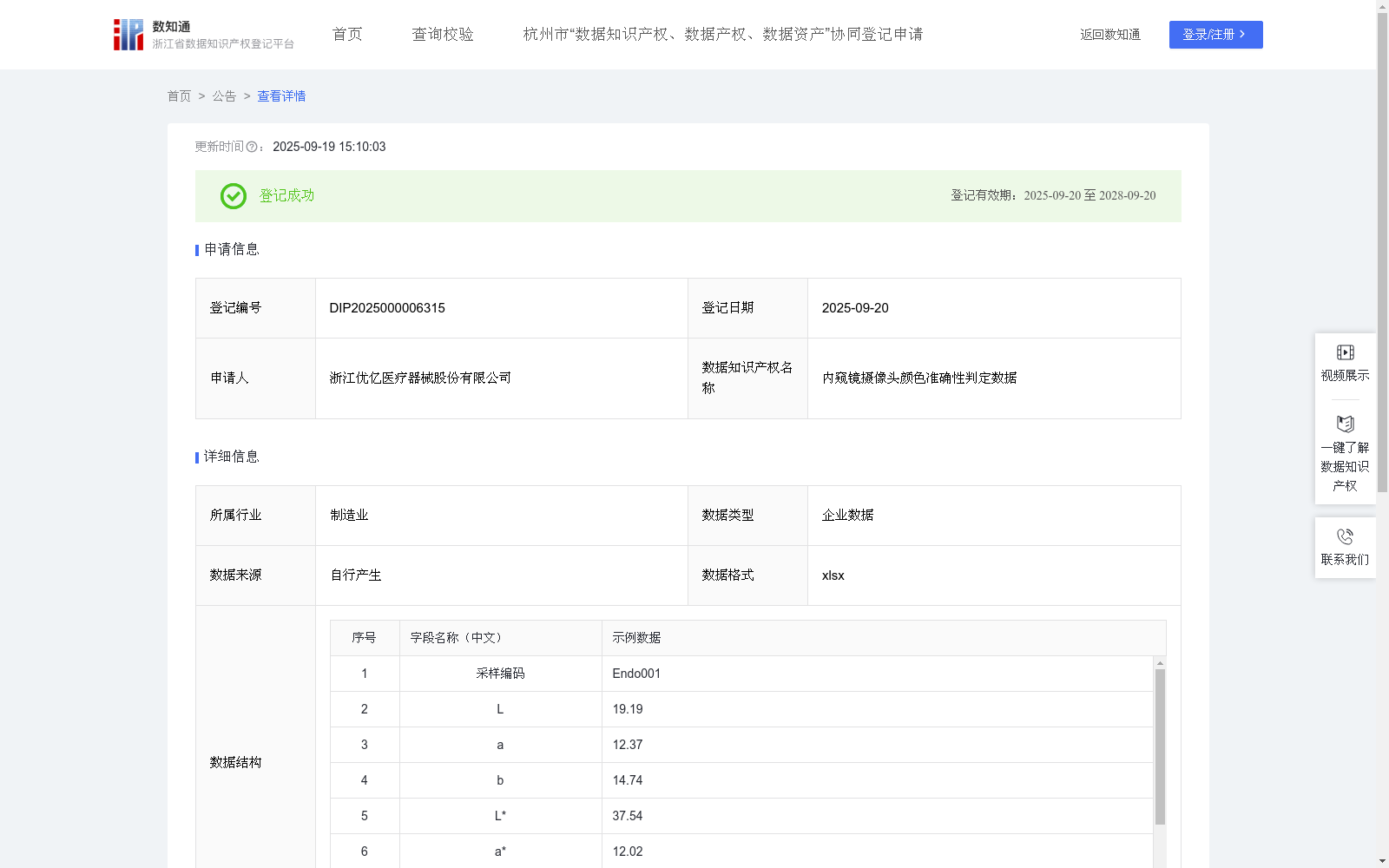
内窥镜摄像头颜色准确性判定数据
收藏资源简介:
该数据用于测试判定摄像头拍摄或者录像时的色彩偏差,内窥镜进入人体后,摄像头获取到的画面与有光环境下存在偏差,本测试数据通过使用带光源内窥镜的摄像头,在Macbeth III标准对色灯箱下,在自带光源的照度lux和色温下,拍摄24色卡卡,获取颜色空间中的坐标值,通过设定理想值和色度差异范围来调整色彩偏差,以满足医护人员需求,以防误判。在开发基于内窥镜图像的AI辅助诊断系统(如识别息肉、肿瘤、出血点)时,模型对颜色非常敏感。本数据可以为AI团队提供色彩准确的“黄金标准”图像,用于模型训练和测试,避免因设备差异导致AI算法失效。同时本数据建立了一个基于客观数据的、可量化的“色彩真实性”标准,可推动行业标准化,推动整个内窥镜行业在色彩质量评估上形成统一标准,从“经验时代”迈向“数字时代”。1、指标解释:L 表示颜色的明度或亮度。它反映了颜色的明暗程度。L 的值范围通常在 0 到 100 之间。a 表示颜色在红色和绿色之间的色度。它是一个色度轴,用于区分红色和绿色。b 表示颜色在黄色和蓝色之间的色度。它是一个色度轴,用于区分黄色和蓝色。ΔC:表示颜色的色度差异,计算的是 a 和 b 两个色度轴的差异。它反映了颜色在色度上的偏差。ΔE:表示颜色的总差异,包括亮度和色度的差异。它是一个综合的指标,用于衡量颜色的总偏差。 2、数据处理:把经过拍照系统处理后的值L,a,b的值与理想值L*,a*,b*进行颜色准确性处理,公示如下: ΔC=Sqrt((a-a*)²+(b-b*)²), ΔE=Sqrt((L-L*)²+(a-a*)²+(b-b*)²) 3、数据输出判断标准:设定要求输出的ΔC小于等于10,ΔE小于等于15,则内窥镜色彩偏差范围符合要求,输出TRUE,否则不符合要求,输出NG,需要重新使用校准工具进行调整,直到输出TRUE为止。
This dataset is used to test color deviation during camera shooting or video recording. Specifically, when an endoscope enters the human body, the images captured by its camera deviate from those in a properly lit environment. This test dataset is collected by using a camera with a built-in light source on an endoscope, shooting a 24-color checker chart under a Macbeth III standard color light booth, with the illuminance (in lux) and color temperature provided by the endoscope's own light source. The color space coordinates of the captured images are obtained, and the color deviation is adjusted by setting ideal values and allowable chromatic difference ranges, so as to meet the needs of medical staff and avoid misjudgments. When developing AI-assisted diagnostic systems based on endoscopic images (such as identifying polyps, tumors, and bleeding spots), the model is highly sensitive to colors. This dataset can provide AI teams with gold-standard images with accurate colors for model training and testing, preventing AI algorithms from failing due to device differences. In addition, this dataset establishes an objective, data-based and quantifiable "color authenticity" standard, which can promote industry standardization, unify the color quality assessment standards for the entire endoscopic industry, and shift the industry from an "empirical era" to a "digital era". 1. Indicator Explanation: - L represents the lightness or brightness of a color, reflecting the degree of darkness or lightness of the color. Its value range is usually between 0 and 100. - a represents the chromaticity of the color between red and green, which is a chromaticity axis used to distinguish red and green. - b represents the chromaticity of the color between yellow and blue, which is a chromaticity axis used to distinguish yellow and blue. - ΔC: Represents the chromatic difference, calculated from the two chromaticity axes a and b, reflecting the chromatic deviation of the color. - ΔE: Represents the total color difference, including differences in lightness and chromaticity. It is a comprehensive indicator used to measure the overall color deviation. 2. Data Processing: Compare the L, a, and b values processed by the shooting system with the ideal values L*, a*, b* for color accuracy verification, with the formulas as follows: ΔC = Sqrt((a - a*)² + (b - b*)²) ΔE = Sqrt((L - L*)² + (a - a*)² + (b - b*)²) 3. Data Output Judgment Criteria: Set the requirements that ΔC ≤ 10 and ΔE ≤ 15. If the endoscope's color deviation range meets the requirements, output TRUE; otherwise, the requirements are not met, output NG, and the calibration tool must be used for adjustment until the output is TRUE.