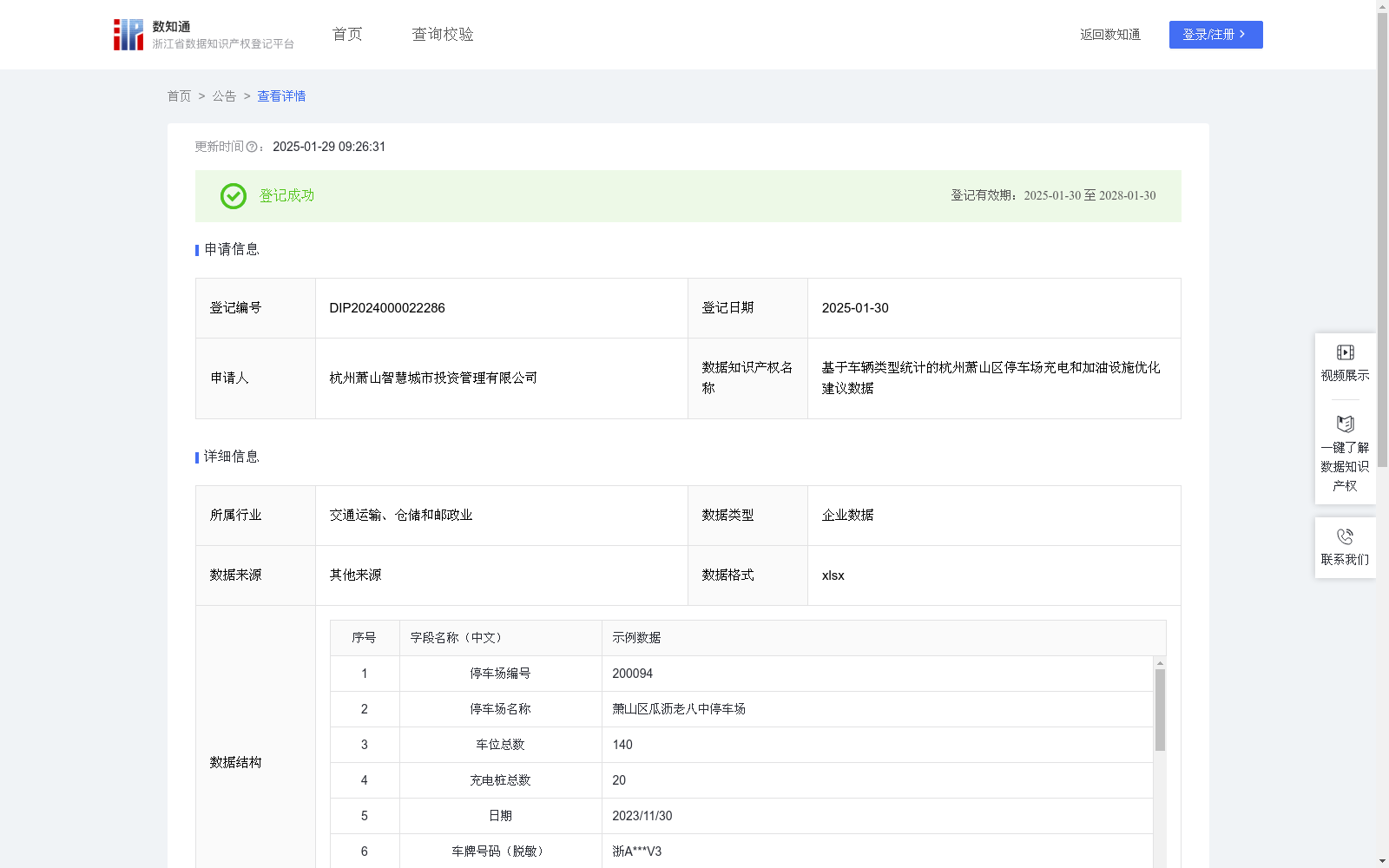
基于车辆类型统计的杭州萧山区停车场充电和加油设施优化建议数据
收藏资源简介:
本数据的面向用户及其应用场景描述如下: 1.面向充电设施运营商:本数据可为运营商优化充电设施布局提供依据,有助于提高充电桩使用率,降低运营成本。 2.面向城市规划或交通管理部门:本数据可为城市规划和交通管理部门制定区域充电设施及加油站建设规划提供辅助参考,有助于优化城市公共充电及加油站网络建设布局,提升城市交通服务效率。 3.面向新能源汽车制造商:从时间序列上对本数据进行长期跟踪,可为新能源汽车制造商提供市场分析支持,深度洞察市场需求的变化,优化产品布局和市场策略。1.数据获取和预处理:(1)通过授权获得萧山区不同停车场每日的停车数据,数据字段包括停车场编号、停车场名称、车位总数、充电桩总数、日期、车牌号码、车辆入场时间、车辆离开时间。(2)对获取的数据进行清洗,对车牌号码进行脱敏。 2.数据加工:(1)根据实时产生的停车记录统计停车订单总数。(2)根据车牌号码位数(含中文字)识别停车订单中的电车和油车数量,7位车牌号码为油车,8位车牌号码为电车。(3)对停车订单中电车数量和油车数量进行实时统计。(4)计算停车订单中电车数量占比和油车数量占比:停车订单中电车数量占比=停车订单中电车数量÷停车订单总数×100%;停车订单中油车数量占比=停车订单中油车数量÷停车订单总数×100%。(5)计算充电车位比:充电桩数量÷车位总数×100%。(6)充电设施供需情况分析:若停车订单中电车数量占比大于充电车位比,意味着充电桩数量不足,则建议增加充电桩数量;反之意味着充电桩数量充足,则建议减少充电桩数量或维持原样。(7)加油设施供需情况分析:若停车订单中油车数量占比小于10%,则建议减少优化停车场附近的加油设施,反之则建议维持原样。
The target users and their application scenarios of this dataset are described as follows: 1. For charging facility operators: This dataset can provide a basis for optimizing the layout of charging facilities, helping to improve the utilization rate of charging piles and reduce operating costs. 2. For urban planning or traffic management departments: This dataset can provide auxiliary references for formulating construction plans for regional charging facilities and gas stations, helping to optimize the construction layout of urban public charging and gas station networks, and improve the efficiency of urban traffic services. 3. For new energy vehicle manufacturers: Long-term tracking of this dataset in time series can provide market analysis support, enabling in-depth insights into changes in market demand and optimizing product layout and marketing strategies. 1. Data acquisition and preprocessing: (1) Daily parking data of various parking lots in Xiaoshan District was obtained with authorization. The data fields include parking lot ID, parking lot name, total number of parking spaces, total number of charging piles, date, license plate number, vehicle entry time, and vehicle departure time. (2) Clean the acquired data and anonymize the license plate numbers. 2. Data processing: (1) Count the total number of parking orders based on real-time generated parking records. (2) Identify the number of electric vehicles and fuel vehicles in parking orders based on the number of digits (including Chinese characters) of the license plate numbers: license plate numbers with 7 digits are fuel vehicles, and those with 8 digits are electric vehicles. (3) Conduct real-time statistics on the number of electric vehicles and fuel vehicles in parking orders. (4) Calculate the proportion of electric vehicles and fuel vehicles in parking orders: Proportion of electric vehicles in parking orders = (Number of electric vehicles in parking orders / Total number of parking orders) × 100%; Proportion of fuel vehicles in parking orders = (Number of fuel vehicles in parking orders / Total number of parking orders) × 100%. (5) Calculate the charging space ratio: (Total number of charging piles / Total number of parking spaces) × 100%. (6) Analysis of charging facility supply and demand: If the proportion of electric vehicles in parking orders is greater than the charging space ratio, it means that the number of charging piles is insufficient, and it is recommended to increase the number of charging piles; conversely, if the number of charging piles is sufficient, it is recommended to reduce the number of charging piles or maintain the status quo. (7) Analysis of fuel facility supply and demand: If the proportion of fuel vehicles in parking orders is less than 10%, it is recommended to reduce and optimize the fuel facilities near the parking lot; otherwise, it is recommended to maintain the status quo.