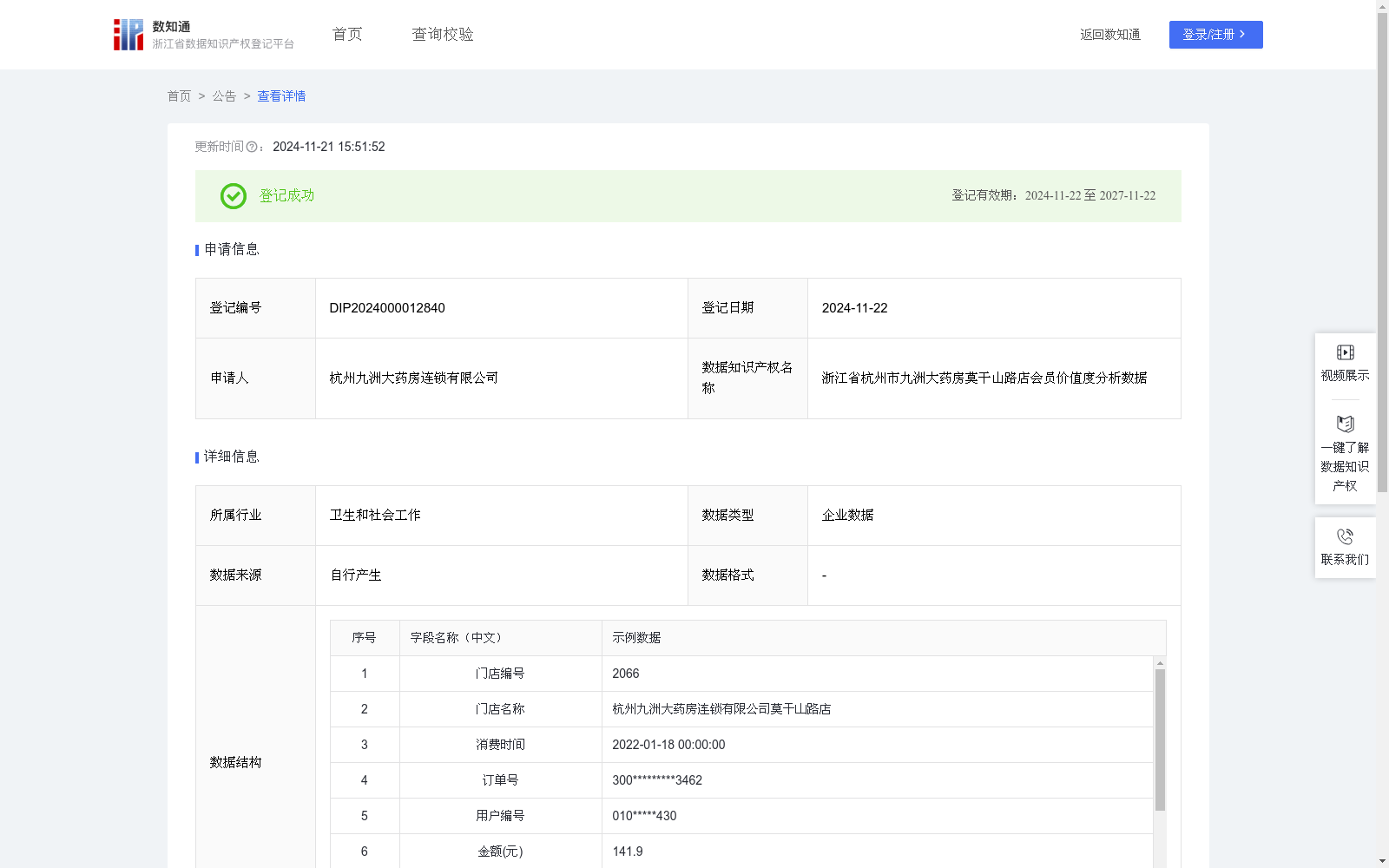
浙江省杭州市九洲大药房莫干山路店会员价值度分析数据
收藏资源简介:
通过分析九洲大药房莫干山路店的会员消费金额、消费次数、消费周期以及距最近一次消费天数,根据RFM模型确定会员价值度,不仅可用于门店会员分类管理、个性化精准营销以及服务优化策略制定;也可用于针对与医药行业相关、对消费者行为模式与消费能力分析等场景下有需求的企业或机构,例如同类医药电商与零售企业、健康管理与咨询服务机构、医药研发与生产企业、金融机构与保险公司等。1.数据来源 采集了浙江省杭州市九洲大药房莫干山路店的会员、消费时间、距最近一次消费天数、消费频次、消费金额等数据。 2.数据处理 基于采集数据,分析该店会员在统计周期(一年)内的消费金额(累计会员在统计周期内的总支出)、消费次数(统计会员的购买频率)、消费周期(分析会员消费的时间间隔,判断其活跃程度)以及距最近一次消费天数,运用RFM(最近消费Recency, 消费频率Frequency, 消费金额Monetary)模型对会员进行了价值分级,具体分为: 重要保持:R值高、F值高、M值高; 重要价值:R值低、F值高、M值高; 重要发展:R值高、F值高、M值低; 重要挽留:R值低、F值低、M值高; 一般重要:R值低、F值高、M值低; 一般客户:R值高、F值低、M值高; 一般挽留:R值高、F值低、M值低; 无价值:R值低、F值低、M值低。 其中,F值大于a为高,M值大于b时为高,R值大于c为高,a、b、c的具体数值为申请人企业机密。
By analyzing the member consumption amount, purchase frequency, consumption cycle, and days since last purchase of the Moganshan Road Store of Jiuzhou Pharmacy, and deriving member value ratings via the RFM model, this dataset can serve multiple purposes: it can be applied to store member classification management, personalized precision marketing, and the formulation of service optimization strategies; additionally, it can support enterprises and institutions with needs in pharmaceutical-related scenarios involving consumer behavior pattern and consumption capacity analysis, including peer pharmaceutical e-commerce and retail enterprises, health management and consulting service providers, pharmaceutical research and development and manufacturing enterprises, financial institutions, and insurance companies, among others. 1. Data Source Relevant data including member information, consumption time, days since last purchase, purchase frequency, and consumption amount were collected from the Moganshan Road Store of Jiuzhou Pharmacy in Hangzhou, Zhejiang Province. 2. Data Processing Based on the collected data, indicators of the store’s members over a one-year statistical cycle were analyzed, including consumption amount (total cumulative expenditure of each member within the cycle), purchase frequency (member purchase frequency), consumption cycle (time interval between consecutive purchases to assess member activeness), and days since last purchase. The RFM (Recency, Frequency, Monetary) model was employed to classify member value levels into 8 categories as follows: - Important Retained Customers: High R value, High F value, High M value; - Important High-Value Customers: Low R value, High F value, High M value; - Important Developing Customers: High R value, High F value, Low M value; - Key Customers Needing Retention: Low R value, Low F value, High M value; - General Important Customers: Low R value, High F value, Low M value; - General Customers: High R value, Low F value, High M value; - General Customers Needing Retention: High R value, Low F value, Low M value; - Low-Value Customers: Low R value, Low F value, Low M value. Specifically, F value is classified as high if greater than a, M value as high if greater than b, and R value as high if greater than c. The specific values of a, b, and c are trade secrets of the applicant’s enterprise.