xpertsystems/oil007-sample
收藏资源简介:
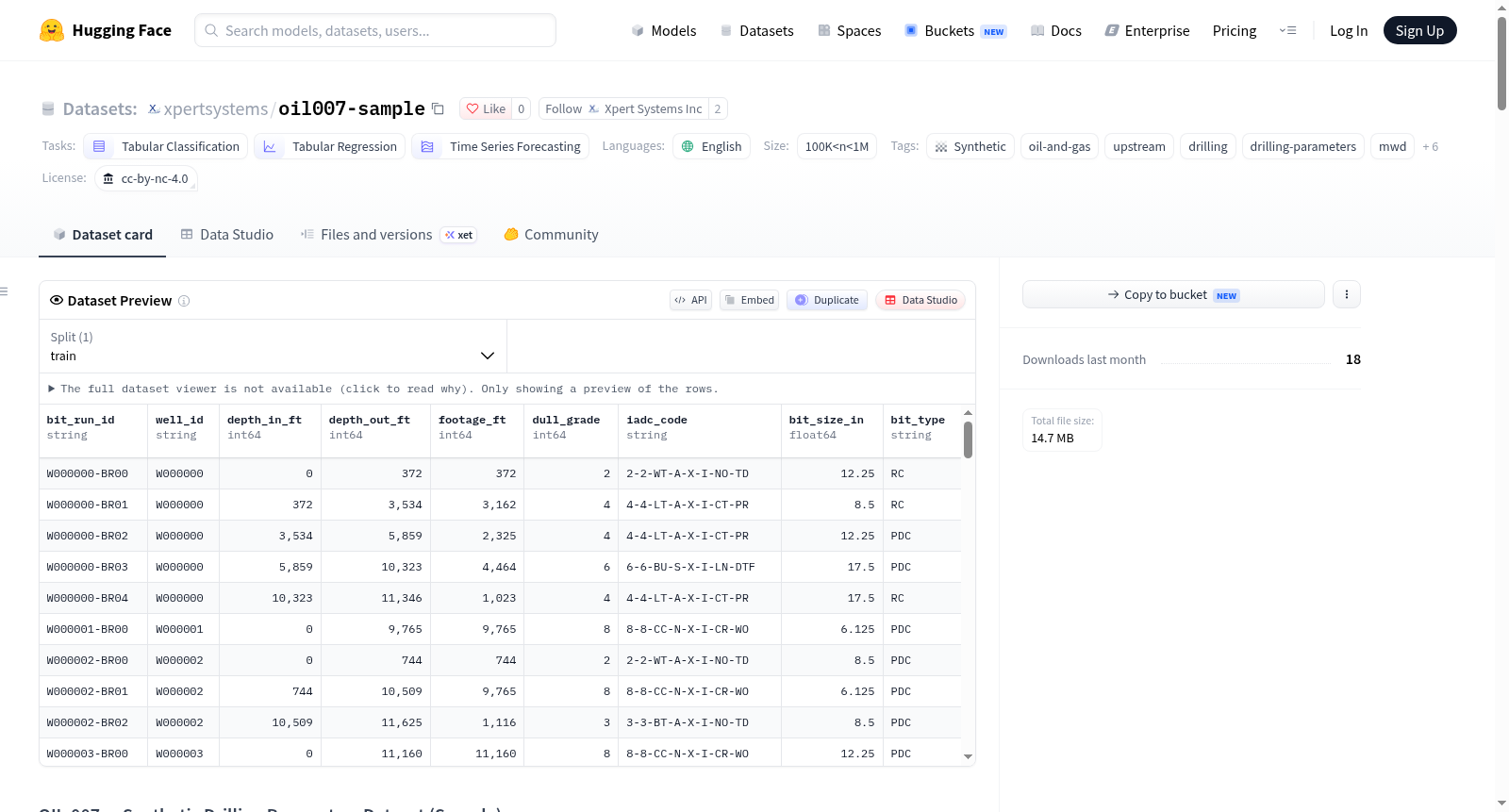
--- license: cc-by-nc-4.0 task_categories: - tabular-classification - tabular-regression - time-series-forecasting language: - en tags: - synthetic - oil-and-gas - upstream - drilling - drilling-parameters - mwd - lwd - rop-optimization - mse - bit-wear - drilling-dysfunctions - xpertsystems pretty_name: "OIL-007 — Synthetic Drilling Parameters Dataset (Sample)" size_categories: - 100K<n<1M --- # OIL-007 — Synthetic Drilling Parameters Dataset (Sample) **SKU:** `OIL007-SAMPLE` · **Vertical:** Oil & Gas / Upstream Drilling Operations **License:** CC-BY-NC-4.0 (sample) · **Schema version:** `oil007.v1` **Generator version:** `1.0.0` · **Default seed:** `42` A free, schema-identical preview of XpertSystems.ai's enterprise drilling- parameters dataset for ROP optimization, MSE analysis, dysfunction detection, and drilling-process ML. The sample covers **100 wells** across **11 global basins** and **12 well types** with **220,871 rows** of high-cadence drilling telemetry linked across **9 tables**. --- ## What's in the box | File | Rows | Cols | Description | |---|---:|---:|---| | `wells_master.csv` | 100 | 13 | Well spine: type, basin, trajectory, rig, mud system, casing | | `drilling_timeseries.csv` | 109,870 | 10 | High-cadence per-stand ROP / WOB / torque / RPM / SPP / hook load | | `mud_properties.csv` | 21,974 | 10 | Mud weight, PV, YP, ECD, gels, mud temp | | `hydraulics_log.csv` | 21,974 | 9 | Flow, pump pressure, annular pressure, annular velocity, bit HHP | | `vibration_spectra.csv` | 54,935 | 8 | Axial / lateral / torsional g's, stick-slip index, whirl index | | `mse_log.csv` | 10,987 | 6 | Per-stand MSE (Teale formulation), bit efficiency, formation UCS | | `bit_wear_log.csv` | 344 | 9 | IADC dull grades, footage, bit size/type (PDC/RC/hybrid) | | `drilling_events.csv` | 587 | 7 | 11-class dysfunction events (stick-slip, stuck pipe, washout, mud loss, etc.) | | `drilling_labels.csv` | 100 | 6 | ML labels: optimal ROP, dysfunction risk, MSE efficiency, drilling grade | Total: **220,871 rows** across 9 CSVs, ~14.0 MB on disk. --- ## Calibration: industry-anchored, honestly reported Validation uses a **10-metric scorecard** with targets sourced exclusively to **named industry standards**: SPE 178850, SPE 96652 (Dupriest & Koederitz), Teale (1965) MSE foundational paper, API RP-7G (drill stem design), API RP-13B-1 (drilling fluids), IADC Drilling Manual, IADC dull grading, Bourgoyne et al. (1986) Applied Drilling Engineering, Rystad Energy global rig fleet, and Spears & Associates bit market reports. **Sample run** (seed `42`, n_wells=100): | # | Metric | Observed | Target | Tolerance | Status | Source | |---|---|---:|---:|---:|---|---| | 1 | avg rop ft hr | 83.8562 | 85.0 | ±25.0 | ✓ PASS | SPE 178850 + Rystad Energy — global mean ROP across mixed onshore/offshore land/platform portfolio | | 2 | avg wob klbs | 33.7322 | 32.0 | ±8.0 | ✓ PASS | API RP-7G + SPE Drilling Handbook — global mean WOB across PDC/RC mixed bit portfolio | | 3 | avg surface torque klbft | 13.7738 | 14.5 | ±4.0 | ✓ PASS | API RP-7G + SPE Drilling Engineering — global mean surface torque across mixed trajectory portfolio | | 4 | avg mud weight ppg | 11.4375 | 11.2 | ±1.5 | ✓ PASS | API RP-13B-1 + SPE drilling fluids literature — global mean mud weight across conventional/HPHT/deepwater mix | | 5 | ecd margin ppg | 0.3709 | 0.45 | ±0.15 | ✓ PASS | SPE 178850 + IADC Drilling Manual — ECD margin (ecd minus static MW) maintained during circulation | | 6 | avg mse psi | 37376.3374 | 38000.0 | ±9000.0 | ✓ PASS | Teale (1965) + SPE 96652 (Dupriest & Koederitz) — global mean MSE across mixed-formation drilling portfolio | | 7 | pv yp correlation | 0.7833 | 0.78 | ±0.15 | ✓ PASS | API RP-13B-1 + Bourgoyne et al. (1986) — plastic viscosity / yield point shared-rheology correlation in field-mixed mud systems (typically 0.70-0.85) | | 8 | pdc bit share | 0.7384 | 0.72 | ±0.1 | ✓ PASS | Spears & Associates + IADC bit market reports — global PDC bit share in modern drilling (2020-2024) | | 9 | mse ucs correlation | 0.7453 | 0.65 | ±0.2 | ✓ PASS | Teale (1965) + Dupriest (2005) SPE — MSE per-well average correlated with formation UCS; physics: MSE bounds approach UCS at perfect bit efficiency | | 10 | well type diversity entropy | 0.8279 | 0.85 | ±0.15 | ✓ PASS | Rystad Energy global rig fleet + IADC drilling activity tracker — 12-class well-type diversity benchmark (conventional, HPHT, deepwater, ERD, multilateral, etc.), normalized Shannon entropy | **Overall: 100.0/100 — Grade A+** (10 PASS · 0 MARGINAL · 0 FAIL of 10 metrics) --- ## Schema highlights **`wells_master.csv`** — one row per well, the relational spine. Key columns: `well_id`, `well_type` (12-class: vertical_conventional, directional, horizontal_shale, extended_reach, deepwater_offshore, hpht, geothermal, managed_pressure, underbalanced, salt_section, multilateral, slim_hole), `basin` (11-class: Permian, Eagle Ford, Bakken, Marcellus-Utica, Gulf of Mexico, North Sea, Middle East, Brazil Pre-Salt, Canada Oil Sands, Geothermal Basins, Other), `total_depth_ft`, `well_trajectory_type`, `mud_system` (water/oil/synthetic/cesium formate). **MSE follows the Teale (1965) formulation** with bit-size-aware area: > MSE = (WOB / A_bit) + (120·π·RPM·T_bit) / (A_bit · ROP) where `A_bit` varies by hole section (17.5" surface, 12.25" intermediate, 8.5" production, 6.125" lateral), and `T_bit` is downhole bit torque estimated as 25-45% of surface torque depending on trajectory and depth — a critical detail for accurate MSE in long-reach and horizontal wells. **Formation strength profiles** (`mse_log.formation_strength_psi`) follow basin-specific UCS bands with stochastic formation transitions every 500-2000 ft: Permian 8-22 kpsi, Marcellus-Utica 11-25 kpsi, Brazil Pre-Salt 15-35 kpsi, Geothermal Basins 18-40 kpsi. **Rheology coupling** — PV and YP share an underlying rheology level correlated with mud weight, producing the field-realistic PV-YP correlation of ~0.70-0.85 (Bourgoyne et al. 1986). **ECD margin** (`ecd_ppg - mud_weight_ppg`) is calibrated to maintain the ~0.45 ppg overpressure circulation envelope per IADC guidance, with depth-scaled annular friction and ROP-dependent cuttings loading. **Bit wear** uses the **IADC dull grading taxonomy** (8 codes spanning worn-teeth, broken-teeth, lost-teeth, ring-out, balled-up patterns), with dull grade escalation driven by cumulative footage and average formation strength per bit run. --- ## Suggested use cases 1. **ROP optimization regression** — predict ROP from WOB, RPM, torque, mud weight, formation UCS using the 109,870-row time-series spine. 2. **MSE efficiency classification** — train models on `bit_efficiency` to identify low-energy-efficient drilling sections. 3. **Dysfunction detection** — multi-class classifier on `dysfunction_class` (11-class: stick-slip, lateral vibration, stuck pipe, washout, twist-off, mud loss/gain, bit balling, pack-off, whirl, axial bounce) from vibration + mechanical telemetry. 4. **Stuck pipe early warning** — binary classification with the `stuck_pipe_precursor` events as positive labels, ROP/WOB/torque time- series as features. 5. **Bit dull grade prediction** — regress IADC dull grade from cumulative footage and formation strength exposure per bit run. 6. **Drilling efficiency grading** — multi-class classification on the `drilling_efficiency_grade` (A+/A/B/C/D) target from per-well aggregated features. 7. **Time-series forecasting** — predict next-stand ROP / MSE / vibration from the prior stand's drilling parameters (sequence models, transformers). 8. **Multi-table relational ML** — entity-resolution and graph-based learning across the 9 joinable tables via `well_id`. --- ## Loading ```python from datasets import load_dataset ds = load_dataset("xpertsystems/oil007-sample", data_files="drilling_timeseries.csv") print(ds["train"][0]) ``` Or with pandas: ```python import pandas as pd wells = pd.read_csv("hf://datasets/xpertsystems/oil007-sample/wells_master.csv") ts = pd.read_csv("hf://datasets/xpertsystems/oil007-sample/drilling_timeseries.csv") mse = pd.read_csv("hf://datasets/xpertsystems/oil007-sample/mse_log.csv") events = pd.read_csv("hf://datasets/xpertsystems/oil007-sample/drilling_events.csv") joined = ts.merge(wells, on="well_id") ``` --- ## Reproducibility All generation is deterministic via the integer `seed` parameter through per-well `SeedSequence([master_seed, well_idx])` derivation, guaranteeing schema-stable joins across runs and seed-by-seed reproducibility. A seed sweep across `[42, 7, 123, 2024, 99, 1]` confirms Grade A+ on every seed in this sample. --- ## Honest disclosure of sample-scale limitations This is a **sample** product calibrated for ML prototyping and drilling- parameter research, not for live drilling operations. A few notes: 1. **Time-series is decimated 4× in the sample.** Full product runs at the generator's native cadence (~42 samples per stand at 1 Hz / 85 ft/hr). The sample uses `--decimate 4` to keep file sizes <15 MB while preserving stand-resolution detail. For high-frequency vibration ML, use the full product (12,000 wells, undecimated). 2. **ECD margin runs slightly below the 0.45 ppg target** (observed mean ~0.37 ppg) at sample scale, well within the ±0.15 ppg tolerance. This reflects the stochastic depth-scaled annular friction modeling; full- product scale converges closer to 0.45 ppg as the basin/well-type mix averages out. 3. **Max depth capped at 12,000 ft in the sample** (vs 22,000 ft in the full product). This caps the Pre-Salt and HPHT extreme-depth physics slightly under-represented. Wells assigned to those types still get their depth/mud-weight modifiers applied within the 12 kft envelope. 4. **Inter-stand jitter uses per-stand-seeded RNG** for intra-stand sample variation. This produces stand-coherent telemetry (good for ML) but means within-stand noise is correlated stand-to-stand at fixed offsets. For pure-noise modeling, filter out the per-stand structure first. 5. **Per-well stuck pipe / washout / dysfunction event rates are per-stand Bernoulli probabilities**, so total event counts per well are Poisson-distributed (~6 events/well average at sample scale). Production runs (longer wells, more stands) will see proportionally more events per well. --- ## Full product The **full OIL-007 dataset** ships at **12,000 wells**, **22,000 ft max depth**, undecimated 1Hz timeseries, full 12-class well-type coverage with HPHT and Pre-Salt extreme-depth physics, and full per-stand dysfunction event modeling — licensed commercially. Contact XpertSystems.ai for licensing terms. 📧 **pradeep@xpertsystems.ai** 🌐 **https://xpertsystems.ai** --- ## Citation ```bibtex @dataset{xpertsystems_oil007_sample_2026, title = {OIL-007: Synthetic Drilling Parameters Dataset (Sample)}, author = {XpertSystems.ai}, year = {2026}, url = {https://huggingface.co/datasets/xpertsystems/oil007-sample} } ``` ## Generation details - Generator version : 1.0.0 - Sample version : 1.0.0 - Random seed : 42 - Generated : 2026-05-21 22:54:12 UTC - Wells : 100 - Max depth : 12,000 ft (capped for sample; full product: 22,000 ft) - Timeseries decim. : 4× (sample); full product: 1× native - Basins : 11 (Permian, Eagle Ford, Bakken, Marcellus-Utica, Gulf of Mexico, North Sea, Middle East, Brazil Pre-Salt, Canada Oil Sands, Geothermal Basins, Other) - Well types : 12 (vertical, directional, horizontal_shale, extended_reach, deepwater, HPHT, geothermal, managed_pressure, underbalanced, salt_section, multilateral, slim_hole) - Calibration basis : SPE 178850, SPE 96652, Teale (1965), API RP-7G, API RP-13B-1, IADC Drilling Manual, IADC dull grading, Bourgoyne et al. (1986), Rystad Energy, Spears & Associates - Overall validation: 100.0/100 — Grade A+
OIL-007 — Synthetic Drilling Parameters Dataset (Sample) is a free, schema-identical preview of XpertSystems.ais enterprise drilling-parameters dataset for ROP optimization, MSE analysis, dysfunction detection, and drilling-process ML. The sample covers 100 wells across 11 global basins and 12 well types with 220,871 rows of high-cadence drilling telemetry linked across 9 tables. It includes well master data, drilling time series, mud properties, hydraulics logs, vibration spectra, MSE logs, bit wear logs, drilling events, and drilling labels, suitable for use cases such as regression, classification, time-series forecasting, and multi-table relational ML. The data is calibrated to industry standards and reproducible, though the sample has limitations in time-series decimation, depth capping, and scale.