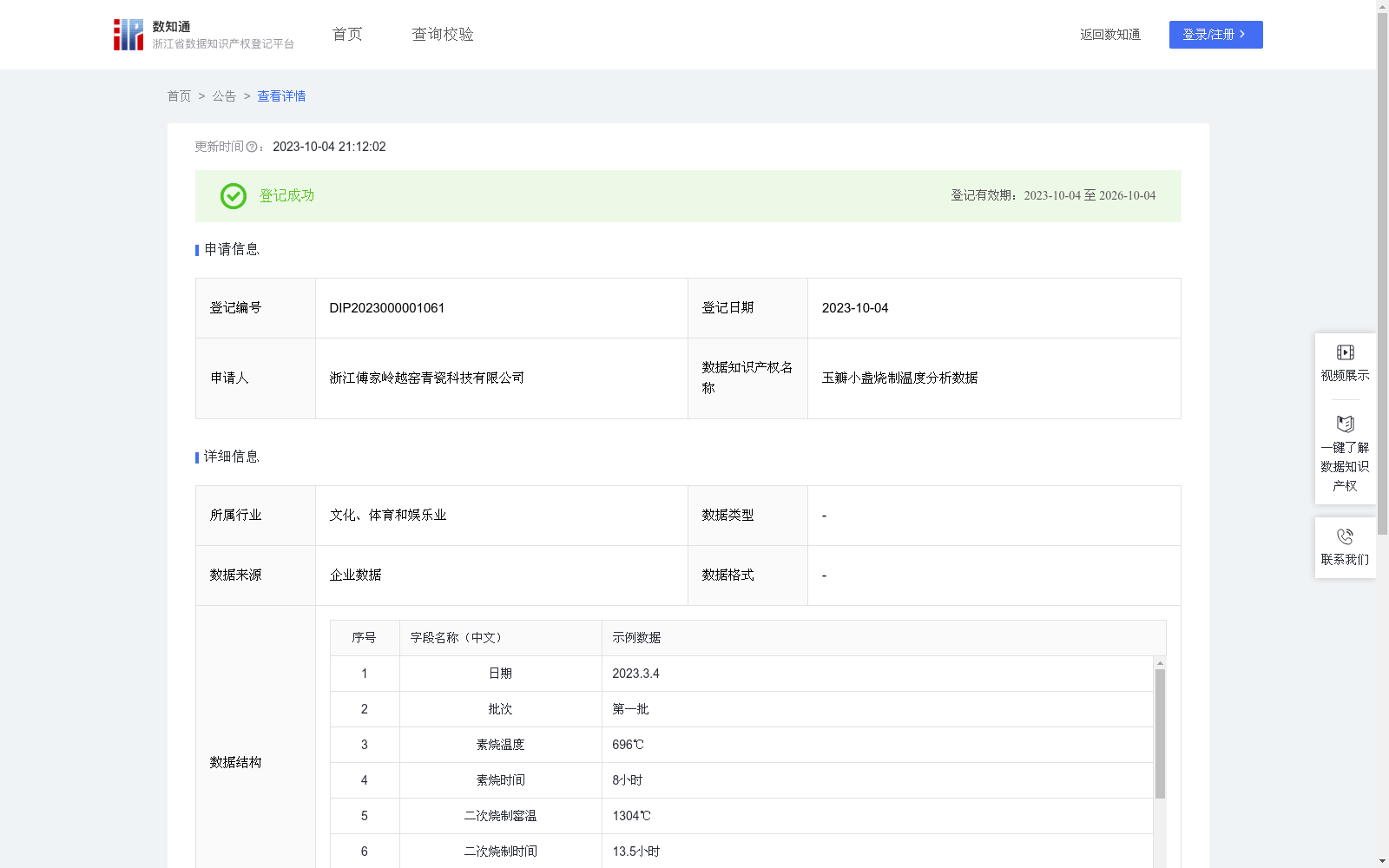
玉瓣小盏烧制温度分析数据
收藏资源简介:
陶瓷材料烧制过程中温度的控制尤为重要,温度过低产品不会变青瓷,过高会窑变,产品变形。结合每次烧制过程中所记录温度相关数据,分析出适合某种产品烧制时适宜温度,大大提高产品合格率。以烧制玉瓣小盏为例,第一批烧制过程中,素烧窑温为696度,待冷却后进行微修之后上釉,上好釉后进行第2次烧制,窑温1304度,烧好后需要在窑内自然降温至100度左右才能开窑门。烧好后完全冷却后进行肉眼检查,发现有黑点、崩裂、变形、窑变、釉水不均等都属于不合格产品。同样第二批继续记录素烧窑温为701度,待冷却后进行微修之后上釉,上好釉后进行第2次烧制,窑温1298度,挑选出不合格产品。以此类推,根据产品合格率来计算出产品的最佳匹配温度。合格率计算公式为合格产品数÷产品总数×100%
Temperature control is critically important during the firing of ceramic materials. If the temperature is too low, the product will not develop into celadon; if too high, kiln transformation and product deformation will occur. By leveraging temperature-related data recorded during each firing cycle, the optimal firing temperature for a specific product can be identified, which significantly boosts the product qualification rate. Take the firing of small jade-petal cups as an example. For the first batch: the bisque firing temperature was set at 696°C. After cooling, minor repairs were performed before glazing. Following glazing, a second firing was conducted at 1304°C. The kiln door could only be opened after naturally cooling down to approximately 100°C inside the kiln post-firing. After complete cooling, visual inspection was carried out. Products with black spots, chipping, deformation, kiln transformation or uneven glaze are categorized as unqualified. For the second batch, the bisque firing temperature was recorded as 701°C. After cooling, minor repairs were conducted prior to glazing, followed by a second firing at 1298°C, and unqualified products were screened out. This process was repeated sequentially, and the optimal matching firing temperature for the product was calculated based on the product qualification rate. The formula for the qualification rate is: (Number of Qualified Products ÷ Total Number of Products) × 100%.