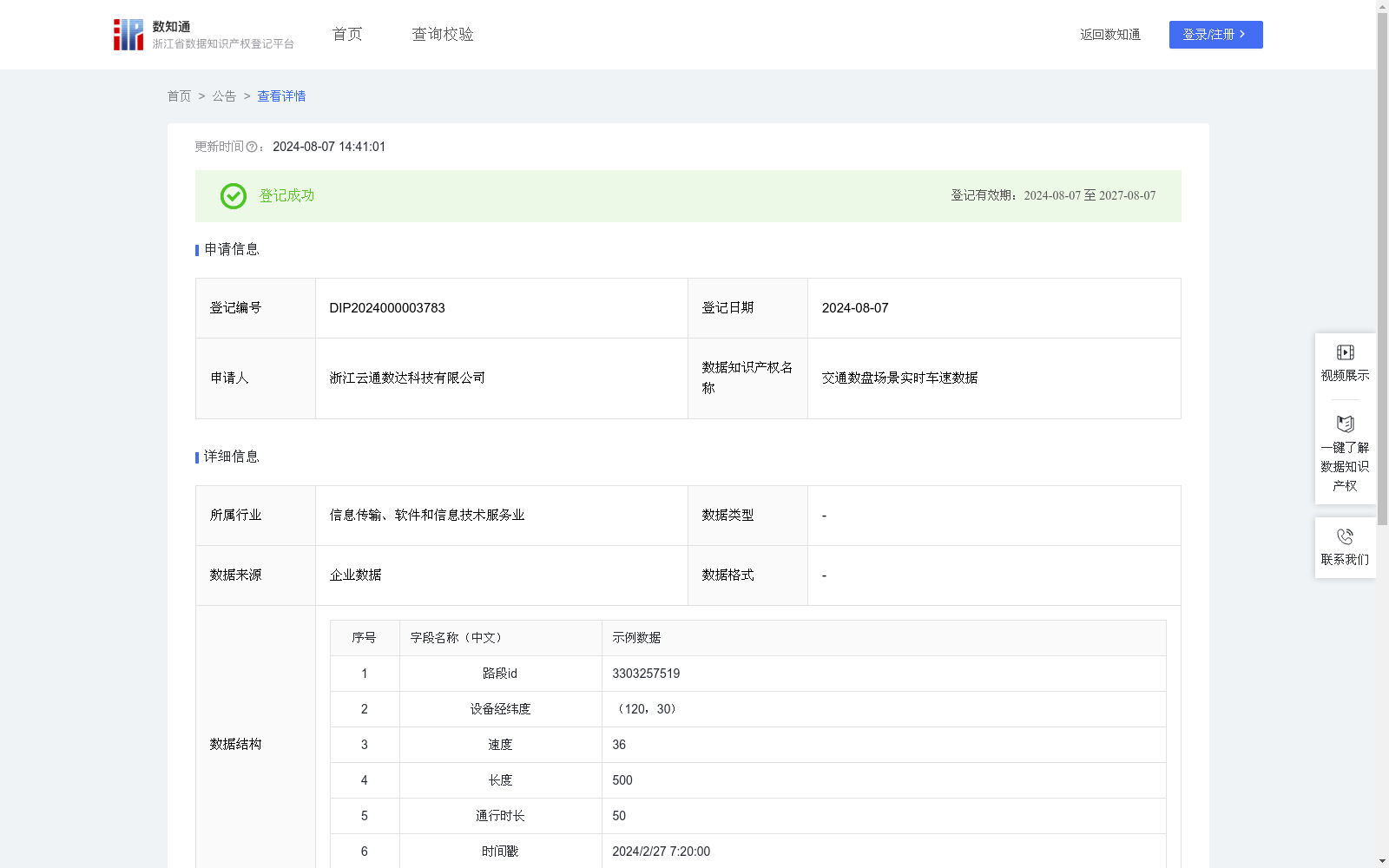
交通数盘场景实时车速数据
收藏资源简介:
依托回传的设备经纬度数据及对应的时间戳,进行加工、分析、构建模型,生成路段实时车速数据;利用实时车速数据分析道路的通行情况及车速分布情况,实现合理优化信号配时、优化交通流等目的。在自研的交通态势数盘平台上,SDK方式回传的设备位置数据,进行加工、分析、挖掘构建模型;通过聚合算法将车辆位置聚合到道路路网中,最终生成车辆的实时车速数据; 一、数据来源 数据清理:从数据库中抽取回传的经纬度数据,对数据进行清洗; 数据处理:对数据进行过滤、去除错误和缺失数据;对数据进行计算和分析,如数据聚合、特征分析、结果校准等; 二、算法建模 模型评估:使用历史车速范围或道路限速等数据对模型进行测试和评估,根据评估结果对模型进行优化; 算法描述:根据设备位置数据,与道路路网中所有路段位置数据进行聚合关联;根据时间戳可计算出时间差,对数据进行分析、校准,最终生成实时车速数据。
Relying on the returned device longitude and latitude data and their corresponding timestamps, we conduct processing, analysis and model construction to generate real-time speed data for road segments. By analyzing road traffic conditions and speed distribution using the real-time speed data, objectives including rational signal timing optimization and traffic flow improvement can be achieved. On the self-developed traffic situation data platform, device location data transmitted back via SDK is processed, analyzed, mined and used to construct models; vehicle locations are aggregated into the road network through aggregation algorithms, and finally real-time vehicle speed data is generated. 1. Data Sources 1.1 Data Cleaning: Extract the returned longitude and latitude data from the database, and clean the dataset. 1.2 Data Processing: Filter the data to remove erroneous and missing values; perform calculations and analysis on the dataset, including data aggregation, feature analysis, result calibration, etc. 2. Algorithm Modeling 2.1 Model Evaluation: Test and evaluate the model using data such as historical speed ranges or road speed limits, and optimize the model based on the evaluation results. 2.2 Algorithm Description: Perform aggregation and association between device location data and the location data of all road segments in the road network; calculate the time difference based on timestamps, analyze and calibrate the data, and finally generate real-time speed data.