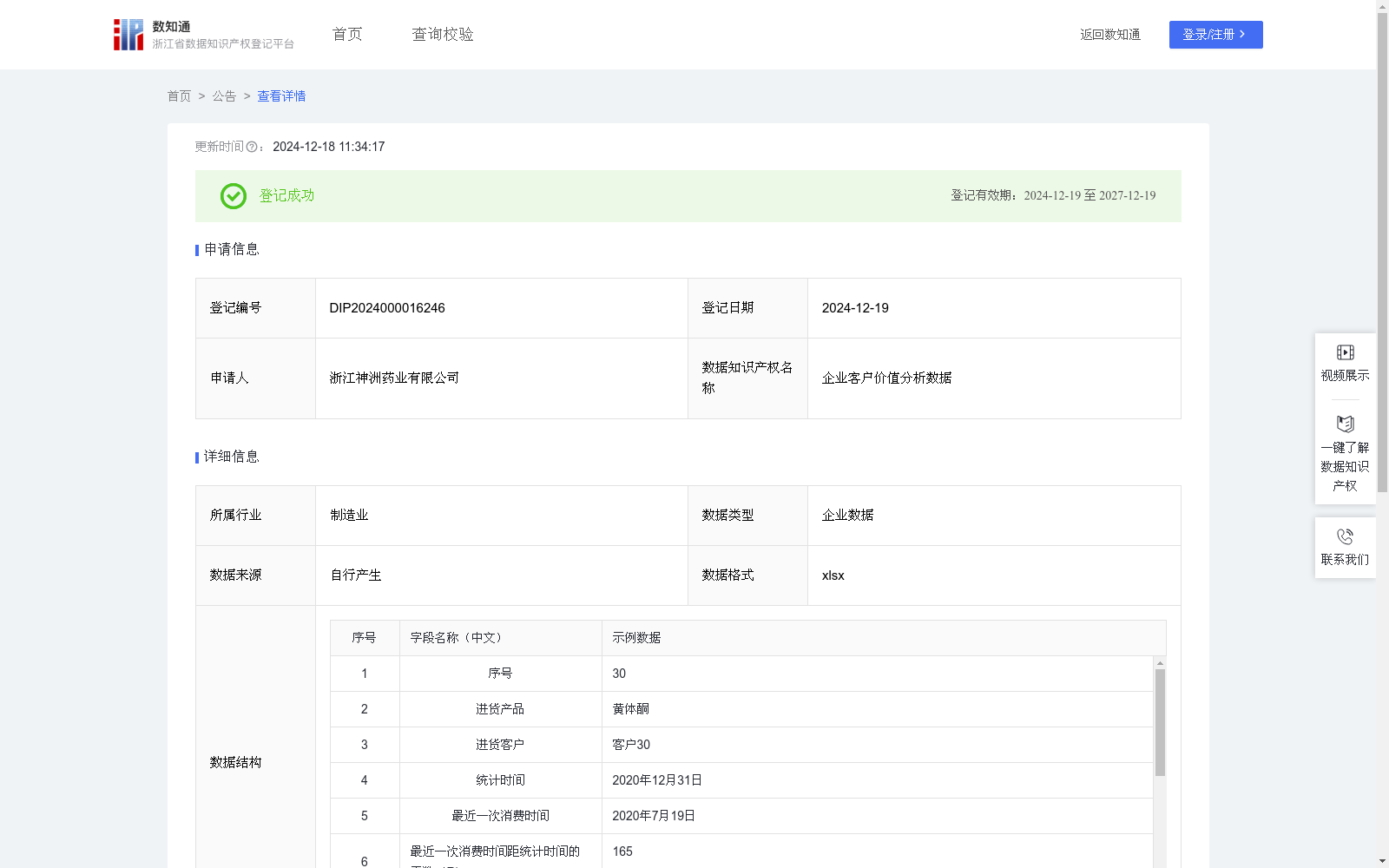
企业客户价值分析数据
收藏资源简介:
采集客户在一年内的消费数据,通过分析客户在最近一次消费时间间隔(R)、最近一段时间内消费频次(F)和最近一段时间内消费金额(M),利用RFM模型对进行价值评级,从而识别出高价值客户和核心客户。针对不同类型的客户,用户可以精细化运营,采用不同的运营手段来提高客户在产品中的活跃度、留存率和付费率。此方法可以用于对消费者行为模式与消费分析能力有需求的各大企业和机构。步骤1:采集客户在一年内的消费数据:序号、进货产品、进货客户、统计时间,最近一次消费时间、最近一段时间内消费频次(F)和最近一段时间内消费金额(M);步骤2:对采集的数据进行加工,计算最近一次消费时间间隔(R,截止统计时间),根据业务实际需求,采用AVERAGE函数计算阈值,将R、F、M三个指标进行向量化,当R大于阈值,则记为0,反之则记为1,当F、M两个数值大于阈值,则记为1,反之则记为0,利用CONCAT统计RFM,根据RFM模型规则将客户群体划分为八个类型,RFM=111为重要价值客户,RFM=101为重要发展客户,RFM=011为重要保持客户,RFM=001为重要挽留客户,RFM=110为一般价值客户,RFM=100为一般发展客户,RFM=010为一般保持客户,RFM=000为一般价值客户;步骤3:根据划分的客户类型,识别高价值、核心和基础客户,从而采取不同的行为模式来提高客户的忠诚度和留存率。
This dataset collects customer consumption data over a one-year period. It analyzes three metrics: recency of the most recent purchase (R), purchase frequency within a recent time window (F), and total consumption amount within a recent time window (M). The RFM model is then used for value rating to identify high-value and core customers. For different customer segments, enterprises can implement refined operations with tailored strategies to boost customer activity, retention rate, and payment conversion rate in the product. This method is applicable to various enterprises and institutions that require consumer behavior analysis and consumption pattern assessment capabilities. Step 1: Collect one-year customer consumption data, including serial number, purchased products, purchasing customers, statistical time, recency of the most recent purchase, purchase frequency (F) within a recent time window, and total consumption amount (M) within a recent time window. Step 2: Process the collected data to calculate the recency interval (R, based on the cutoff statistical time). Set thresholds using the AVERAGE function per actual business requirements, then vectorize the three indicators R, F and M: assign a value of 0 to R if it exceeds the threshold, otherwise assign 1; assign a value of 1 to F and M if their values exceed the threshold, otherwise assign 0. Use the CONCAT function to generate the RFM composite code, and divide customer groups into 8 categories according to the RFM model rules: 1. RFM=111: Important Value Customers 2. RFM=101: Important Development Customers 3. RFM=011: Important Retention Customers 4. RFM=001: Important Win-back Customers 5. RFM=110: General Value Customers 6. RFM=100: General Development Customers 7. RFM=010: General Retention Customers 8. RFM=000: General Value Customers Step 3: Identify high-value, core and basic customers based on the divided customer types, and adopt corresponding strategies to enhance customer loyalty and retention rate.