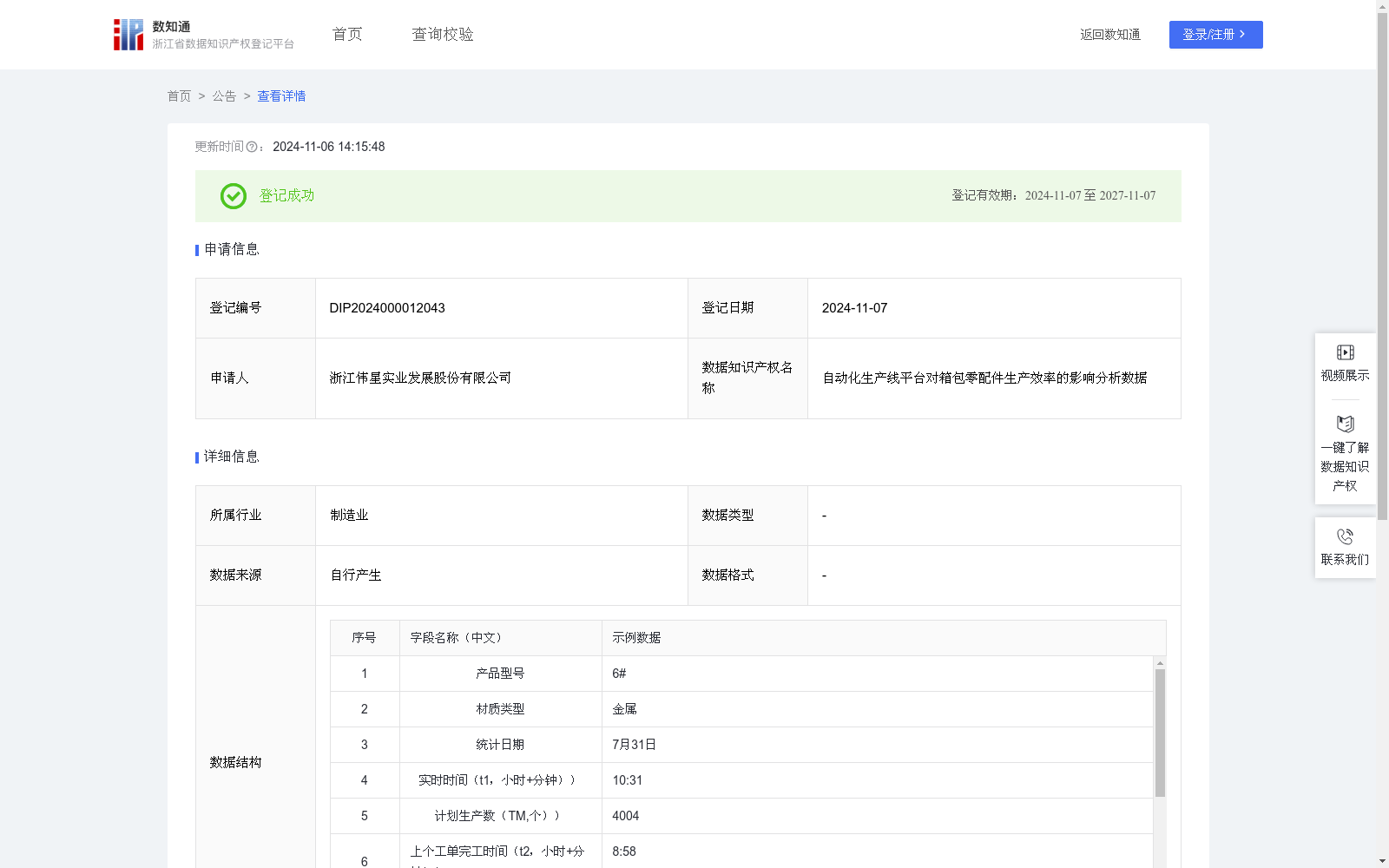
自动化生产线平台对箱包零配件生产效率的影响分析数据
收藏资源简介:
箱包零配件主要以金属材质为主,但其种类及形状繁多,基于客户的需求,生产厂家需要在规模化生产的基础上又要实现个性化、定制化生产,通过人工判断客户需求再传达到生产线,所需要的环节非常复杂且损耗的时间成本巨大。 在行业内引进具备自动化生产线功能的IIOT平台系统,目的是通过在生产过程中的各种数据要素感知、采集和转化,实现需求和生产的精准对接,减少因信息不对称产生的产能浪费,最大化提升产能效率。本项数据分析通过采集生产过程的各种数据要素,运用数据计算分析IIOT平台是否真正实现了箱包行业产能效率的提升。本项数据分析对整个箱包行业的产业升级具有极高的参考价值,可以在全行业内进行推广。1.数据采集:通过物联网将IIOT平台系统在生产过程的各种数据要素感知采集。采集的主要数据要素有:实时时间(t1,小时+分钟)、计划生产数(TM,个)、上个工单完工时间(t2,小时+分钟)、标准工时(SWH,个/分钟)、已完工数量(M,个)等。 2.数据计算:根据以下公式计算预计完工时间(T1)和实时核算完工时间(T2):T1 = TM / SWH + t2 ; T2 =(TM - M)/ SWH + t1。 3.数据分析:对T1和T2进行比较。若T2≤T1,则结果显示为“效率提升”,若T2>T1则分析结果显示为“效率降低”。该数据分析的最终结论是引进IIOT平台系统成功实现了产能效率提升。
Most luggage accessories are made of metal materials, with a vast variety of types and shapes. To meet customer demands, manufacturers must achieve both mass production and personalized/customized production. Previously, customer demands were manually identified and relayed to the production line, which involved extremely complex procedures and incurred substantial time costs. Introducing the IIoT platform system equipped with automated production line functions aims to achieve precise matching between customer demands and production by sensing, collecting and transforming various data elements during the production process, thereby reducing production capacity waste caused by information asymmetry and maximizing production efficiency. This data analysis collects various data elements from the production process, and uses data computation and analysis to verify whether the IIoT platform has effectively improved the production capacity efficiency of the luggage industry. This data analysis holds extremely high reference value for the industrial upgrading of the entire luggage sector and can be promoted on an industry-wide scale. 1. Data Collection: Various data elements during the production process are sensed and collected via the IIoT platform system through the Internet of Things. The main collected data elements include: real-time time (t1, hour + minute), planned production volume (TM, unit), completion time of the previous work order (t2, hour + minute), standard working hours (SWH, units per minute), completed quantity (M, unit), etc. 2. Data Calculation: Calculate the estimated completion time (T1) and real-time calculated completion time (T2) using the following formulas: T1 = TM / SWH + t2 ; T2 = (TM - M) / SWH + t1. 3. Data Analysis: Compare T1 and T2. If T2 ≤ T1, the result is marked as "Efficiency Improved"; if T2 > T1, the analysis result is marked as "Efficiency Reduced". The final conclusion of this data analysis is that the introduction of the IIoT platform system has successfully improved production capacity efficiency.