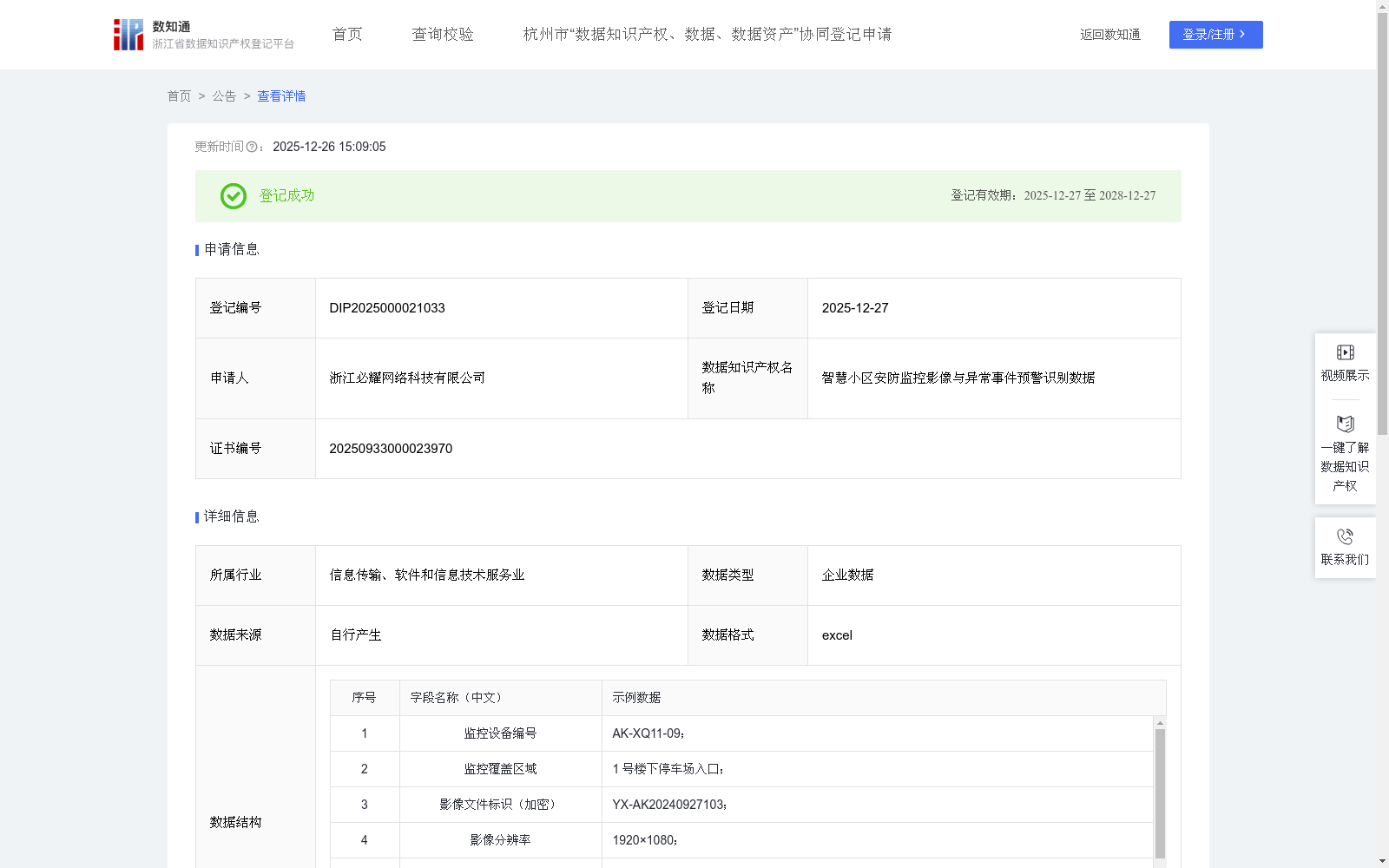
智慧小区安防监控影像与异常事件预警识别数据
收藏资源简介:
适用于各类居民小区、高端商住社区的全域安防防护场景,针对小区出入口、楼栋周边、地下车库、绿化带等关键区域的监控影像流、设备运行参数及异常事件记录等数据,通过智能影像分析与特征匹配,解决传统监控依赖人工巡查导致的异常发现滞后、安防漏洞难排查、事件追溯效率低等问题,为物业安防人员提供实时预警与事件定位支撑,保障业主人身与财产安全,提升小区安防管理智能化水平。算法规则简要说明 通过监控影像特征提取与异常识别算法模型,实现小区安防的实时预警与事件管控,具体过程如下: 1.数据采集:通过小区内高清网络摄像头、红外监控设备等内部采集实时影像流、设备运行状态(如帧率、存储容量)等企业数据;同步捕获影像中人员、车辆等目标的外观特征等个人数据。对影像文件标识进行不可逆加密,对涉及的人员面部特征采用模糊化预处理。 2.数据预处理:对采集的影像流进行关键帧提取与降噪处理,剔除因设备抖动导致的模糊画面;通过目标检测算法(YOLOv8)分离人员、车辆等前景目标与背景环境;清洗设备离线、存储故障导致的无效数据,关联设备编号与覆盖区域信息,构建结构化影像分析数据集。 3.异常识别模型构建与运行:基于深度学习构建异常事件识别模型,预设 “高空抛物、陌生人徘徊、车辆违规停放” 等 15 类异常特征库;将预处理后的目标特征与特征库进行比对,通过余弦相似度算法计算匹配度,同时结合时间维度(如凌晨 2-5 点非住户频繁出入)设定场景权重。 4.预警触发与数据追溯:当匹配度≥90% 且场景权重达标时,系统自动触发预警,推送含影像片段、事发位置的信息至安防中心;对预警事件的处置过程进行全程记录,对涉及个人的影像数据采用面部打码后存档;按周、月统计异常事件类型分布、预警准确率、处置耗时等指标,形成安防分析报表,为优化监控点位与防护策略提供数据支撑。
This dataset is tailored for full-scenario security protection scenarios across various residential communities and high-end commercial-residential complexes. It targets data including monitoring video streams, device operating parameters and abnormal event records collected from key areas such as community entrances and exits, building perimeters, underground garages and green belts. By leveraging intelligent video analysis and feature matching, it addresses the pain points of traditional monitoring systems, including delayed anomaly detection due to reliance on manual patrols, difficulty in identifying security vulnerabilities, and low efficiency in event tracing. The dataset provides real-time early warning and event location support for property security personnel, ensuring the personal and property safety of residents and elevating the intelligent level of community security management. Brief description of algorithm rules: 1. Data Collection: Real-time video streams, device operating status (such as frame rate, storage capacity) and other relevant operational data of the property enterprise are collected internally via high-definition network cameras, infrared monitoring equipment and other devices in the community. Meanwhile, personal data including appearance features of targets such as personnel and vehicles in the captured videos are also acquired. Irreversible encryption is applied to the identification tags of video files, and facial features of involved personnel are preprocessed with blurring treatment. 2. Data Preprocessing: Key frame extraction and denoising processing are conducted on the collected video streams to eliminate blurry frames caused by device jitter. The YOLOv8 target detection algorithm is used to separate foreground targets such as personnel and vehicles from the background environment. Invalid data caused by device offline or storage faults are cleaned, and device numbers and their covered area information are associated to build a structured video analysis dataset. 3. Construction and Operation of Anomaly Recognition Model: An abnormal event recognition model is developed based on deep learning, with 15 preset abnormal feature libraries covering scenarios such as "high-altitude object throwing", "strangers loitering", "illegal vehicle parking" and others. The preprocessed target features are compared against the preset feature library, with the matching degree calculated via the cosine similarity algorithm. Additionally, scene weights are set in combination with time dimensions, such as applying stricter weight settings for frequent access by non-residents between 2 and 5 a.m. 4. Early Warning Triggering and Data Tracing: When the matching degree reaches ≥90% and the scene weight meets the preset standards, the system automatically triggers an early warning and pushes information including video clips and the incident location to the security center. The entire disposal process of early warning events is fully recorded, and personal-related video data is archived with facial blurring. Indicators such as the distribution of abnormal event types, early warning accuracy rate and disposal time consumption are counted weekly and monthly to generate security analysis reports, providing data support for optimizing monitoring points and protection strategies.