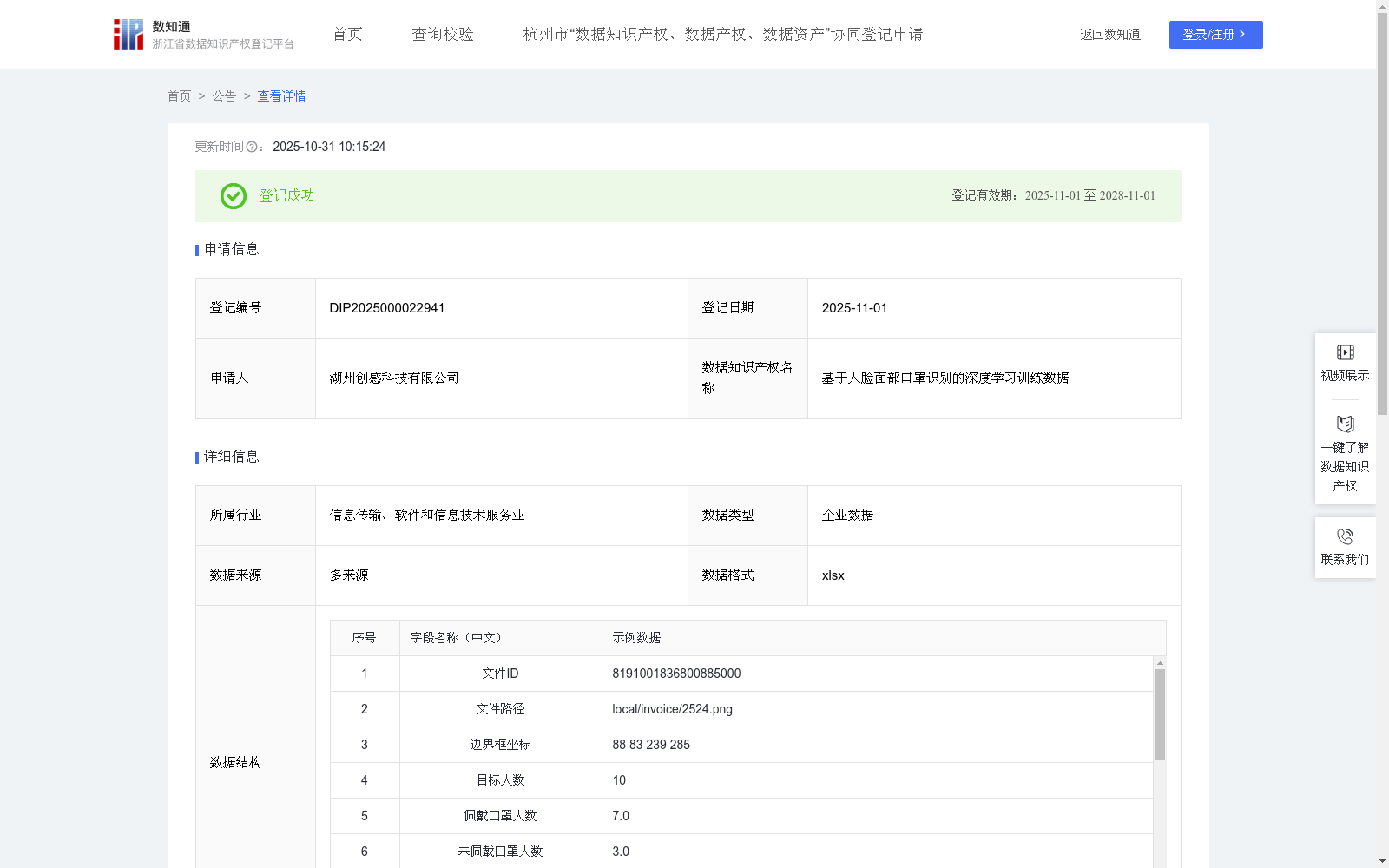
基于人脸面部口罩识别的深度学习训练数据
收藏资源简介:
基于人脸面部口罩识别的深度学习训练数据,在诸多场景中有着重要应用。在公共卫生防控方面,机场、车站、商场等人员密集场所,通过部署相关识别系统,利用深度学习训练数据支撑的模型,可实时监测人群口罩佩戴情况。一旦发现未戴口罩者,能及时发出警报或提示,降低病毒传播风险,助力疫情防控常态化工作 。医疗环境里,医院入口、病房区域等,该数据支持下的识别技术可精准区分患者、医护人员是否正确佩戴口罩。像手术室、重症监护室等对卫生要求极高的区域,保证人员规范佩戴口罩,能有效减少病菌交叉感染,保障医疗环境安全。企事业单位的门禁系统也可引入此技术。员工打卡进门时,系统借助训练数据快速识别其是否合规佩戴口罩,既完成身份验证,又确保工作场所防疫安全,提升单位整体防控水平 。1、数据采集:企业采集大量标注佩戴口罩与未佩戴口罩的个体图片,图片涵盖不同场景,不同拍摄角度,不同质量的图片信息,确保数据的多样性从而为提升模型的泛化能力做准备。生成每个文件的ID,记录图片的文件路径。 2、文件预处理:所有图像均经过严格的预处理,包括自动方向校正和EXIF方向信息的剥离,确保所有图像在输入模型前方向一致。此外,为了适应目标检测算法的要求,所有图像都被标准化为固定像素的尺寸,通过拉伸的方式进行调整。再使用自适应均衡化技术来增强图像的对比度,有助于训练出来的模型在不同光照条件下更准确地识别口罩。 3、数据标注:在数据集中,每张图像都被精确标注,定义了戴口罩和未戴口罩两个类别。预处理过后的图片大多数标注框的中心点集中在图像中心区域,标注框的尺寸多集中在一定的范围内,表明大部分人脸标注框的大小比例相对一致,有利于模型识别和预测。 4、模型训练:首先导入并加载预训练的YOLOv8模型。获取数据集的yaml的绝对路径:local/invoice。接着开始训练模型。其中指定了训练数据的配置文件路径,使用CPU进行训练,使用2个工作进程加载数据,输入图像的大小为固定值,学习率固定为0.001,每个批次的大小为8。识别过程中对人脸坐标进行记录标记,以json文件的格式保存到coordinates_num文件夹下。 5、模型预测:使用测试集对模型进行评估,统计和计算模型在不同的样本数据下识别的训练精度、召回率、F1值、以及实时性能评估等性能指标,确保模型进行口罩识别的准确性与适应性。 6、模型应用:将最终训练后得到的模型应用到实际具体的项目中。在实际应用中,根据当前环境场景再对模型的实时性能、检测的准确性和处理速度进行检测和评估,微调和增加部分特定场景数据进行训练,确保满足应用需求,以达到快速、准确识别的效果。
Deep learning training data for facial mask recognition has important applications in various scenarios. In public health prevention and control, for crowded places such as airports, stations and shopping malls, deploying relevant recognition systems and using models supported by the deep learning training data can monitor the mask-wearing status of the crowd in real time. Once people not wearing masks are found, alarms or prompts can be issued in time to reduce the risk of virus transmission and support the normalized work of COVID-19 prevention and control. In medical environments such as hospital entrances and ward areas, the recognition technology supported by this data can accurately distinguish whether patients and medical staff are wearing masks correctly. In areas with extremely high hygiene requirements such as operating rooms and intensive care units (ICUs), ensuring that personnel wear masks properly can effectively reduce cross-infection of pathogens and ensure the safety of the medical environment. Access control systems in enterprises and public institutions can also adopt this technology. When employees check in at the entrance, the system quickly identifies whether they are wearing masks properly with the support of the training data, completing identity verification while ensuring epidemic prevention safety in the workplace and improving the overall prevention and control level of the unit. 1. Data Collection: The enterprise collects a large number of labeled individual images of people wearing and not wearing masks. The images cover various scenarios, shooting angles and quality levels, ensuring data diversity to improve the generalization ability of the model. Each file is assigned a unique ID, and the file path of the image is recorded. 2. File Preprocessing: All images undergo strict preprocessing, including automatic orientation correction and stripping of EXIF orientation information, to ensure that all images have consistent orientation before being input into the model. In addition, to meet the requirements of object detection algorithms, all images are standardized to a fixed pixel size via stretching. Adaptive equalization technology is then used to enhance image contrast, which helps the trained model recognize masks more accurately under different lighting conditions. 3. Data Annotation: Each image in the dataset is accurately annotated, with two defined categories: wearing a mask and not wearing a mask. For most preprocessed images, the center points of the bounding boxes are concentrated in the central area of the image, and the sizes of the bounding boxes mostly fall within a certain range, indicating that the size proportions of most facial bounding boxes are relatively consistent, which is beneficial for model recognition and prediction. 4. Model Training: First, import and load the pre-trained YOLOv8 model. Obtain the absolute path of the dataset's YAML configuration file: local/invoice. Then start training the model. The configuration file path of the training data is specified, CPU is used for training, 2 worker processes are used to load data, the input image size is fixed, the learning rate is set to 0.001, and the batch size is 8. During the recognition process, facial coordinates are recorded and marked, and saved in JSON file format to the coordinates_num folder. 5. Model Prediction: The test set is used to evaluate the model, and performance indicators such as recognition accuracy, recall rate, F1-score, and real-time performance evaluation under different sample data are counted and calculated, to ensure the accuracy and adaptability of the model for mask recognition. 6. Model Application: The finally trained model is applied to actual specific projects. In practical applications, the real-time performance, detection accuracy and processing speed of the model are further detected and evaluated based on the current environmental scenarios, and fine-tuning is conducted by adding and training specific scenario data to ensure that the model meets application requirements and achieves fast and accurate recognition results.