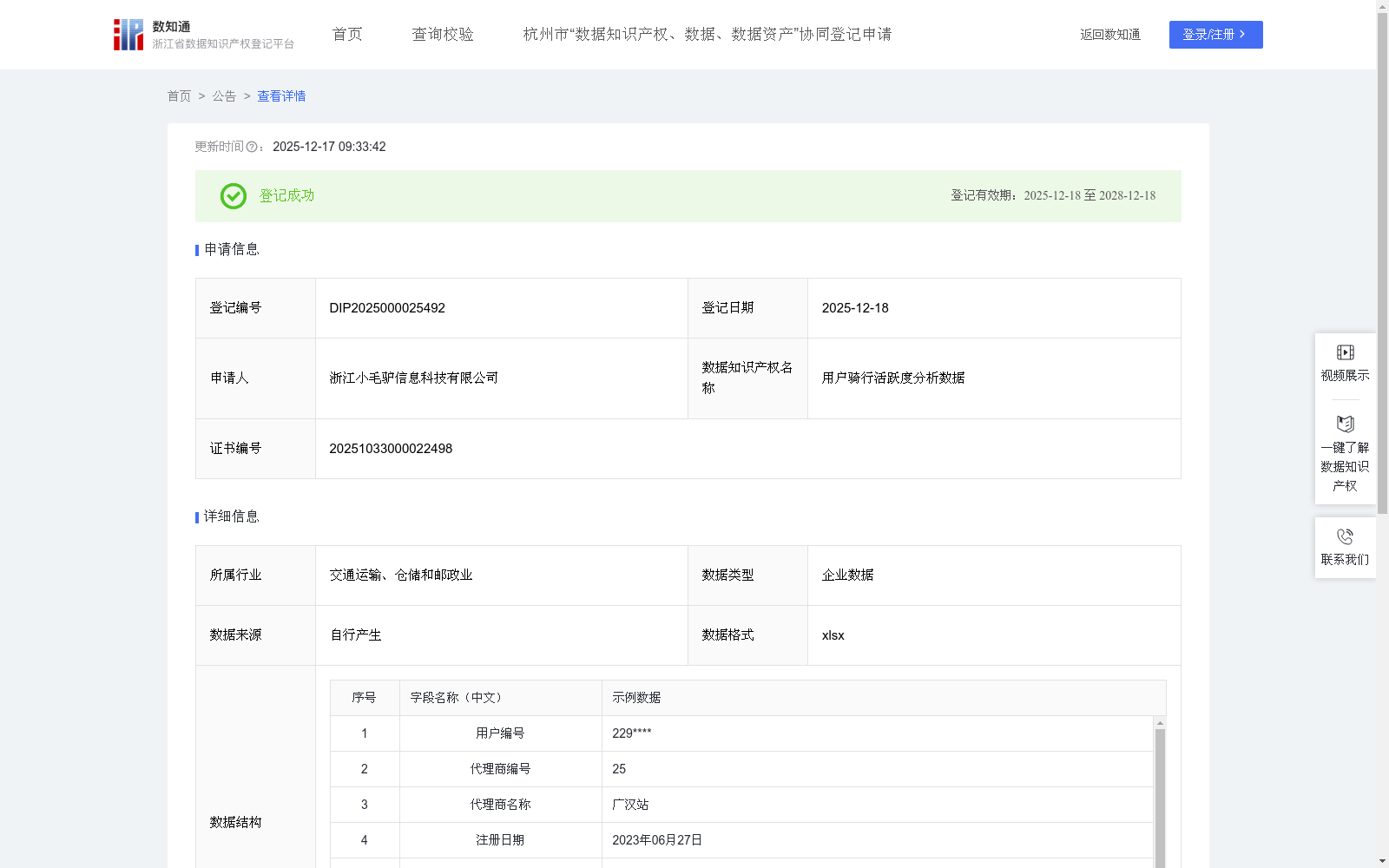
用户骑行活跃度分析数据
收藏资源简介:
通过分析用户骑行频次,可精准掌握不同用户的骑行消费行为。对于骑行频次高的用户,可推送高端骑行装备、定制化骑行路线等增值服务;针对长期未骑行,能开展限时折扣、新手骑行礼包等召回活动。此分析可为骑行平台优化用户分层运营、提升用户粘性助力行业精细化运营。同时为区域内用户群体高度重合的关联企业(如自行车销售店,引运动装备店等)定位潜在用户,推送针对性服务;也可以为骑行相关的体育赛事提供数据支持;在城市交通方面还可以为打造特色骑行路线提供数据分析支持。用户骑行频次C=L/(Z-R),判断用户使用密集度 C是用户骑行频次 L是累计骑行订单数 Z是最后一次骑行日期 R是注册日期 可按频次划分用户类型,高频用户(C≥0.002单/天),中频用户(C为0.001-0.0.002单/天),低频用户(C<0.001单/天),后续能针对性运营(如给低频用户发骑行优惠券,给高频用户推会员)
Analyzing users' cycling frequency can accurately grasp the cycling consumption behaviors of different user groups. For users with high cycling frequency, value-added services such as high-end cycling equipment and customized cycling routes can be recommended; for users who have not cycled for a long time, recall campaigns including limited-time discounts and novice cycling gift packs can be launched. This analysis can help cycling platforms optimize user tiered operations, improve user stickiness, and promote the industry's refined operational management. Meanwhile, it can also assist affiliated enterprises with highly overlapping user groups in the region (such as bicycle retail stores, sports equipment stores, etc.) to locate potential users and push targeted services; it can also provide data support for cycling-related sports events; in terms of urban transportation, it can offer data analysis support for the development of characteristic cycling routes. The user cycling frequency is calculated using the formula C = L/(Z - R), which is used to assess users' usage intensity, where: - C: User cycling frequency - L: Cumulative number of cycling orders - Z: Date of the user's last cycling ride - R: User's registration date Users can be categorized by their cycling frequency into three groups: high-frequency users (C ≥ 0.002 orders per day), medium-frequency users (0.001 orders per day ≤ C < 0.002 orders per day), and low-frequency users (C < 0.001 orders per day). Targeted operational measures can then be implemented, such as sending cycling coupons to low-frequency users and promoting membership plans to high-frequency users.