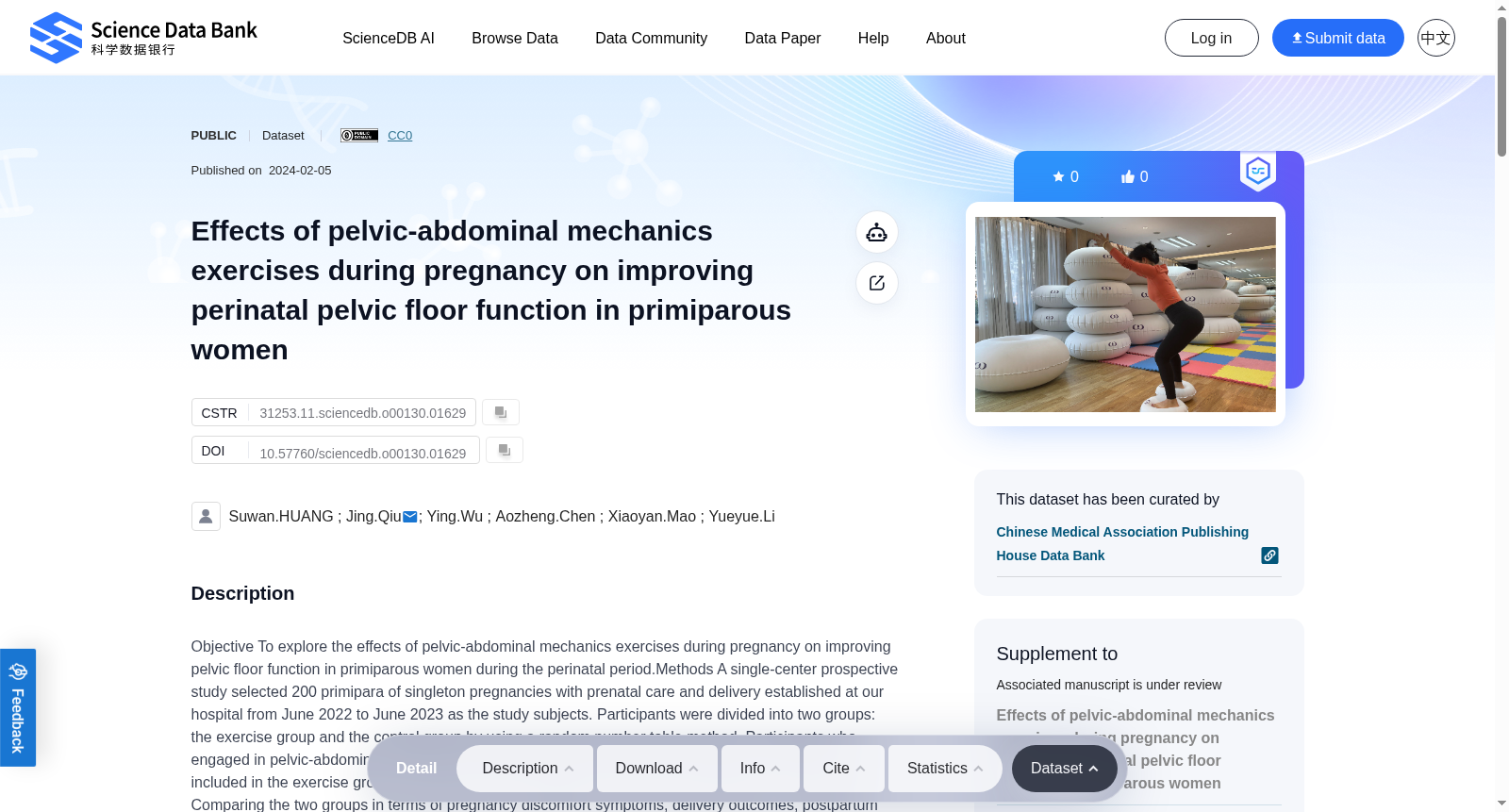
Effects of pelvic-abdominal mechanics exercises during pregnancy on improving perinatal pelvic floor function in primiparous women
收藏资源简介:
Objective To explore the effects of pelvic-abdominal mechanics exercises during pregnancy on improving pelvic floor function in primiparous women during the perinatal period.Methods A single-center prospective study selected 200 primipara of singleton pregnancies with prenatal care and delivery established at our hospital from June 2022 to June 2023 as the study subjects. Participants were divided into two groups: the exercise group and the control group by using a random number table method. Participants who engaged in pelvic-abdominal mechanics exercises for at least 3 months, exercising once a week, were included in the exercise group. Those who did not engage in exercise were included in control group. Comparing the two groups in terms of pregnancy discomfort symptoms, delivery outcomes, postpartum pelvic floor electromyography results, postpartum quality of life, and pelvic floor disease incidence.Results In the late pregnancy period, the exercise group showed significantly better scores in Visual Analog Scale (VAS) for well-being, emotional state, and quality of life compared to the control group, with statistical significance (P < 0.05). However, there was no statistically significant difference between the two groups in terms of sleep quality and incidence of urinary incontinence during the late pregnancy period (P > 0.05). Regarding delivery outcomes, the exercise group had a higher rate of vaginal delivery (81.44%) compared to the control group (64.28%). The exercise group also had a shorter duration of the second stage of labor compared to the control group, with statistical significance (P < 0.05). At the postpartum 42 days assessment of pelvic floor function, the exercise group demonstrated significantly better values in terms of vaginal pressure, muscle strength, pelvic-abdominal coordination during contraction, and Modified Oxford (MOS) grading compared to the control group, with statistical significance (P < 0.05). There was no statistically significant difference between the two groups in terms of the incidence of pelvic organ prolapse (P > 0.05). However, the exercise group had a significantly lower incidence of SUI compared to the control group, with statistical significance (P < 0.05). Regarding postpartum quality of life, the exercise group showed significantly better results compared to the control group, with statistical significance (P < 0.05).Conclusion Pelvic-abdominal mechanics exercises have advantages in reducing symptoms related to perinatal pelvic floor dysfunction, improving postpartum pelvic floor muscle strength, enhancing pelvic floor function, and preventing the occurrence of pelvic floor disease.
目的 探讨孕期盆腹力学运动(pelvic-abdominal mechanics exercises)对围产期初产妇盆底功能(pelvic floor function)的改善作用。方法 本研究为单中心前瞻性研究,选取2022年6月至2023年6月于本院建档产检并分娩的200名单胎妊娠初产妇作为研究对象。采用随机数字表法将受试者分为运动组与对照组:每周进行至少3个月盆腹力学运动者纳入运动组,未进行任何运动者纳入对照组。比较两组受试者的妊娠不适症状、分娩结局、产后盆底肌电图(pelvic floor electromyography)结果、产后生活质量及盆底疾病发病率。结果 晚孕期,运动组在主观幸福感、情绪状态及生活质量的视觉模拟评分法(Visual Analog Scale, VAS)评分均显著优于对照组,差异具有统计学意义(P < 0.05)。但两组在晚孕期睡眠质量及尿失禁发病率方面差异无统计学意义(P > 0.05)。分娩结局方面,运动组阴道分娩率为81.44%,高于对照组的64.28%;且运动组第二产程时长较对照组更短,差异具有统计学意义(P < 0.05)。产后42天盆底功能评估结果显示,运动组在阴道压力、肌肉力量、收缩时盆腹协调性及改良牛津(Modified Oxford, MOS)评分方面均显著优于对照组,差异具有统计学意义(P < 0.05)。两组盆腔器官脱垂(pelvic organ prolapse)发病率差异无统计学意义(P > 0.05),但运动组压力性尿失禁(stress urinary incontinence, SUI)发病率显著低于对照组,差异具有统计学意义(P < 0.05)。产后生活质量方面,运动组评分显著优于对照组,差异具有统计学意义(P < 0.05)。结论 盆腹力学运动可有效缓解围产期盆底功能障碍相关症状,提升产后盆底肌肉力量,改善盆底功能,并预防盆底疾病的发生。