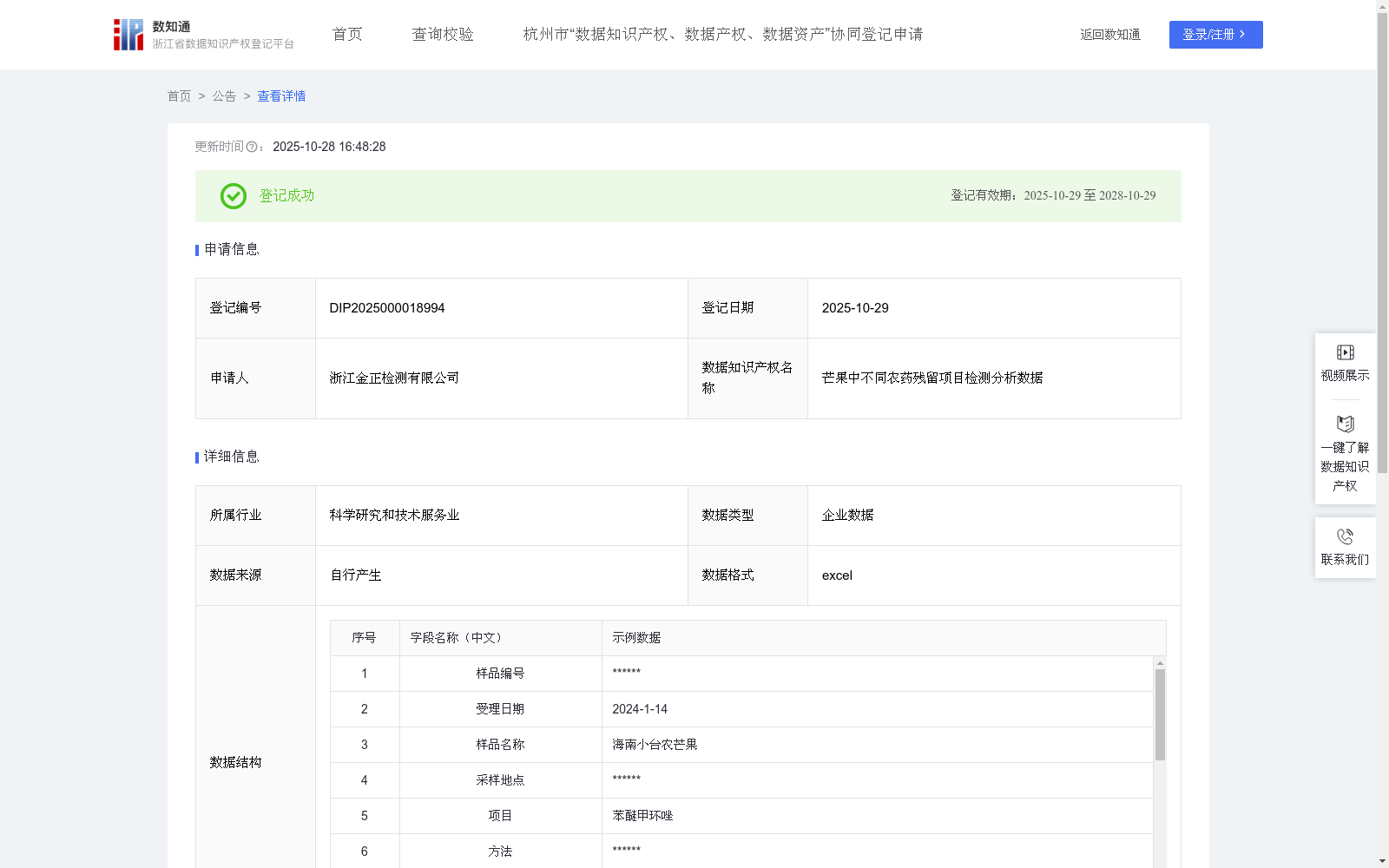
芒果中不同农药残留项目检测分析数据
收藏资源简介:
芒果广受消费者喜欢,并且以凉拌果蔬、果茶饮料等多种形式走入消费者视野中,然而芒果生长过程中经常被使用较多农药化肥来保护其生长,这些化学物质会残留在芒果皮和果肉中,极大地影响了芒果的质量和安全。此外,芒果本身是一种特别难清洗的水果,所以即使农民使用了一定量的农药和化肥,也很难完全去除果皮和果肉中的残留物质。因此通过对芒果中不同农药残留项目的检测分析,明确不同农残项目风险等级,能让种植业更好评估农药使用安全范围,同时也为监管单位进行农残监管提供数据支持,更好保障消费者的健康和安全。1、数据采集:根据要求采集芒果样品进行样品制备,一个样品编号对应一个批次样品,依据检测方法进行不同农药残留项目的定量分析,获得检测结果值。2、数据处理:通过定量分析获得结果值,依据GB 2763设定标准值,当结果值≤标准值时,判定合格,否则判定不合格;该项目检测不合格数A为该项目判定不合格的总批次数,该项目检出数B为结果值不为“未检出”的有值批次数之和。该项目检测合格率a =(该项目检测批次数N-该项目检测不合格数A)/该项目检测批次数N*100%;该项目检出率b =该项目检出数B/该项目检测批次数N*100%。当b为0.00%时,项目风险评价为S;当0.00%<b≤30%且a≥95%时,项目风险评价为LR;当0.00%<b≤30%且85%<a<95%时,评价为MR;当0.00%<b≤30%且a≤85%时,评价为HR;当b>30%时,评价为AHR。3、数据应用:对芒果中多种农药残留项目检测数据进行分析,可以了解芒果中不同农药残留情况,通过项目风险评价能了解易超标易检出的风险项目,从而加强对芒果中农药使用情况的关注,为生产单位合理使用农药具有参考意义,也为监管单位进行芒果中农残监测提供数据支持。
Mangoes are widely favored by consumers, and they have entered consumers' daily lives in various forms such as cold mixed fruit and vegetable dishes and fruit tea beverages. However, a large amount of pesticides and fertilizers are often used to protect mangoes during their growth, and these chemical residues will remain in the mango peel and pulp, greatly compromising the quality and safety of mangoes. Additionally, mango is a particularly difficult-to-clean fruit, so even if farmers apply a certain amount of pesticides and fertilizers, it is challenging to completely eliminate the residual substances in the peel and pulp. Therefore, conducting detection and analysis of different pesticide residue items in mangoes and clarifying the risk levels of these items can help the planting industry better evaluate the safe range of pesticide use, and also provide data support for regulatory authorities to carry out pesticide residue supervision, thereby better protecting consumers' health and safety. 1. Data Collection: Collect mango samples and prepare them as required. Each sample number corresponds to one batch of samples. Quantitative analysis of different pesticide residue items is performed in accordance with standard detection methods to obtain the detection result values. 2. Data Processing: Derive result values via quantitative analysis, and set the standard limits in accordance with GB 2763. A sample is judged as qualified if the result value is less than or equal to the standard limit, otherwise it is deemed unqualified. Let A denote the total number of unqualified batches for a given pesticide residue item, and B denote the sum of batches with result values other than "not detected" for the same item. The qualified rate a of the item is calculated as: $a = (N - A)/N imes 100\%$, where $N$ is the total number of test batches for the item. The detection rate $b$ of the item is calculated as: $b = B/N imes 100\%$. The risk assessment for the item is conducted as follows: - Rated S when $b = 0.00\%$; - Rated LR when $0.00\% < b leq 30\%$ and $a geq 95\%$; - Rated MR when $0.00\% < b leq 30\%$ and $85\% < a < 95\%$; - Rated HR when $0.00\% < b leq 30\%$ and $a leq 85\%$; - Rated AHR when $b > 30\%$. 3. Data Application: Analyze the detection data of multiple pesticide residue items in mangoes to gain insights into the status of different pesticide residues in mangoes. Through project risk assessment, high-risk items that are prone to exceeding standard limits and being detected can be identified, which helps strengthen the supervision of pesticide use in mango production. This work provides reference for production units to rationally apply pesticides, and also offers data support for regulatory authorities to carry out pesticide residue monitoring in mangoes.