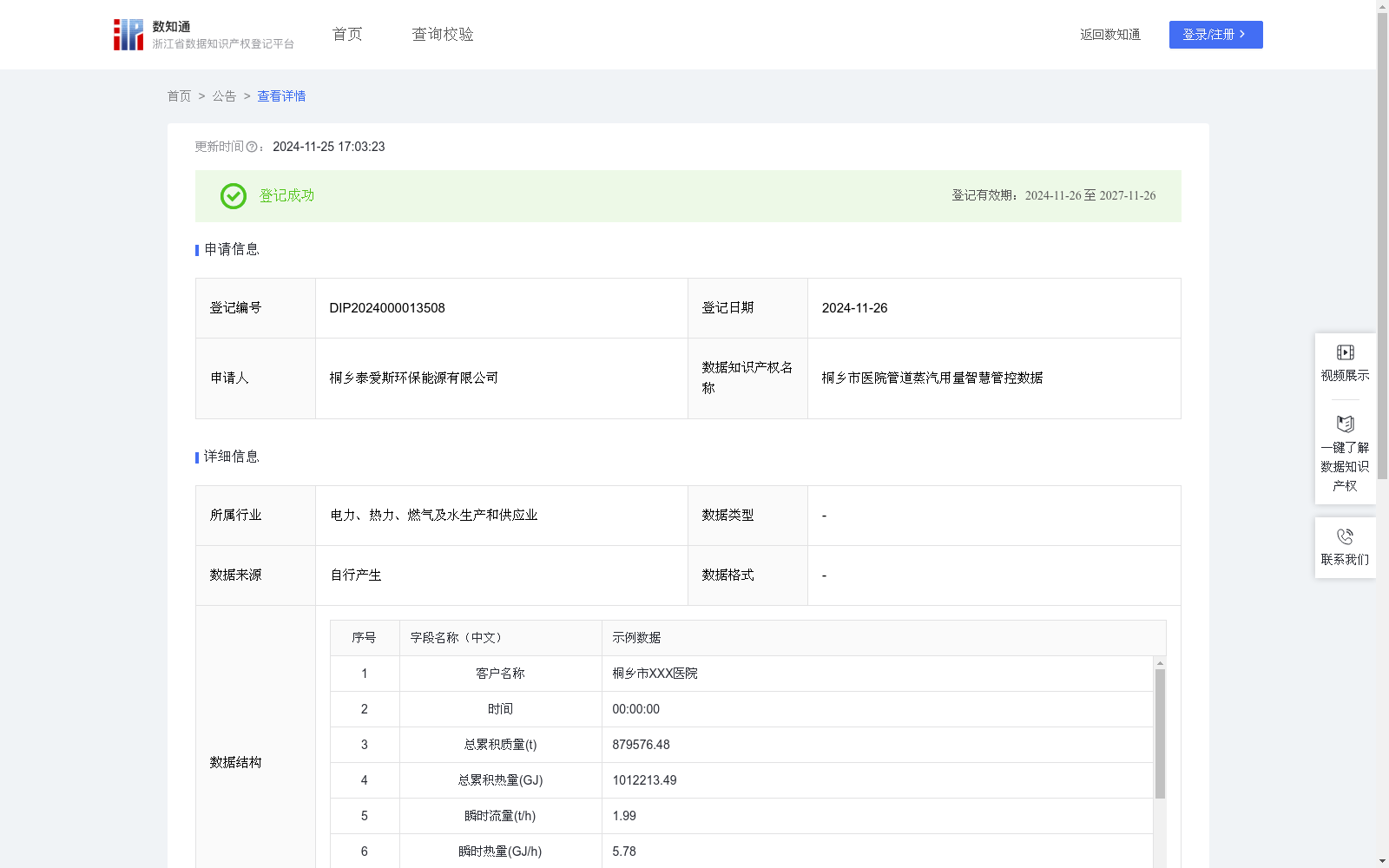
桐乡市医院管道蒸汽用量智慧管控数据
收藏资源简介:
通过收集和分析医院管道蒸汽用量的时间、总累积质量、总累积热量、瞬时流量、瞬时热量、瞬时温度、瞬时压力、密度、输入电流等相关数据,了解医院对用热量的需求,以及对医院用热量影响分析,能够更准确地预测医院未来的用热量,以便更好地进行能源管理和成本控制,利于医院自我管控。医院管理者可以直观地看到蒸汽用量的高峰和低谷时期,从而合理调整能源采购计划。医院管道蒸汽用量智慧管控数据可以为医院的资源分配提供参考。医院管理者可以合理安排资金用于设备更新和维护,也使得社会医疗资源得到更合理的利用,提高了医疗资源的投入产出比,促进智慧医疗行业的发展。选用卷积神经网络模型进行构建。步骤1:数据进行收集处理,整理为一个形状为(n_samples, 9)的numpy数组,管道蒸汽用量的时间、总累积质量、总累积热量、瞬时流量、瞬时热量、瞬时温度、瞬时压力、密度、输入电流分别为9个特征,再进行标准化处理,使得每个特征的均值为0,标准差为1。步骤2:利用python创建模型,添加一维卷积层、最大池化层,添加第二个卷积层、最大池化层,将卷积层的输出展平,添加全连接层,最后添加输出层,模型核心为使用一维卷积层来提取特征,然后通过最大池化层降低特征维度,将卷积层的输出展平后连接全连接层,最后输出一个预测值。步骤3:对模型进行编译,划分训练集、验证集和测试集,最后对输入数据进行形状调整,以适应卷积层的输入要求,再训练该模型。步骤4:测试和评估模型性能,绘制训练和验证损失曲线,观察训练过程,防止过拟合。步骤5:卷积神经网络模型输出预测蒸汽流量值和最高临界值为16.4t/h,当预测蒸汽流量值>16.4t/h,管道状态显示“管道异常”,当0≤预测蒸汽流量值≤16.4t/h,显示“管道正常”。
By collecting and analyzing relevant data of hospital pipeline steam usage, including time, total cumulative mass, total cumulative heat, instantaneous flow rate, instantaneous heat, instantaneous temperature, instantaneous pressure, density, and input current, this dataset aims to understand hospitals' heat demand and conduct impact analysis on hospital heat usage, thereby enabling more accurate prediction of future hospital heat consumption for better energy management and cost control, and facilitating hospital self-management. Hospital managers can intuitively observe the peak and trough periods of steam usage to reasonably adjust energy procurement plans. The smart management and control data of hospital pipeline steam usage can also provide references for hospital resource allocation. Managers can reasonably arrange funds for equipment renewal and maintenance, promote more rational utilization of social medical resources, improve the input-output ratio of medical resources, and facilitate the development of the smart healthcare industry. A convolutional neural network (CNN) is selected for model construction. The specific steps are as follows: Step 1: Collect and process the data, organize it into a numpy array with a shape of (n_samples, 9), where the 9 features correspond to the aforementioned 9 indicators (time, total cumulative mass, total cumulative heat, instantaneous flow rate, instantaneous heat, instantaneous temperature, instantaneous pressure, density, and input current). Then perform standardization processing to make the mean of each feature 0 and the standard deviation 1. Step 2: Create the model using Python, add the first 1D convolutional layer and max pooling layer, followed by the second 1D convolutional layer and max pooling layer, flatten the output of the convolutional layers, add a fully connected layer, and finally add an output layer. The core of the model is to use 1D convolutional layers to extract features, reduce feature dimensions via max pooling layers, flatten the output of the convolutional layers, connect to the fully connected layer, and finally output a predicted value. Step 3: Compile the model, split the dataset into training, validation and test sets, adjust the shape of the input data to meet the input requirements of the convolutional layers, and then train the model. Step 4: Test and evaluate the model performance, plot the training and validation loss curves, observe the training process to prevent overfitting. Step 5: The CNN model outputs the predicted steam flow value, with a maximum critical value of 16.4 t/h. When the predicted steam flow value exceeds 16.4 t/h, the pipeline status will display "Pipeline Abnormal"; when 0 ≤ predicted steam flow value ≤ 16.4 t/h, the status will display "Pipeline Normal".