
Cell-free DNA comprises an in vivo, genome-wide nucleosome footprint that informs its tissue(s)-of-origin
收藏DataCite Commons2020-10-10 更新2025-04-09 收录
下载链接:
https://db.cngb.org/search/project/PRJNA291063/
下载链接
链接失效反馈官方服务:
资源简介:
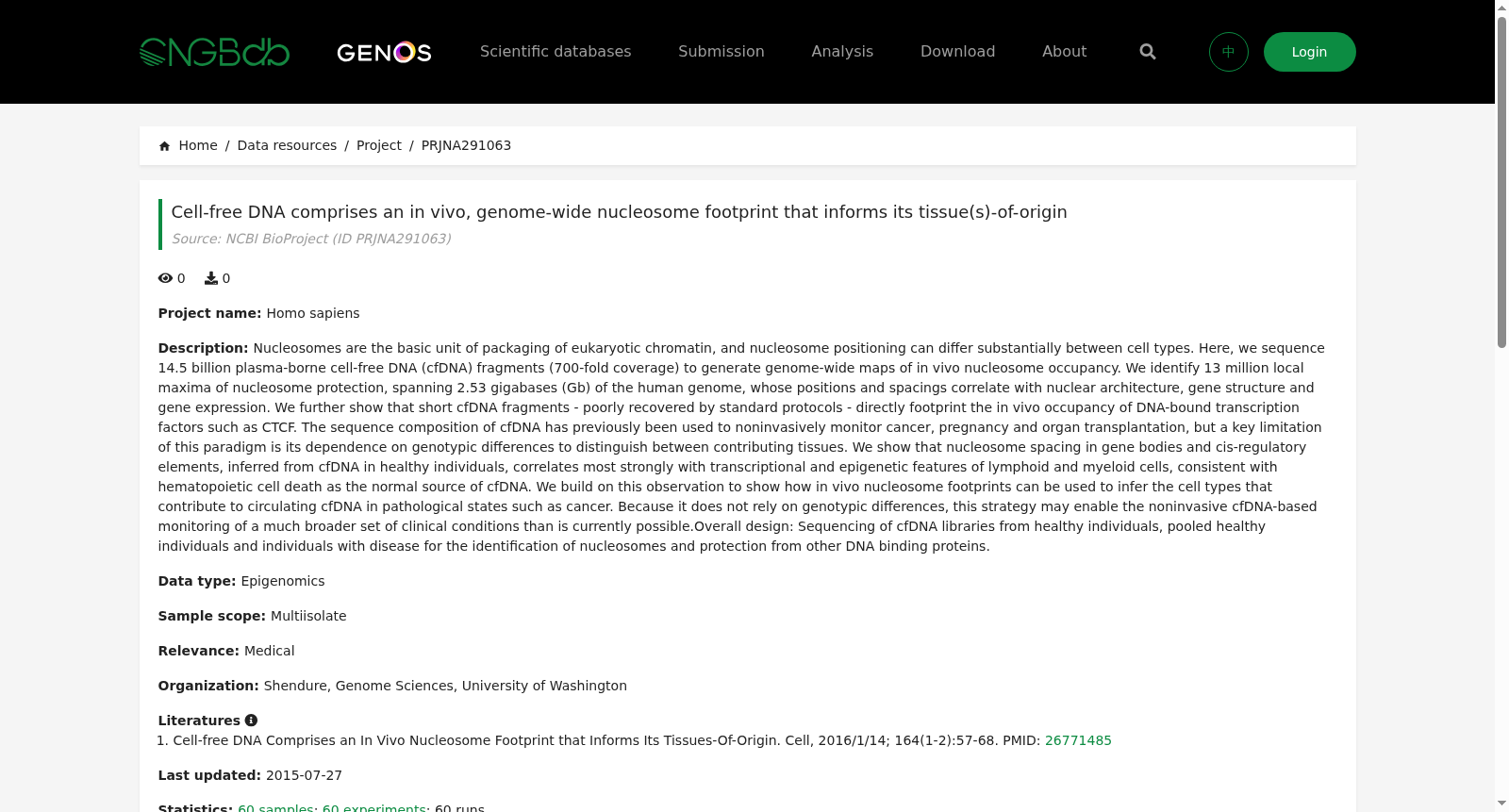
Nucleosomes are the basic unit of packaging of eukaryotic chromatin, and nucleosome positioning can differ substantially between cell types. Here, we sequence 14.5 billion plasma-borne cell-free DNA (cfDNA) fragments (700-fold coverage) to generate genome-wide maps of in vivo nucleosome occupancy. We identify 13 million local maxima of nucleosome protection, spanning 2.53 gigabases (Gb) of the human genome, whose positions and spacings correlate with nuclear architecture, gene structure and gene expression. We further show that short cfDNA fragments - poorly recovered by standard protocols - directly footprint the in vivo occupancy of DNA-bound transcription factors such as CTCF. The sequence composition of cfDNA has previously been used to noninvasively monitor cancer, pregnancy and organ transplantation, but a key limitation of this paradigm is its dependence on genotypic differences to distinguish between contributing tissues. We show that nucleosome spacing in gene bodies and cis-regulatory elements, inferred from cfDNA in healthy individuals, correlates most strongly with transcriptional and epigenetic features of lymphoid and myeloid cells, consistent with hematopoietic cell death as the normal source of cfDNA. We build on this observation to show how in vivo nucleosome footprints can be used to infer the cell types that contribute to circulating cfDNA in pathological states such as cancer. Because it does not rely on genotypic differences, this strategy may enable the noninvasive cfDNA-based monitoring of a much broader set of clinical conditions than is currently possible. Overall design: Sequencing of cfDNA libraries from healthy individuals, pooled healthy individuals and individuals with disease for the identification of nucleosomes and protection from other DNA binding proteins.
核小体(Nucleosomes)是真核染色质包装的基本单元,且不同细胞类型间的核小体定位差异显著。本研究对145亿份血浆游离DNA(cell-free DNA, cfDNA)片段进行测序(覆盖度达700倍),构建了全基因组范围的活体内核小体占据图谱。我们共鉴定出1300万个核小体保护位点的局部峰值,覆盖人类基因组2.53吉碱基(gigabases, Gb),其位置与间距与细胞核架构、基因结构及基因表达水平密切相关。
我们进一步证实,标准实验方案难以高效回收的短片段cfDNA可直接反映DNA结合转录因子(如CTCF)的活体内占据状态。此前,cfDNA的序列组成已被用于无创监测癌症、妊娠及器官移植,但该方法的关键局限在于依赖基因型差异以区分不同来源的组织。
我们发现,从健康个体cfDNA中推断出的基因体及顺式调控元件区域的核小体间距,与淋巴样及髓样细胞的转录组和表观组特征相关性最强,这与cfDNA的正常来源为造血细胞死亡的结论相符。基于这一发现,我们展示了活体内核小体足迹如何被用于推断癌症等病理状态下循环cfDNA的细胞来源组成。由于该策略不依赖基因型差异,其可实现基于cfDNA的无创临床监测,覆盖范围远超当前现有技术。
整体实验设计:对健康个体、混合健康个体及疾病患者的cfDNA文库进行测序,以鉴定核小体及其他DNA结合蛋白的保护位点。
提供机构:
CNGB创建时间:
2018-10-20
搜集汇总
数据集介绍
背景与挑战
背景概述
该数据集基于高通量测序技术(Illumina HiSeq 2000),对健康个体和疾病个体的细胞游离DNA(cfDNA)进行深度测序,以研究体内核小体足迹和DNA结合蛋白的保护作用。其关键特点在于利用cfDNA的核小体定位信息推断组织来源,为无创临床监测(如癌症和器官移植)提供了新策略,属于表观基因组学领域,具有医学应用价值。
以上内容由遇见数据集搜集并总结生成

暂无相关数据集


