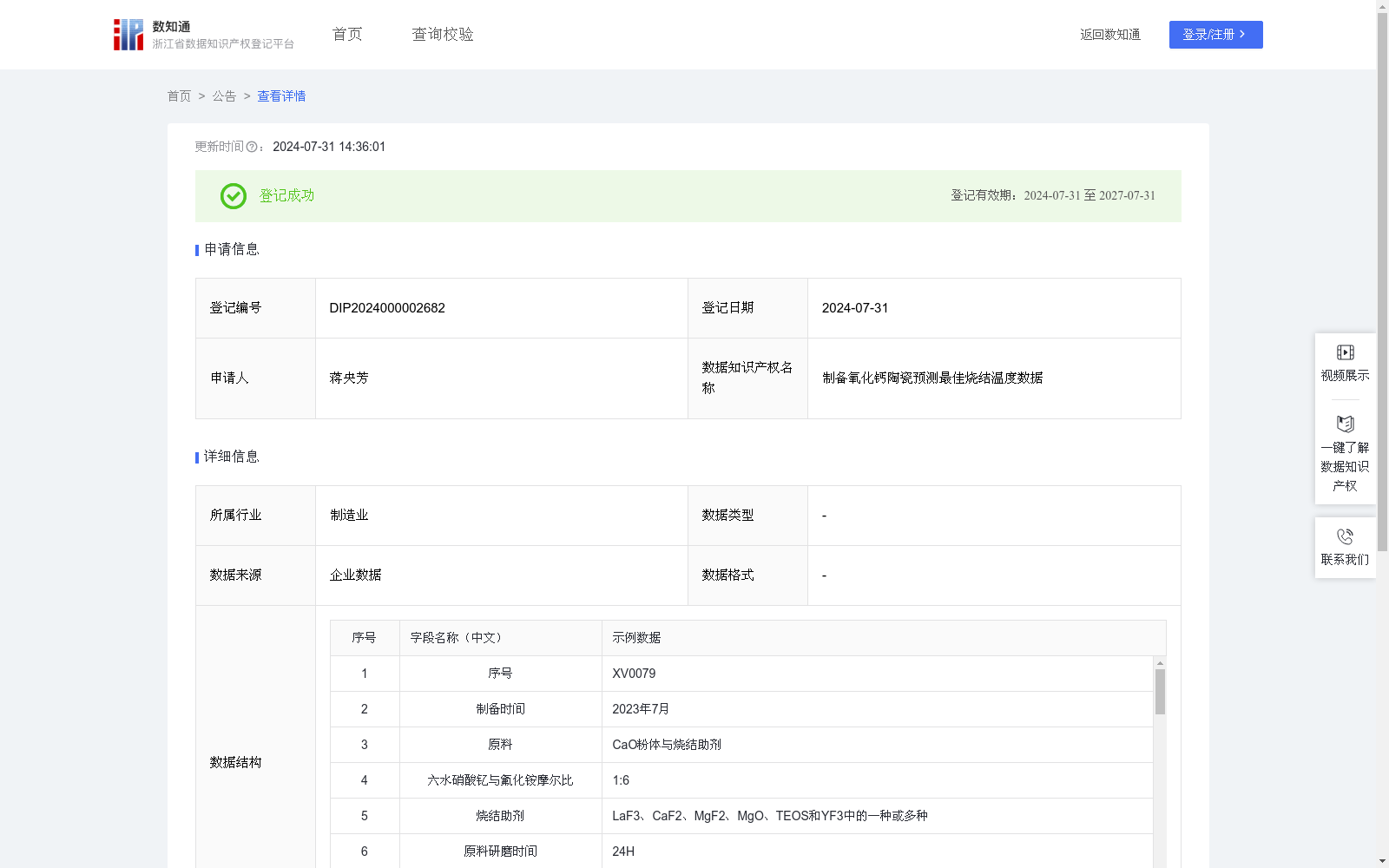
制备氧化钙陶瓷预测最佳烧结温度数据
收藏资源简介:
将采集到的数据使用一元线性回归模型用来预测制备陶瓷过程中的最佳烧结温度。该模型在泥浆比重、泥浆水分、稠化性、回坯泥比重、釉浆细度等数据为固定量条件下,通过该预测模型来预测最佳坯体收缩率时的烧结温度,从而能够为制备陶瓷预测出最佳的烧结温度,为广大的陶瓷生产企业提高了产品质量和生产效率提供技术支持。将采集到的数据使用一元线性回归模型用来预测制备陶瓷的最佳烧结温度。该模型在泥浆比重、泥浆水分、稠化性、回坯泥比重、釉浆细度等数据为固定量条件下,烧结温度与坯体收缩率构成一元函数关系(y(坯体收缩率)=F(烧结温度)),通过该函数公式来反推根据因变量变化的变化,在最佳坯体收缩率时根据极大似然法取概率分布最大的烧结温度的取值,从而能够为制备陶瓷出最佳的烧结温度。
The collected data are utilized with a simple linear regression model to predict the optimal sintering temperature during ceramic preparation. Under the condition that parameters including slurry specific gravity, slurry moisture content, thickening property, specific gravity of returned green body clay, and fineness of glaze slurry are fixed, this prediction model is employed to forecast the sintering temperature corresponding to the optimal green body shrinkage rate, thereby enabling the determination of the optimal sintering temperature for ceramic preparation and providing technical support for ceramic production enterprises to enhance product quality and production efficiency. Additionally, the collected data can also be applied with the same simple linear regression model for predicting the optimal sintering temperature of ceramic preparation. Under the fixed aforementioned parameter conditions, a univariate functional relationship is established between sintering temperature and green body shrinkage rate, expressed as y (green body shrinkage rate) = F (sintering temperature). Through this functional formula, reverse inference is performed based on the variation of the dependent variable; specifically, the sintering temperature value corresponding to the maximum probability distribution is selected via maximum likelihood estimation when the green body shrinkage rate reaches its optimal level, thus obtaining the optimal sintering temperature for ceramic preparation.