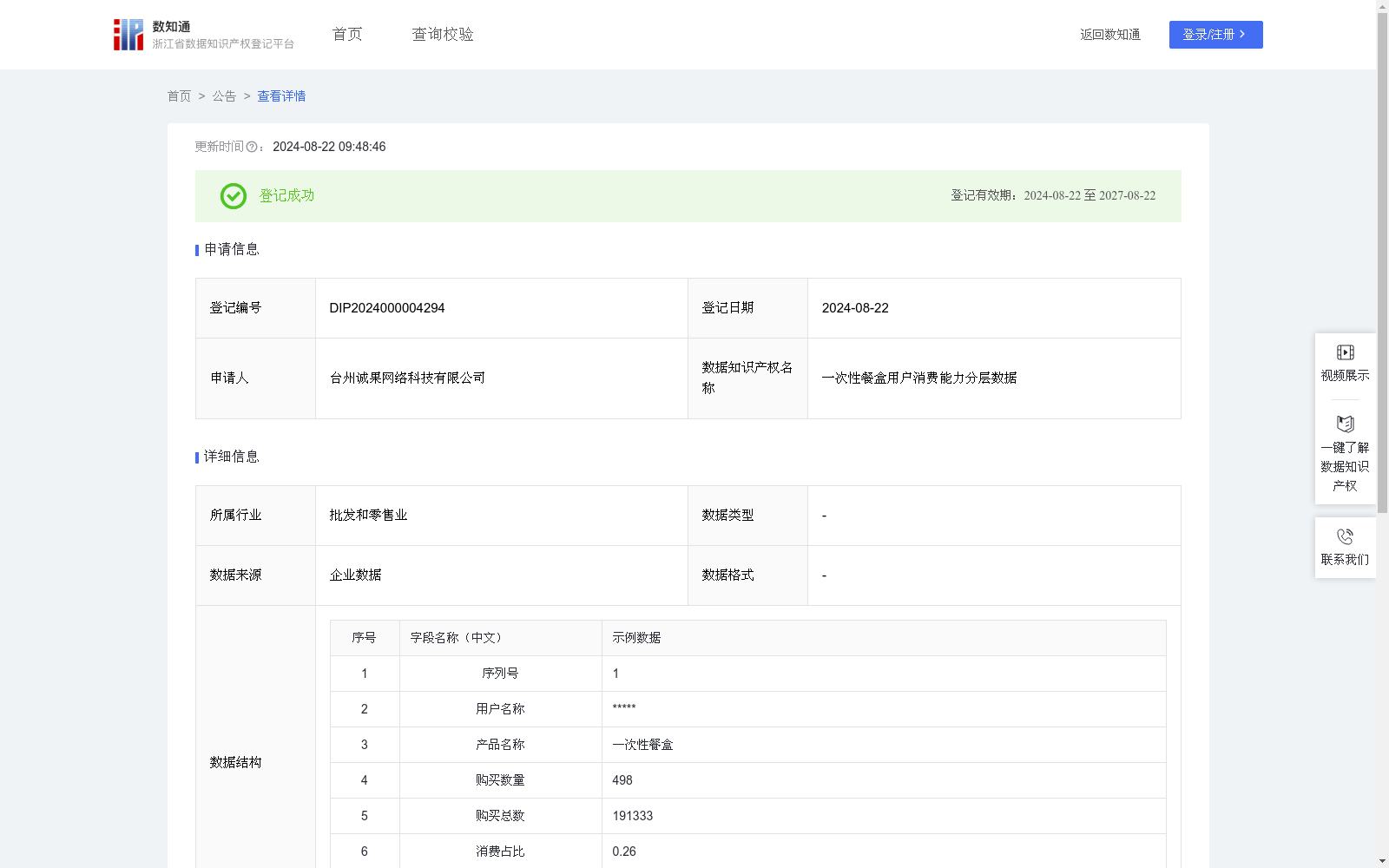
一次性餐盒用户消费能力分层数据
收藏资源简介:
一次性快餐盒已由泡沫饭盒转向环保饭盒,原来的泡沫饭盒由于不耐高温,且制作过程对环境造成破坏被淘汰,取而待之的有塑料饭盒,纸制饭盒,木制饭盒,降解饭盒等等。其中,塑料具有毒性较低、熔点较高、可塑性强、生产简便及相对成本较低等特点,因而成了制造一次性快餐盒的主流材料。统计分析一次性餐盒的消费数据,通过对历史下单用户建立表格,对用户进行标签制定,定位用户消费级别,为企业在全国各地设立产品周转仓对一次性餐盒的购买量和使用量,制定广告营销策略提供数据支持。1. 数据采集:采集一次性餐盒在各个维修店消费等信息; 2. 用户购买一次性餐盒数量占总消费一次性餐盒数量的比例=用户购买一次性餐盒数量/总消费一次性餐盒数量*100%; 3. 用户消费占总消费的比例按从大到小进行排名;消费分类运用ABCDEF分类法,对占比0.26%以上的,给予“A类消费”分层;占比0.21%到0.25%区间的,则给予“B类消费”分层;占比在0.16%到0.20%区间,则给予“C类消费”分层;占比在0.11%到0.15%区间,则给予“D类消费”分层;占比在0.06%到0.1%区间,则给予“E类消费”分层;占比在0.05%以下,则给予“F类消费”分层; 4. 数据应用: 一次性餐盒的购买力结果可以作为一次性餐盒消费等级评价依据,为监管部门向监管提供技术支撑。
Disposable food containers have evolved from styrofoam food containers to environmentally friendly alternatives. Original styrofoam food containers were phased out due to their heat intolerance and environmental damage caused during the manufacturing process, and have been replaced by plastic, paper, wooden, biodegradable food containers and other types. Among these materials, plastic has become the dominant material for manufacturing disposable food containers thanks to its relatively low toxicity, high melting point, good plasticity, simple production process and relatively low cost. This dataset conducts statistical analysis on the consumption data of disposable food containers: by creating tables for historical ordering users, developing user tags and classifying their consumption tiers, it provides data support for enterprises to formulate advertising and marketing strategies when establishing product distribution warehouses across the country, based on the purchase and usage volumes of disposable food containers. 1. Data Collection: Collect consumption information of disposable food containers at various repair shops and other related scenarios; 2. Proportion Calculation: The proportion of a user's purchased disposable food containers in the total consumption volume is calculated as: (User's purchased disposable food containers / Total consumption volume of disposable food containers) × 100%; 3. Ranking and Classification: Rank users in descending order of their consumption proportion in the total consumption. The consumption classification adopts the ABCDEF classification method for stratification: users with a proportion over 0.26% are classified as "Class A Consumers"; those with a proportion between 0.21% and 0.25% are "Class B Consumers"; those with a proportion between 0.16% and 0.20% are "Class C Consumers"; those with a proportion between 0.11% and 0.15% are "Class D Consumers"; those with a proportion between 0.06% and 0.10% are "Class E Consumers"; and those with a proportion below 0.05% are "Class F Consumers"; 4. Data Application: The purchasing power results of disposable food containers can serve as the basis for evaluating the consumption tiers of disposable food containers, providing technical support for regulatory authorities to carry out their supervision work.