
yanwang0129/aav2_capsid_viability
收藏资源简介:
--- tags: - biology - protein-sequence - aav - regression pretty_name: "AAV2 Capsid Viability Dataset" size_categories: - 100K<n<1M # 289,736 variants source_datasets: - custom # Derived from Bryant et al. 2021, Nature Biotechnology (https://www.nature.com/articles/s41587-020-00793-4) # Dataset Configurations (assuming one file 'aav2_viability_processed.csv' loaded as 'train') configs: - config_name: default data_files: - split: train # Single file defaults to 'train' split path: aav2_processed.csv # Optional but recommended: Dataset structure information # You can often auto-generate this using: datasets-cli dummy-metadata --repo_id your_username/your_dataset_name dataset_info: features: - name: variable_region_sequence dtype: string - name: source_partition dtype: string - name: viral_selection dtype: float32 # Or float64 if that's the precision used - name: vp1_sequence dtype: string - name: vp2_sequence dtype: string - name: vp3_sequence dtype: string - name: edit_distance_from_wt dtype: int32 config_name: default splits: - name: train num_bytes: 568803013 # <-- FILL IN: Get size of your CSV file in bytes num_examples: 289805 download_size: 568579900 # <-- FILL IN: Size of file(s) to download (usually same as dataset_size for single CSV) dataset_size: 568803013 # <-- FILL IN: Total size on disk (usually same as num_bytes for single CSV) --- # AAV2 Capsid Viability Dataset This dataset contains a preprocessed version of the Adeno-associated virus 2 (AAV2) capsid viability dataset from [Bryant et al. 2021](https://www.nature.com/articles/s41587-020-00793-4), including the full VP1, VP2, and VP3 sequences for each variant. 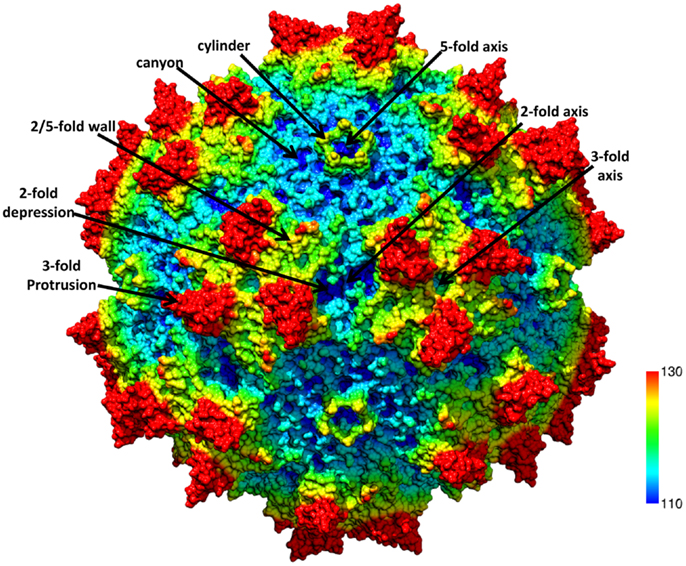 ## Description This processed version of the dataset contains 289,805 variants with the following columns: - `variable_region_sequence` (str): The unique amino acid sequence of the variable region for each AAV2 variant - `source_partition` (str): Metadata field indicating the source partition aka method used to generate the variant in the original paper. - `viral_selection` (float): The viral selection of the variant. See [Viral Selection Values](#viral-selection-values) for more details. - `vp1_sequence` (str): The VP1 sequence of the variant. - `vp2_sequence` (str): The VP2 sequence of the variant. - `vp3_sequence` (str): The VP3 sequence of the variant. - `edit_distance_from_wt` (int): The edit distance from the wild type variable region sequence. ### Preprocessing - We removed 57 variants because they contained a premature stop codon (denoted as "*") in the variable region. - We also removed all instances of variants that had a duplicate sequence in the dataset as in all of these cases multiple viral_selection values were present. This resulted in the removal of 7,108 variants. ### Viral Selection Values The experiments conducted in the paper aimed to generate diverse AAV2 capsid variants far beyond natural diversity while maintaining viability, using machine learning guidance. Viability was assessed using a high-throughput assay measuring the ability of each variant sequence to assemble an integral capsid that packages the viral genome. For each variant, the fitness or 'viral selection' was calculated as the log of the ratio of the variant's read counts in the output 'viral library' pool to the read counts in the input 'DNA library' pool: $$ \text{Viral Selection for Variant i} = log(\frac{n_{i,viral}}{n_{i,DNA}}) $$   ### VP1, VP2, and VP3 sequences [The AAV2 capsid is a 60-unit multimer made up of a 5:5:50 ratio of three viral proteins: VP1, VP2, and VP3. Through alternative splicing and leaky ribosomal scanning, the same mRNA (mRNA9) can give rise to VP2 and VP3, depending on which start codon is used. VP1 is translated from a distinct transcript initiated by the P5 promoter.](https://viralzone.expasy.org/226). We have provided the full VP1, VP2, and VP3 sequences for each variant in the `vp1_sequence`, `vp2_sequence`, and `vp3_sequence` columns respectively. To recreate the full VP1, VP2, and VP3 sequences for each variant, we collected the following wildtype source sequences: - VP1 Source Sequence: [YP_680426.1](https://www.ncbi.nlm.nih.gov/protein/YP_680426.1?report=fasta) - VP2 Source Sequence: [YP_680427.1](https://www.ncbi.nlm.nih.gov/protein/YP_680427.1?report=fasta) - VP3 Source Sequence: [YP_680428.1](https://www.ncbi.nlm.nih.gov/protein/YP_680428.1?report=fasta) We then replaced the wildtype variable region (`DEEEIRTTNPVATEQYGSVSTNLQRGNR`) in each of these source sequences with the corresponding `variable_region_sequence` for each variant. ## Source Data The sequences in this dataset are sourced from the publication *"Deep diversification of an AAV capsid protein by machine learning"* [(Bryant et al. 2021)](https://www.nature.com/articles/s41587-020-00793-4), which contains 293,574 experimentally characterized variants of a wild-type AAV2 capsid protein sequence. The mutations introduced to create the variants focused on a 28-amino acid segment (residue positions 561-588 of the full VP1 AAV2 capsid protein sequence) which were targeted due to this region being involved in a variety of structural and functional roles. ### Original Dataset Availability GitHub containing the original dataset: [https://github.com/alibashir/aav](https://github.com/alibashir/aav) Source Publication: [Bryant et al. 2021](https://www.nature.com/articles/s41587-020-00793-4) # Citation If you use this dataset in your research, please cite the original publication these variants are sourced from: ```bibtex @article{bryant2021deep, title={"Deep diversification of an AAV capsid protein by machine learning"}, author={Bryant, Drew H and Bashir, Ali and Sinai, Sam and Jain, Nina K and Ogden, Pierce J and Riley, Patrick F and Church, George M and Colwell, Lucy J and Kelsic, Eric D}, journal={Nature Biotechnology}, volume={39}, number={6}, pages={691--696}, year={2021}, publisher={Springer Science and Business Media LLC}, doi={10.1038/s41587-020-00793-4} } ```
标签: - 生物学 - 蛋白质序列 - AAV - 回归任务 展示名称:"AAV2衣壳活力数据集" size_categories: - 100K<n<1M # 289,736个变体 source_datasets: - 自定义 # 源自Bryant等人2021年发表于《自然·生物技术》的研究(https://www.nature.com/articles/s41587-020-00793-4) # 数据集配置(假定单文件`aav2_viability_processed.csv`作为训练集加载) configs: - config_name: default data_files: - split: train # 单文件默认分配至`train`划分 path: aav2_processed.csv # 可选但推荐提供:数据集结构信息 # 您通常可通过以下命令自动生成:datasets-cli dummy-metadata --repo_id your_username/your_dataset_name dataset_info: features: - 字段名:variable_region_sequence 数据类型:字符串 - 字段名:source_partition 数据类型:字符串 - 字段名:viral_selection 数据类型:float32 # 若使用更高精度则为float64 - 字段名:vp1_sequence 数据类型:字符串 - 字段名:vp2_sequence 数据类型:字符串 - 字段名:vp3_sequence 数据类型:字符串 - 字段名:edit_distance_from_wt 数据类型:int32 config_name: default splits: - 划分名称:train 字节大小:568803013 # <-- 请填入:您的CSV文件的字节大小 样本数量:289805 download_size: 568579900 # <-- 请填入:待下载文件的总大小(单CSV文件通常与数据集大小一致) dataset_size: 568803013 # <-- 请填入:磁盘上的总占用大小(单CSV文件通常与num_bytes一致) # AAV2衣壳活力数据集 本数据集为源自[Bryant等人2021](https://www.nature.com/articles/s41587-020-00793-4)的腺相关病毒2型(AAV2)衣壳活力数据集的预处理版本,包含所有变体的完整VP1、VP2及VP3序列。  ## 数据集说明 本预处理版本的数据集包含289,805个变体,具备以下列字段: - `variable_region_sequence`(字符串):每个AAV2变体的可变区独特氨基酸序列 - `source_partition`(字符串):元数据字段,用于指示原始研究中生成该变体所使用的源分区(即生成方法) - `viral_selection`(浮点型):该变体的病毒选择得分,详见[病毒选择得分说明](#病毒选择得分说明) - `vp1_sequence`(字符串):该变体的VP1序列 - `vp2_sequence`(字符串):该变体的VP2序列 - `vp3_sequence`(字符串):该变体的VP3序列 - `edit_distance_from_wt`(整型):该变体可变区序列与野生型的编辑距离 ### 预处理流程 - 我们移除了57个在可变区中包含提前终止密码子(以"*"标记)的变体。 - 我们同时移除了数据集中所有序列重复的变体,此类变体均存在多个病毒选择得分值,此次操作共移除7,108个变体。 ### 病毒选择得分说明 该原始论文中的实验旨在借助机器学习指导,生成远超自然多样性的多样化AAV2衣壳变体,同时保留其活力。活力通过高通量实验评估,即检测每个变体序列组装完整衣壳并包装病毒基因组的能力。对于每个变体,其适合度或“病毒选择得分”通过变体在输出“病毒文库”池中的读段数与输入“DNA文库”池中的读段数之比的对数计算得到: $$ \text{变体i的病毒选择得分} = log(\frac{n_{i,viral}}{n_{i,DNA}}) $$   ### VP1、VP2及VP3序列 [AAV2衣壳为由VP1、VP2、VP3三种病毒蛋白以5:5:50的比例组成的60亚基多聚体。通过可变剪接和渗漏核糖体扫描,同一mRNA(mRNA9)可根据起始密码子的不同翻译产生VP2和VP3;而VP1则由P5启动子启动的独立转录本翻译而来。](https://viralzone.expasy.org/226) 我们已在`vp1_sequence`、`vp2_sequence`及`vp3_sequence`列中分别提供每个变体的完整VP1、VP2及VP3序列。 为重构每个变体的完整VP1、VP2及VP3序列,我们收集了以下野生型参考序列: - VP1参考序列:[YP_680426.1](https://www.ncbi.nlm.nih.gov/protein/YP_680426.1?report=fasta) - VP2参考序列:[YP_680427.1](https://www.ncbi.nlm.nih.gov/protein/YP_680427.1?report=fasta) - VP3参考序列:[YP_680428.1](https://www.ncbi.nlm.nih.gov/protein/YP_680428.1?report=fasta) 随后我们将每个参考序列中的野生型可变区(`DEEEIRTTNPVATEQYGSVSTNLQRGNR`)替换为对应变体的`variable_region_sequence`。 ## 源数据 本数据集的序列源自论文《通过机器学习实现AAV衣壳蛋白的深度多样化》[(Bryant等人2021)](https://www.nature.com/articles/s41587-020-00793-4),该论文包含293,574个经实验表征的野生型AAV2衣壳蛋白变体。引入的突变集中于28个氨基酸的区段(完整VP1 AAV2衣壳蛋白序列的第561至588位残基),该区段因参与多种结构与功能过程而被选为靶向区域。 ### 原始数据集获取 包含原始数据集的GitHub仓库:[https://github.com/alibashir/aav](https://github.com/alibashir/aav) 源论文:[Bryant等人2021](https://www.nature.com/articles/s41587-020-00793-4) ## 引用说明 若您在研究中使用本数据集,请引用该变体的原始来源论文: bibtex @article{bryant2021deep, title={"Deep diversification of an AAV capsid protein by machine learning"}, author={Bryant, Drew H and Bashir, Ali and Sinai, Sam and Jain, Nina K and Ogden, Pierce J and Riley, Patrick F and Church, George M and Colwell, Lucy J and Kelsic, Eric D}, journal={Nature Biotechnology}, volume={39}, number={6}, pages={691--696}, year={2021}, publisher={Springer Science and Business Media LLC}, doi={10.1038/s41587-020-00793-4} }


