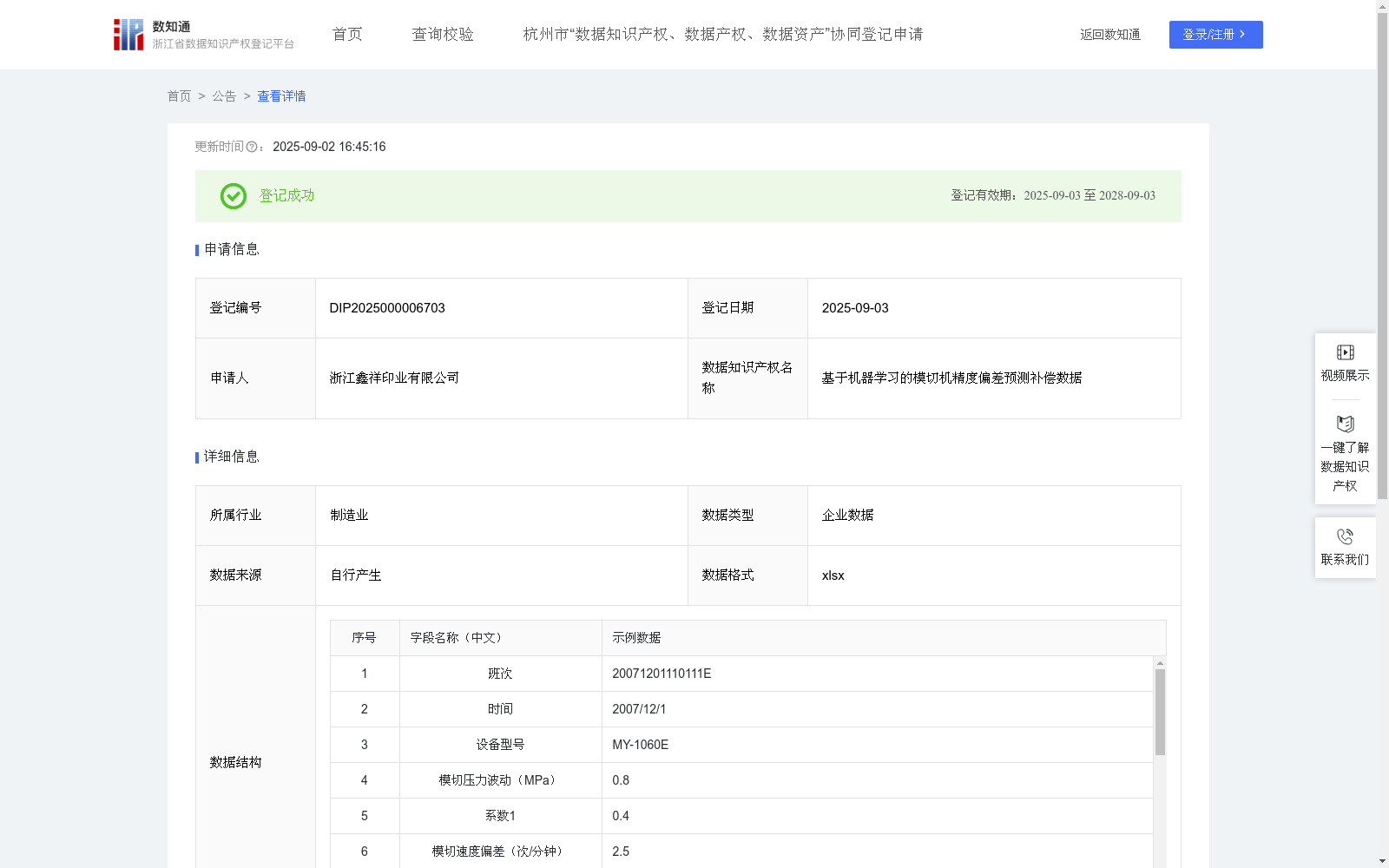
基于机器学习的模切机精度偏差预测补偿数据
收藏资源简介:
模切机精度偏差是指在模切加工过程中,因机械传动误差、材料弹性形变、模具磨损或环境温湿度变化等因素,导致实际切割位置与预设轮廓发生偏移的现象。本数据具有以下应用场景:在企业内部,本行业所有企业可基于模切压力波动、速度偏差、材料厚度误差等参数,通过机器学习模型精准预测偏差趋势,并动态计算补偿量,实现设备参数的闭环优化。还可以根据残余偏差(|预测值-补偿量|)划分设备状态,避免过度补偿或补偿不足,减少材料浪费和设备异常磨损。在企业外部,算法模型可迁移至激光切割、冲压成型等依赖高精度裁切的行业(如汽车零部件、柔性电路板制造),帮助中小企业实现智能化升级。还可以向材料供应商共享裁切精度数据,推动基材厚度均匀性、硬度稳定性等性能改进,促进产业链技术协同。1、数据收集:数据采集来源于伺服电机编码器、压力传感器、激光测厚仪和生产日志,每日实时采集模切机模切压力波动、模切速度偏差和材料厚度误差等运行参数,对模切机设备采集到的数据进行降噪、清洗、加工后进行处理。 2、数据处理:、偏差预测公式:偏差预测值=模切压力波动*系数1+模切速度偏差*系数2+材料厚度误差*系数3+偏置项,3个系数值需通过机器学习训练确定,总和为1。补偿量=偏差预测值*比例系数+偏差变化率*动态响应系数,基于补偿后的残余偏差为偏差预测值与补偿量差值的绝对值。3、残余偏差越小,表明设备越健康。残余偏差大于等于1μm,这代表了设备补偿失效,应立即停机检修;补偿量小于等于0.3μm,这代表了设备补偿完全覆盖偏差,应维持当前补偿参数;补偿量在0.3μm至1μm范围内,这代表了设备补偿不足或过冲,应微调比例系数和动态响应系数。
Die-cutting machine precision deviation refers to the phenomenon where the actual cutting position deviates from the predetermined contour during die-cutting processing, caused by factors such as mechanical transmission errors, material elastic deformation, mold wear, and changes in ambient temperature and humidity. This dataset has the following application scenarios: Internally within enterprises: All enterprises in this industry can use machine learning models to accurately predict deviation trends and dynamically calculate compensation amounts based on parameters such as die-cutting pressure fluctuation, speed deviation, and material thickness error, so as to realize closed-loop optimization of equipment parameters. They can also divide equipment status according to residual deviation (|predicted value - compensation amount|), avoid over-compensation or under-compensation, and reduce material waste and abnormal equipment wear. Externally: The algorithm model can be migrated to industries relying on high-precision cutting such as laser cutting and stamping forming (e.g., auto parts manufacturing, flexible circuit board manufacturing), helping small and medium-sized enterprises (SMEs) achieve intelligent upgrading. Additionally, cutting precision data can be shared with material suppliers to promote improvements in base material performance such as thickness uniformity and hardness stability, and facilitate technical collaboration across the industrial chain. 1. Data Collection: Data is collected from servo motor encoders, pressure sensors, laser thickness gauges, and production logs. Operating parameters including die-cutting pressure fluctuation, die-cutting speed deviation, and material thickness error are collected in real time daily. The data collected by die-cutting machines is preprocessed via denoising, cleaning and data processing steps. 2. Data Processing: Deviation prediction formula: Deviation predicted value = die-cutting pressure fluctuation * coefficient 1 + die-cutting speed deviation * coefficient 2 + material thickness error * coefficient 3 + bias term. The three coefficients must be determined through machine learning training, with their total sum equal to 1. Compensation amount = deviation predicted value * proportional coefficient + deviation change rate * dynamic response coefficient. The residual deviation after compensation is the absolute value of the difference between the deviation predicted value and the compensation amount. The smaller the residual deviation, the healthier the equipment. When the residual deviation is ≥1μm, it indicates that the equipment compensation has failed and an immediate shutdown for maintenance is required. When the compensation amount is ≤0.3μm, it indicates that the equipment compensation fully covers the deviation, and the current compensation parameters should be maintained. When the compensation amount is between 0.3μm and 1μm, it indicates that the equipment has under-compensation or overshoot, and the proportional coefficient and dynamic response coefficient should be fine-tuned.