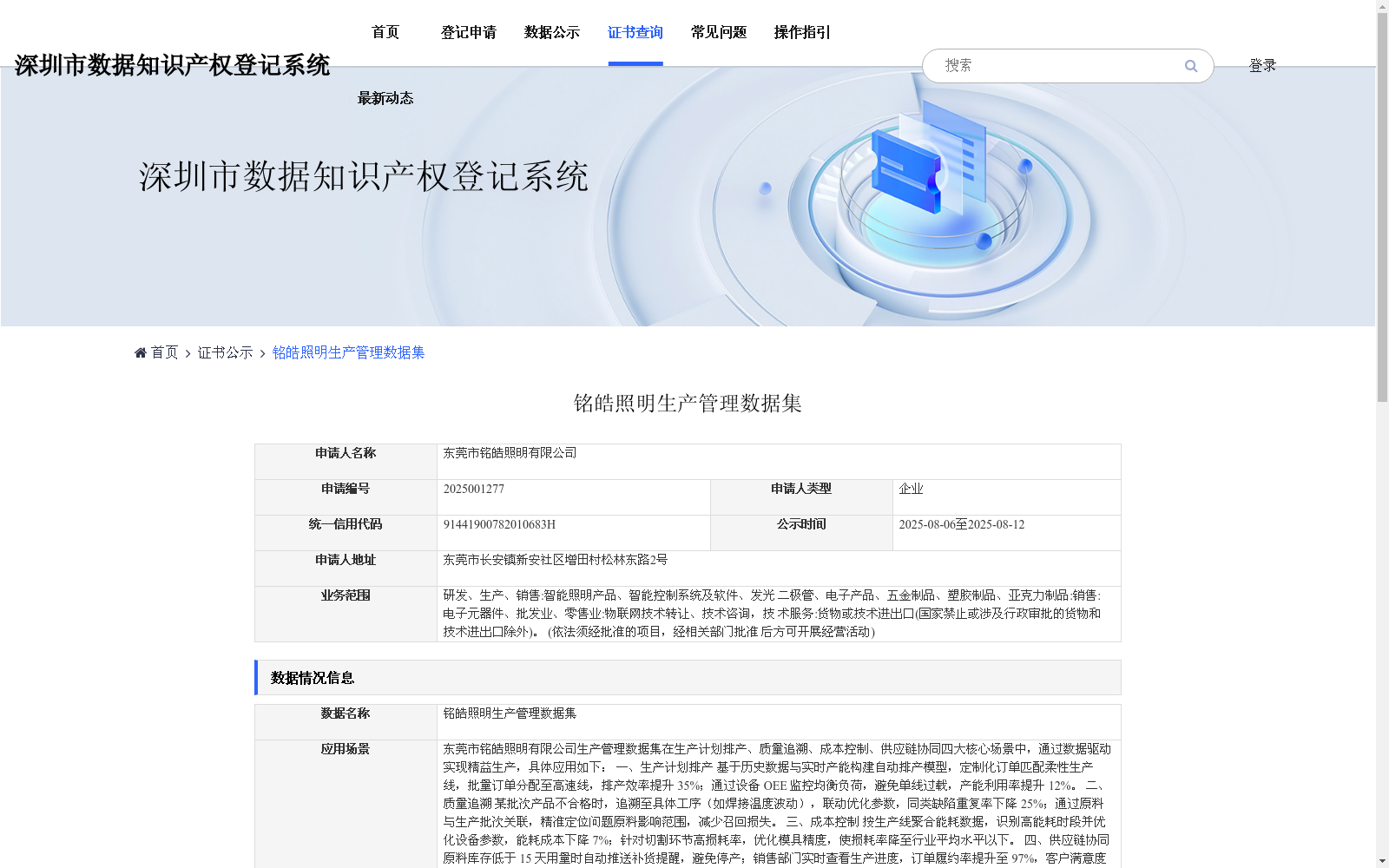
铭皓照明生产管理数据集
收藏资源简介:
东莞市铭皓照明有限公司生产管理数据集在生产计划排产、质量追溯、成本控制、供应链协同四大核心场景中,通过数据驱动实现精益生产,具体应用如下: 一、生产计划排产 基于历史数据与实时产能构建自动排产模型,定制化订单匹配柔性生产线,批量订单分配至高速线,排产效率提升 35%;通过设备 OEE 监控均衡负荷,避免单线过载,产能利用率提升 12%。 二、质量追溯 某批次产品不合格时,追溯至具体工序(如焊接温度波动),联动优化参数,同类缺陷重复率下降 25%;通过原料与生产批次关联,精准定位问题原料影响范围,减少召回损失。 三、成本控制 按生产线聚合能耗数据,识别高能耗时段并优化设备参数,能耗成本下降 7%;针对切割环节高损耗率,优化模具精度,使损耗率降至行业平均水平以下。 四、供应链协同 原料库存低于 15 天用量时自动推送补货提醒,避免停产;销售部门实时查看生产进度,订单履约率提升至 97%,客户满意度提升 20%。 五、跨场景协同 生产与仓储联动,优先使用近效期原料,损耗率降低 9%;仓储反馈的库存数据支撑排产调整,滞销成品减少 22%,实现全链路精益管理。
The Production Management Dataset of Dongguan Minghao Lighting Co., Ltd. achieves lean production via data-driven methods across four core scenarios: production planning and scheduling, quality traceability, cost control, and supply chain collaboration. Specific applications are as follows: 1. Production Planning and Scheduling: Construct an automatic scheduling model based on historical data and real-time production capacity, match customized orders with flexible production lines, and allocate bulk orders to high-speed production lines, resulting in a 35% improvement in scheduling efficiency. Monitor and balance production load through equipment OEE monitoring to avoid single-line overloading, leading to a 12% increase in production capacity utilization rate. 2. Quality Traceability: When a batch of products is found non-conforming, trace back to the specific production process (e.g., fluctuations in welding temperature) and link and optimize relevant parameters, reducing the repeat rate of similar defects by 25%. By associating raw materials with production batches, accurately locate the impact scope of problematic raw materials, thereby reducing recall losses. 3. Cost Control: Aggregate energy consumption data by production line, identify high-energy-consumption time periods and optimize equipment parameters, cutting energy consumption costs by 7%. For the high loss rate in the cutting process, optimize the precision of molds to bring the loss rate below the industry average. 4. Supply Chain Collaboration: Automatically send restocking reminders when the raw material inventory is lower than the 15-day usage volume to avoid production shutdowns. The sales department can view production progress in real time, increasing the order fulfillment rate to 97% and improving customer satisfaction by 20%. 5. Cross-scenario Collaboration: Link production and warehousing to give priority to using raw materials nearing their expiry dates, reducing the loss rate by 9%. Inventory data fed back by the warehouse supports scheduling adjustments, reducing unsold finished products by 22% and achieving full-link lean management.