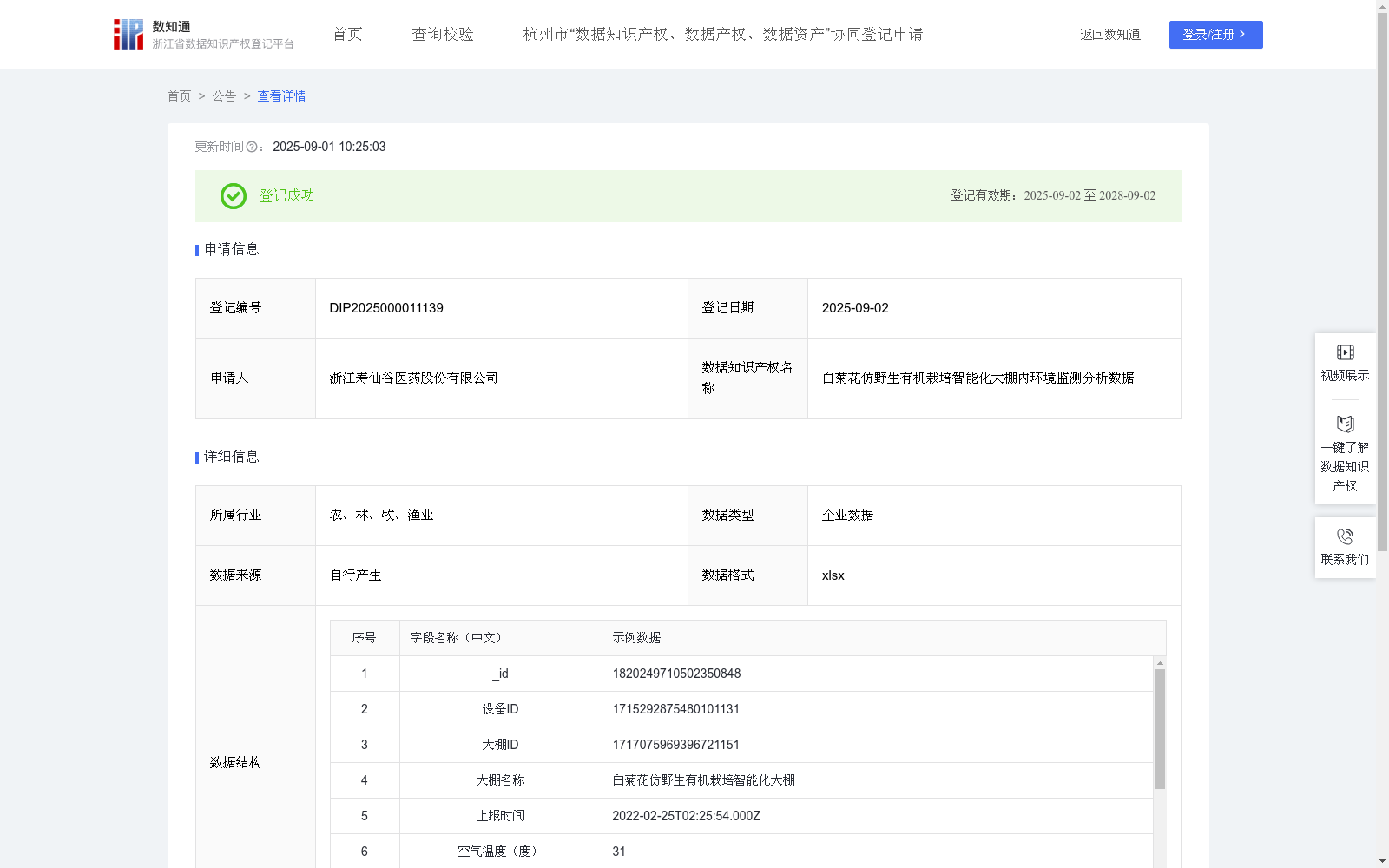
白菊花仿野生有机栽培智能化大棚内环境监测分析数据
收藏资源简介:
采集白菊花仿野生有机栽培智能化大棚内的空气环境参数:空气温度、空气湿度和土壤环境参数:土壤温度、土壤湿度,通过计算大棚内空气环境的热应力指数(HSI)和结露风险值(△T)进行温度管控,同时通过计算大棚内土壤的根系活力指数(RAI)和缺水预警值(WAI)进行土壤的管控,通过大数据进行智能控制大棚内环境,进而保证灵芝的种植效率和质量。热应力指数:HSI=空气温度+0.1空气湿度,档HSI大于32时触发降温系统; 结露风险值:△T=空气温度-0.2空气湿度,△T<5时有结露风险;当△T<5持续3小时,则触发灰霉病预警。 根系活力指数:RAI=(土壤温度/25)*(土壤湿度/30),0.9-1.1为根系活力最佳状态,当RAI<0.8持续24小时则触发“根腐病检测任务"; 缺水预警值:WAI=(土壤湿度-15)/20,WAI<0.6时开始灌溉,当WAI>0.8时停止灌溉。
This dataset collects air environmental parameters (air temperature, air humidity) and soil environmental parameters (soil temperature, soil humidity) in an intelligent greenhouse for simulated-wild organic cultivation of white chrysanthemums. Intelligent control of the greenhouse environment is implemented via big data, based on two sets of indicators: for air environment management, the thermal stress index (HSI) and condensation risk value (△T) are calculated; for soil management, the root activity index (RAI) and water shortage warning value (WAI) are calculated, so as to ensure the planting efficiency and quality of Ganoderma lucidum. Thermal Stress Index (HSI): HSI = air temperature + 0.1 × air humidity. The cooling system is triggered when HSI exceeds 32. Condensation Risk Value (△T): △T = air temperature - 0.2 × air humidity. Condensation risk occurs when △T < 5; if △T < 5 lasts for 3 consecutive hours, a gray mold warning is triggered. Root Activity Index (RAI): RAI = (soil temperature / 25) × (soil humidity / 30). The optimal range of root activity is 0.9–1.1. If RAI < 0.8 lasts for 24 consecutive hours, the "root rot detection task" is triggered. Water Shortage Warning Value (WAI): WAI = (soil humidity - 15) / 20. Irrigation starts when WAI < 0.6, and stops when WAI > 0.8.