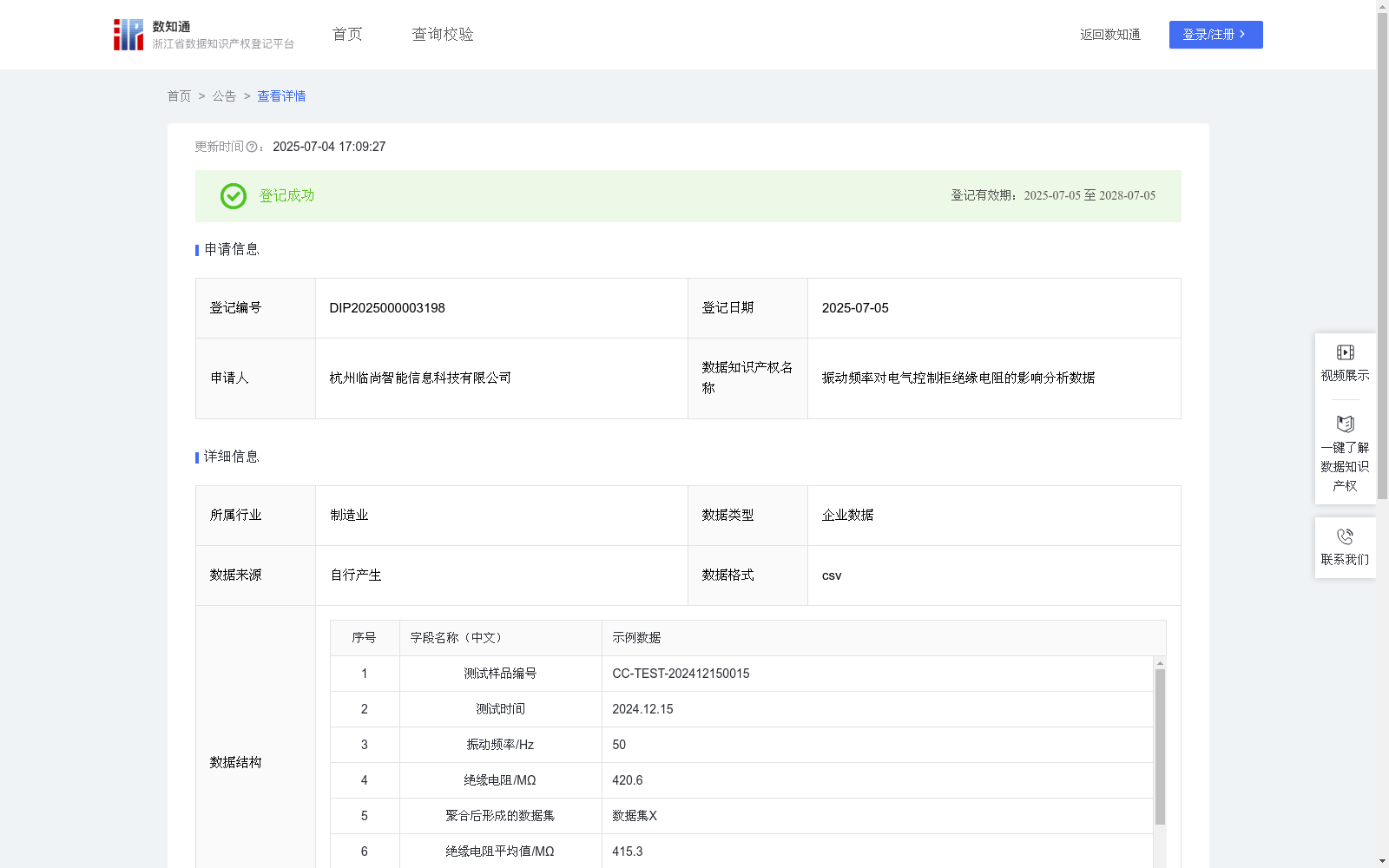
振动频率对电气控制柜绝缘电阻的影响分析数据
收藏资源简介:
本数据聚焦于分析振动频率对电气控制柜绝缘电阻的影响,为公司(作为电气设备制造商)及外部相关方提供了重要的决策依据,具有重要的应用价值。具体体现在以下方面: 1.提升设备抗振性能设计:公司可通过分析振动频率对绝缘电阻的影响,优化控制柜的减震结构(如采用阻尼材料、改进紧固件设计)、开发抗振型绝缘组件,并制定适用于高振动环境的产品可靠性标准,显著提高设备在机械振动工况下的长期运行稳定性。 2.推动行业技术进步:本数据可为轨道交通、船舶等振动敏感领域的电气设备研发提供实验支撑,促进抗振绝缘材料研究、振动疲劳寿命预测技术发展,并推动相关行业振动测试标准的完善与升级。1.数据采集: 实时记录不同振动频率条件下的电气控制柜绝缘电阻测试数据,包括测试样品编号、测试时间、振动频率/Hz、绝缘电阻/MΩ等字段。 2.数据预处理: (1) 对采集的数据进行去噪处理,确保数据准确性。 (2) 将历史采集的数据(包含本次采集)进行聚合,形成数据集X,并针对数据集X中的绝缘电阻字段,计算出其平均值。 3.计算线性回归斜率a和截距b: (1) 基于数据集X(以振动频率为自变量、绝缘电阻为因变量),运用SLOPE函数,基于最小二乘法原理确定斜率a,运用INTERCEPT函数确定截距b。 (2) 斜率a表示单位振动频率变化对绝缘电阻的影响程度,截距b表示基准振动频率下电气控制柜的绝缘电阻值。 4.结果运用: (1) 计算比例系数k:k=|a/绝缘电阻平均值|×100%。 (2) 若k≥15%,则判定为"高影响",若8%≤k<15%,则判定为"中影响",若k<8%,则判定为"低影响"。
This dataset focuses on analyzing the effect of vibration frequency on the insulation resistance of electrical control cabinets, providing critical decision-making support for the company (as an electrical equipment manufacturer) and external stakeholders, with substantial application value. Specifically reflected in the following aspects: 1. Optimizing anti-vibration design of equipment: The company can optimize the vibration-damping structure of control cabinets (e.g., adopting damping materials, improving fastener design), develop anti-vibration insulation components, and formulate product reliability standards applicable to high-vibration environments by analyzing the impact of vibration frequency on insulation resistance, thereby significantly improving the long-term operational stability of equipment under mechanical vibration operating conditions. 2. Promoting industrial technological progress: This dataset can provide experimental support for the R&D of electrical equipment in vibration-sensitive sectors such as rail transit and shipping, advancing research on anti-vibration insulation materials, the development of vibration fatigue life prediction technology, and the improvement and upgrading of vibration testing standards in relevant industries. 1. Data Collection: Real-time recording of insulation resistance test data for electrical control cabinets under varying vibration frequency conditions, including fields such as test sample ID, test timestamp, vibration frequency (unit: Hz), insulation resistance (unit: MΩ), etc. 2. Data Preprocessing: (1) Denoise the collected data to ensure data accuracy. (2) Aggregate all historically collected data (including this batch of collected data) to form dataset X, and calculate the average value of the insulation resistance field within dataset X. 3. Calculation of Linear Regression Slope a and Intercept b: (1) Based on dataset X, with vibration frequency as the independent variable and insulation resistance as the dependent variable, use the SLOPE function to determine slope a and the INTERCEPT function to determine intercept b, both based on the principle of least squares. (2) Slope a represents the degree of influence of a unit change in vibration frequency on insulation resistance, while intercept b represents the insulation resistance value of the electrical control cabinet under the reference vibration frequency. 4. Application of Results: (1) Calculate the proportional coefficient k: k = |a / average insulation resistance| × 100%. (2) Classify the impact level as "high impact" if k ≥ 15%, "medium impact" if 8% ≤ k < 15%, and "low impact" if k < 8%.