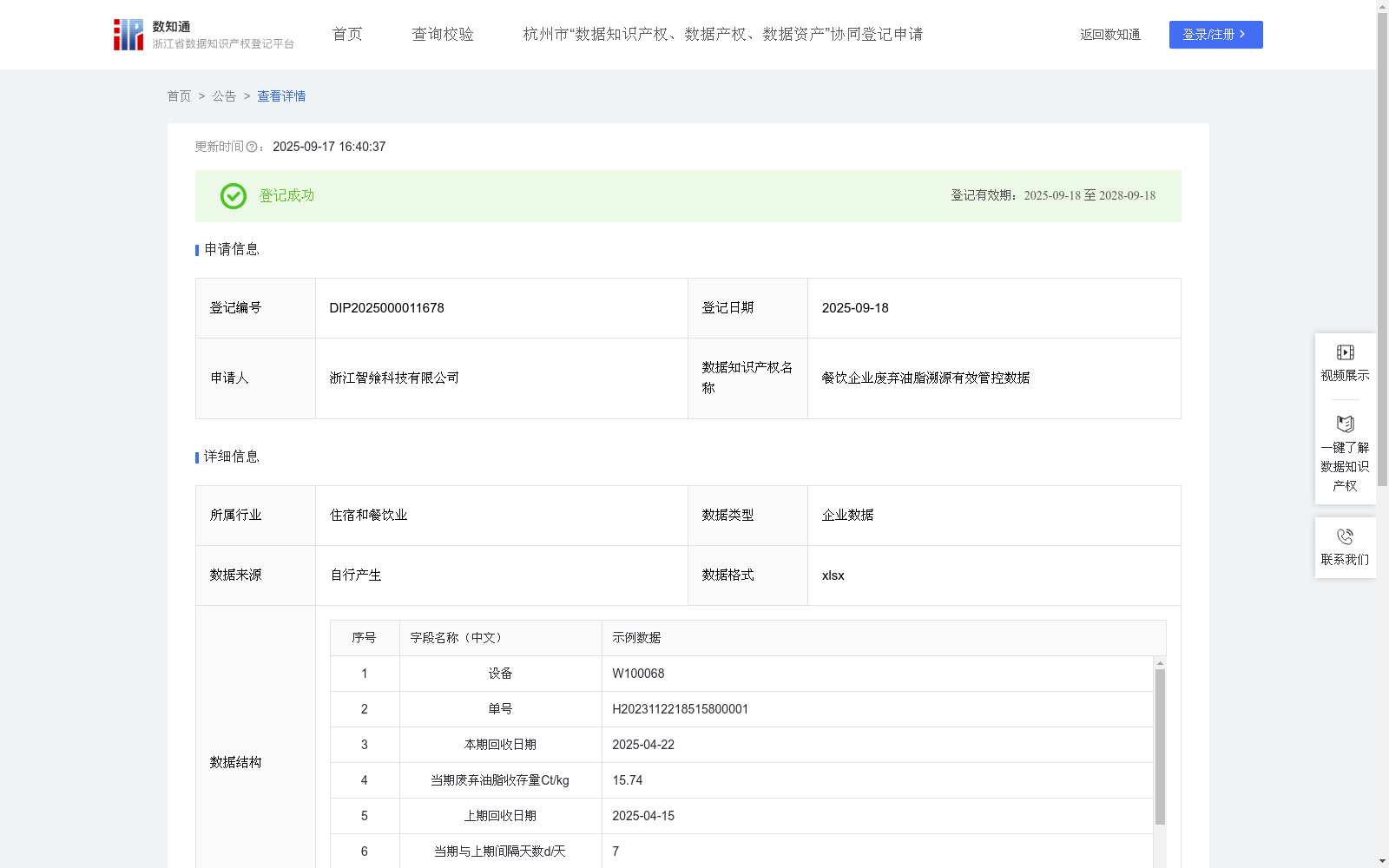
餐饮企业废弃油脂溯源有效管控数据
收藏资源简介:
餐饮企业废弃油脂溯源有效管控数据是一个创新的量化工具,可用于可服务于餐饮产业链各环节的精细化管理和创新发展。1.对餐饮企业而言,本数据可实时监控后厨用油-产废比,若废弃油脂量异常偏离菜品标准的理论值,则提示可能存在违规用油或废油非法回流风险,需立即启动食品安全自查。2.对监管部门而言,本数据构建的"用油-产废"动态模型可智能识别异常企业。当企业申报的采购量、废弃量与系统推算值偏差超过10%时,自动触发重点核查机制。3.对保险公司而言,本数据可构建餐饮企业用油安全风险评估模型。通过分析废弃油脂的产出规律、处置合规性等数据指标,保险公司能够精准评估投保企业的食品安全风险等级,开发差异化的保险产品。4.对环保设备厂商而言,本数据为其产品研发和市场拓展提供了重要参考。通过分析不同规模餐饮企业的废油产出特征,厂商可针对性开发智能收集设备。1.数据抽取和预处理:(1)在经原始数据授权的前提下,从本单位运营的“智慧绿色环境数字化产业管理平台”上获得由本单位研制的智能油水分离机采集的社会餐饮业的每期废弃油脂收存数据。(2)对抽取的数据进行清洗,去除重复、错误或无关的信息,以便后续的分析和建模。2.算法加工步骤: ①分步骤算法:计算当期与上期的间隔天数d;计算当期日均收存量At:当期日均收存量At=当期废弃油脂收存量Ct÷当期与上期间隔天数d;计算基准日均收存量Abase:基准日均收存量Abase=前三期废弃油脂收存总量(Ct-1+Ct-2+Ct-3)÷前三期总天数(dt-1+dt-2+dt-3);计算当期日均收存量偏离率Deviationt:当期日均收存量偏离率Deviationt=(当期日均收存量At-基准日均收存量Abase)÷基准日均收存量Abase×100%;根据当期日均收存量偏离率Deviationt的值判定当期收存状态Statet:①若当期日均收存量偏离率Deviationt≥10%或≤-10%,则判定为“异常”;②若当期日均收存量偏离率Deviationt<10%且>-10%则判定为“正常”。
The Valid Traceability and Control Data for Waste Oil of Catering Enterprises is an innovative quantitative tool that supports refined management and innovative development across all links of the catering industry chain. 1. For catering enterprises: This data can monitor the kitchen oil usage-to-waste generation ratio in real time. If the amount of waste oil abnormally deviates from the theoretical value corresponding to standard dishes, it will alert to potential risks of illegal oil use or illegal backflow of waste oil, requiring immediate initiation of food safety self-inspection. 2. For regulatory authorities: The dynamic "oil use-waste generation" model built with this data can intelligently identify abnormal enterprises. When the deviation between the purchase volume and waste volume declared by the enterprise and the system's calculated values exceeds 10%, the key verification mechanism will be automatically triggered. 3. For insurance companies: This data can be used to construct a food safety risk assessment model for catering enterprises. By analyzing data indicators such as the output pattern of waste oil and the compliance of disposal, insurance companies can accurately assess the food safety risk level of insured enterprises and develop differentiated insurance products. 4. For environmental protection equipment manufacturers: This data provides an important reference for their product R&D and market expansion. By analyzing the waste oil output characteristics of catering enterprises of different scales, manufacturers can develop targeted intelligent collection equipment. 1. Data extraction and preprocessing: (1) With the authorization of the original data, obtain the periodic waste oil storage data of the social catering industry collected by the intelligent oil-water separator developed by our unit from the "Smart Green Environmental Digital Industry Management Platform" operated by our unit. (2) Clean the extracted data to remove duplicate, erroneous or irrelevant information for subsequent analysis and modeling. 2. Algorithm processing steps: ① Step-by-step algorithm: Calculate the interval days d between the current period and the previous period; Calculate the average daily waste oil storage volume At of the current period: At = total current period waste oil storage volume Ct ÷ interval days d between the current period and the previous period; Calculate the benchmark average daily storage volume Abase: Abase = total waste oil storage volume of the previous three periods (Ct-1 + Ct-2 + Ct-3) ÷ total days of the previous three periods (dt-1 + dt-2 + dt-3); Calculate the deviation rate Deviationt of the current period's average daily storage volume: Deviationt = (At - Abase) ÷ Abase × 100%; Determine the current storage status Statet based on the value of Deviationt: ① If Deviationt ≥ 10% or ≤ -10%, the status is determined as "Abnormal"; ② If -10% < Deviationt < 10%, the status is determined as "Normal".