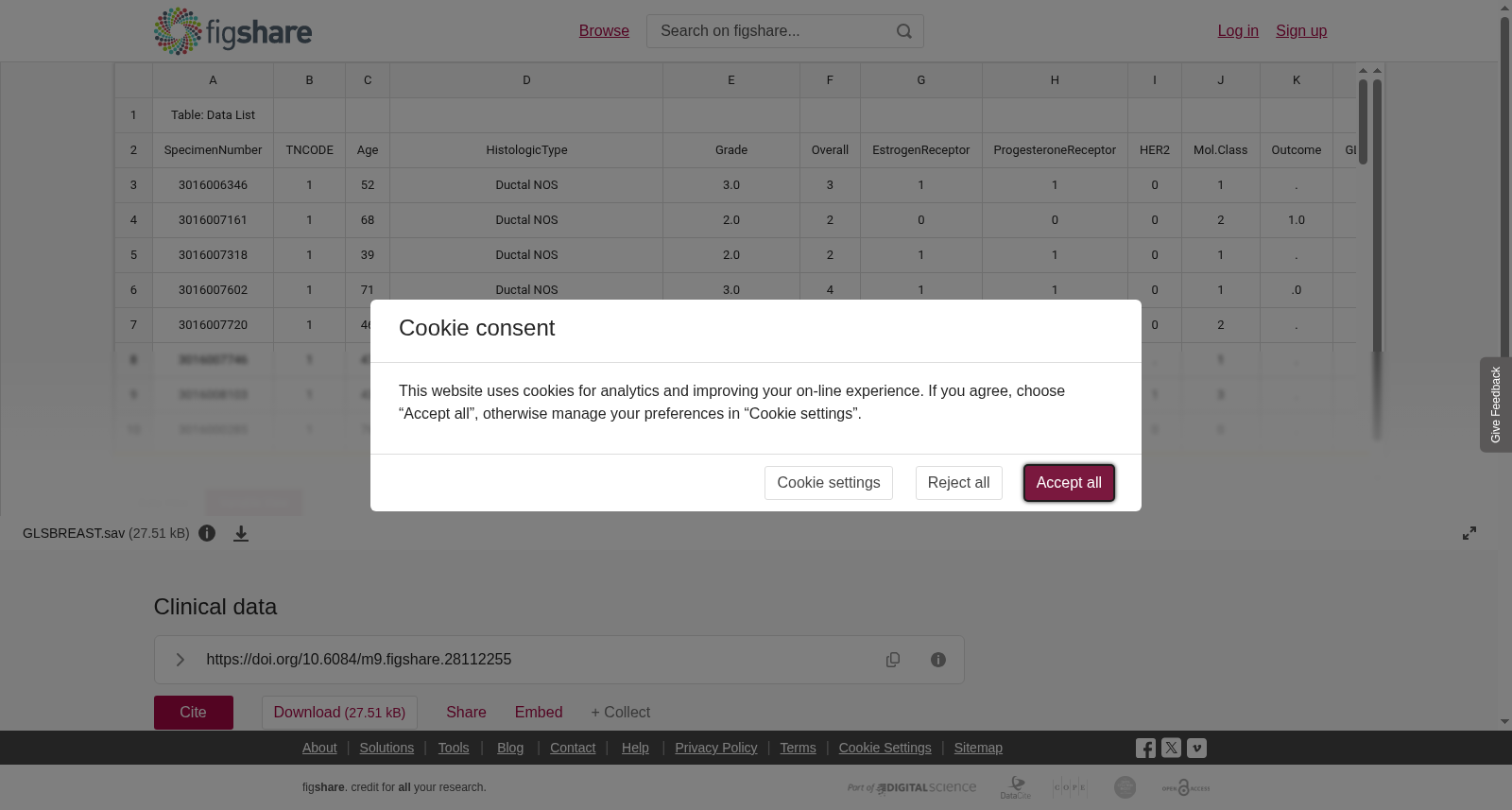
Clinical data
收藏资源简介:
Breast cancer remains the most common malignancy among women, with significant heterogeneity in molecular subtypes and clinical outcomes. This study examines the clinicopathological significance of GLUT-1, GLS1, and GLS2 expression in breast cancer tissues from Jordanian patients, focusing on their role in metabolic reprogramming and potential as therapeutic targets. Using tissue microarray analysis and immunohistochemistry, we evaluated 306 invasive breast cancer cases and 52 normal tissue samples. Overexpression of all three markers was observed in tumor tissues compared to normal samples (p ≤ 0.01). GLUT-1 and GLS2 showed significant associations with higher tumor grades and triple-negative breast cancer (TNBC) subtypes, highlighting their potential role in aggressive tumor biology. Conversely, GLS1 expression was consistently elevated in cancer tissues but did not vary significantly across grades or subtypes. Strong correlations between high GLUT-1/GLS2 expression and Ki-67 proliferative index underscore their contributions to tumor proliferation and metabolic adaptation. Population-specific patterns, such as the higher GLS2 expression in HER2-negative cases, reflect potential genetic or environmental influences unique to Jordanian patients. These findings emphasize the critical role of metabolic reprogramming in breast cancer progression and underscore the translational potential of targeting GLUT-1 and GLS2, particularly in aggressive subtypes like TNBC. Further research is warranted to explore functional mechanisms and validate these markers in diverse populations. This study provides novel insights into the metabolic dynamics of breast cancer, offering a foundation for regionally tailored therapeutic strategies.
乳腺癌仍是女性最常见的恶性肿瘤,其分子亚型与临床结局存在显著异质性。本研究探讨了约旦患者乳腺癌组织中葡萄糖转运蛋白1(GLUT-1)、谷氨酰胺酶1(GLS1)与谷氨酰胺酶2(GLS2)表达的临床病理意义,重点分析其在代谢重编程中的作用及作为治疗靶点的潜力。本研究采用组织微阵列分析与免疫组织化学法,对306例浸润性乳腺癌样本及52例正常组织样本进行了检测。相较于正常组织样本,三种标志物在肿瘤组织中均呈现过表达(P≤0.01)。GLUT-1与GLS2的高表达与更高肿瘤分级及三阴性乳腺癌(TNBC)亚型显著相关,提示二者在侵袭性肿瘤生物学行为中发挥潜在作用。与之相反,GLS1在癌组织中始终呈高表达,但在不同肿瘤分级或亚型间无显著差异。GLUT-1/GLS2的高表达与Ki-67增殖指数呈显著正相关,进一步证实二者对肿瘤增殖与代谢适应的促进作用。具有约旦人群特异性的表达模式,例如HER2阴性病例中GLS2的高表达,反映了约旦患者特有的遗传或环境因素影响。本研究结果证实了代谢重编程在乳腺癌进展中的关键作用,并凸显了靶向GLUT-1与GLS2的转化潜力,尤其是针对三阴性乳腺癌(TNBC)这类侵袭性亚型。未来需开展进一步研究以探索其功能机制,并在不同人群中验证这些标志物的临床价值。本研究为乳腺癌代谢动态特征提供了全新见解,可为定制化区域治疗策略提供理论基础。