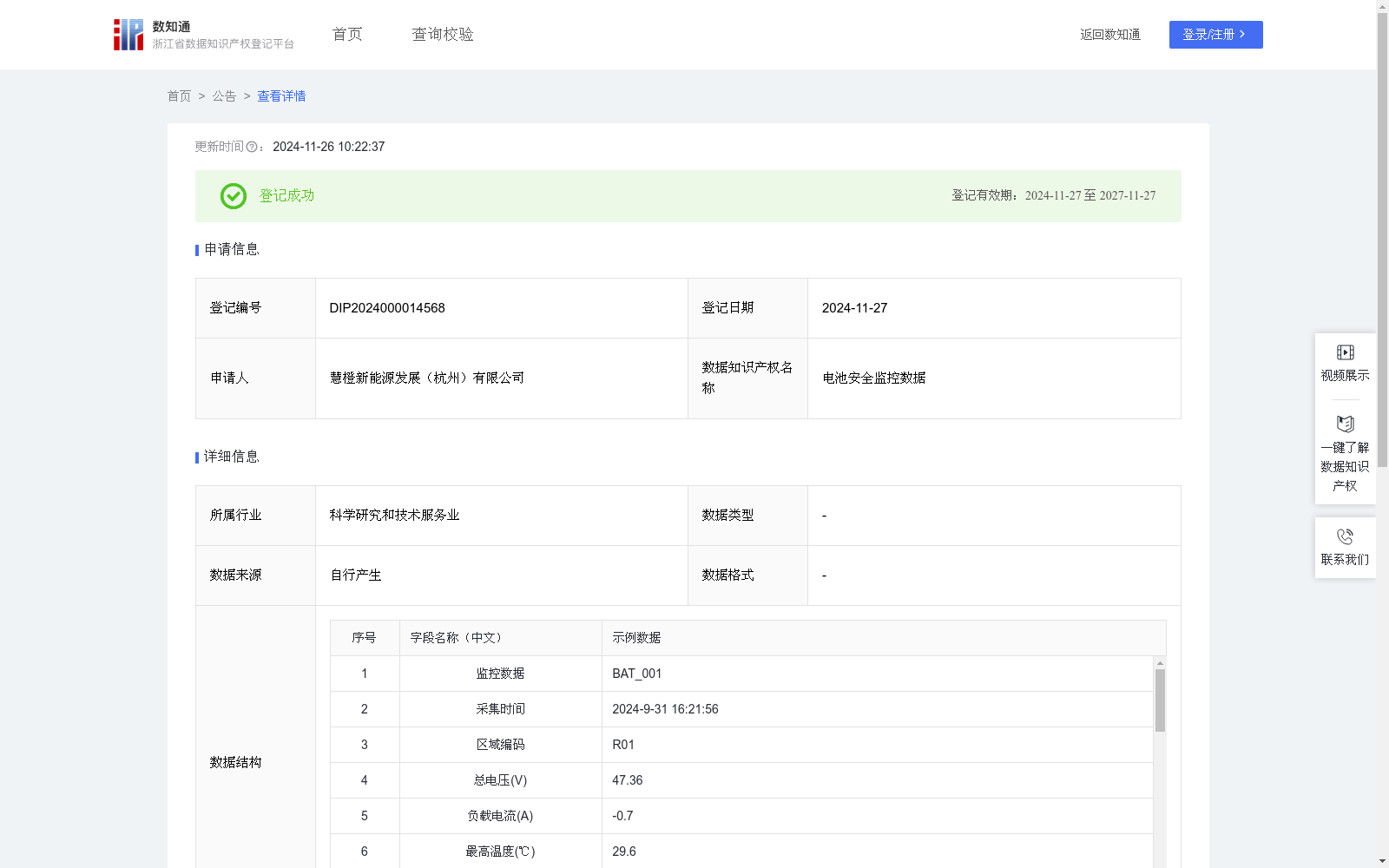
电池安全监控数据
收藏资源简介:
随着城市低碳出行需求的增长,低速电动车因其经济环保的特点得到广泛应用。作为低速电动车的核心动力来源,电池系统的安全监控直接关系到车辆使用安全和运行效率。通过建立多维度的电池安全监控数据体系,实时掌握各区域电池组的运行状态,有助于及时发现潜在风险,制定相应的维护策略,确保储能系统的安全稳定运行。 一、提升电池系统安全管理的精准性: 通过电池安全监控数据分析体系,可以对电池系统进行全方位评估。系统通过对电压、温度、电流等关键参数的实时监测,结合多层级阈值判定与加权分析方法,快速识别出正常运行和存在风险的电池组。对于运行正常的电池组,保持现有运维策略;对于出现警告或危险状态的电池组,及时调整运行参数,采取预防性维护措施,有效降低安全事故风险。 二、优化电池系统的预防性维护: 通过分析故障代码分布,可以精准识别各类故障的发生规律。当系统出现过压、欠压、温度异常等故障时,可以根据故障类型采取相应的维护策略,如调整充放电管理策略、优化温控系统参数、更新系统监控阈值等。这种基于数据驱动的预防性维护不仅延长了电池系统的使用寿命,还显著降低了维护成本。一、数据采集:原始数据来自公司业务采集数据,包含监控数据、采集时间、区域编码、总电压(V)、负载电流(A)、最高温度(℃)、最低温度(℃)、最高单体电压(V)、最低单体电压(V)、剩余电量(%)、放电深度(%)、充放电状态等原始数据字段。 二、算法规则: 电池安全监控数据采用多层级阈值判定与加权分析方法,具体标准如下:1)电压管理(权重35%):正常范围:36-54V、警告范围:32-36V或54-58V、危险范围:<32V 或 >58V;2)温度管理(权重35%):正常范围:10-45℃、警告范围:0-10℃或45-55℃、危险范围:-20至0℃或55-100℃;3)电流管理(权重30%):正常范围:±50A、警告范围:±50A至±60A、危险范围:<-60A或>60A;4)评估机制:单参数分值:正常(1分)、警告(2分)、危险(3分)。 加权计算:加权总分 = 电压分值×0.35 + 温度分值×0.35 + 电流分值×0.30,最终等级取决于最差项评级。三、数据应用:1)先计算加权总分作为参考值;2)给出对应的故障代码;3)给出安全等级。
With the growing demand for low-carbon urban travel, low-speed electric vehicles have been widely applied due to their economical and environmentally friendly characteristics. As the core power source of low-speed electric vehicles, the safety monitoring of battery systems is directly related to vehicle operational safety and efficiency. Establishing a multi-dimensional battery safety monitoring data system to grasp the real-time operating status of battery packs in various regions helps to identify potential risks in a timely manner, formulate corresponding maintenance strategies, and ensure the safe and stable operation of energy storage systems. 1. Improving the Accuracy of Battery System Safety Management Through the battery safety monitoring data analysis system, a comprehensive assessment of the battery system can be performed. The system conducts real-time monitoring of key parameters including voltage, temperature, current, etc., combined with multi-level threshold judgment and weighted analysis methods, to quickly distinguish battery packs in normal operation from those at risk. For battery packs operating normally, existing operation and maintenance strategies will be maintained; for those with warning or dangerous states, operating parameters will be adjusted in a timely manner and preventive maintenance measures will be taken, effectively reducing the risk of safety accidents. 2. Optimizing Preventive Maintenance of Battery Systems By analyzing the distribution of fault codes, the occurrence patterns of various faults can be accurately identified. When the system encounters faults such as overvoltage, undervoltage, and abnormal temperature, corresponding maintenance strategies can be adopted based on the fault type, such as adjusting charge-discharge management strategies, optimizing temperature control system parameters, and updating system monitoring thresholds. This data-driven preventive maintenance not only extends the service life of the battery system but also significantly reduces maintenance costs. ### Data Collection The original data is sourced from the company's business collection data, including original data fields such as monitoring data, collection time, regional code, total voltage (V), load current (A), maximum temperature (℃), minimum temperature (℃), maximum cell voltage (V), minimum cell voltage (V), remaining power (%), depth of discharge (%), charge-discharge status, etc. ### Algorithm Rules The battery safety monitoring data adopts a multi-level threshold judgment and weighted analysis method, with specific standards as follows: 1) Voltage Management (Weight: 35%): Normal range: 36-54V, warning range: 32-36V or 54-58V, dangerous range: <32V or >58V; 2) Temperature Management (Weight: 35%): Normal range: 10-45℃, warning range: 0-10℃ or 45-55℃, dangerous range: -20 to 0℃ or 55-100℃; 3) Current Management (Weight: 30%): Normal range: ±50A, warning range: ±50A to ±60A, dangerous range: < -60A or >60A; 4) Evaluation Mechanism: Single parameter score: Normal (1 point), Warning (2 points), Dangerous (3 points). Weighted calculation formula: Weighted total score = Voltage score × 0.35 + Temperature score × 0.35 + Current score × 0.30. The final safety level is determined by the worst-performing parameter's rating. ### Data Application 1) First calculate the weighted total score as a reference value; 2) Generate the corresponding fault code; 3) Determine the safety level.