
<b>Chest Wall Hydatid Disease: Surgical management and risk Factors for Recurrence and Mortality</b>
收藏DataCite Commons2024-11-11 更新2024-08-19 收录
下载链接:
https://figshare.com/articles/dataset/_b_Chest_Wall_Hydatid_Disease_Surgical_management_and_risk_Factors_for_Recurrence_and_Mortality_b_/26384143/1
下载链接
链接失效反馈官方服务:
资源简介:
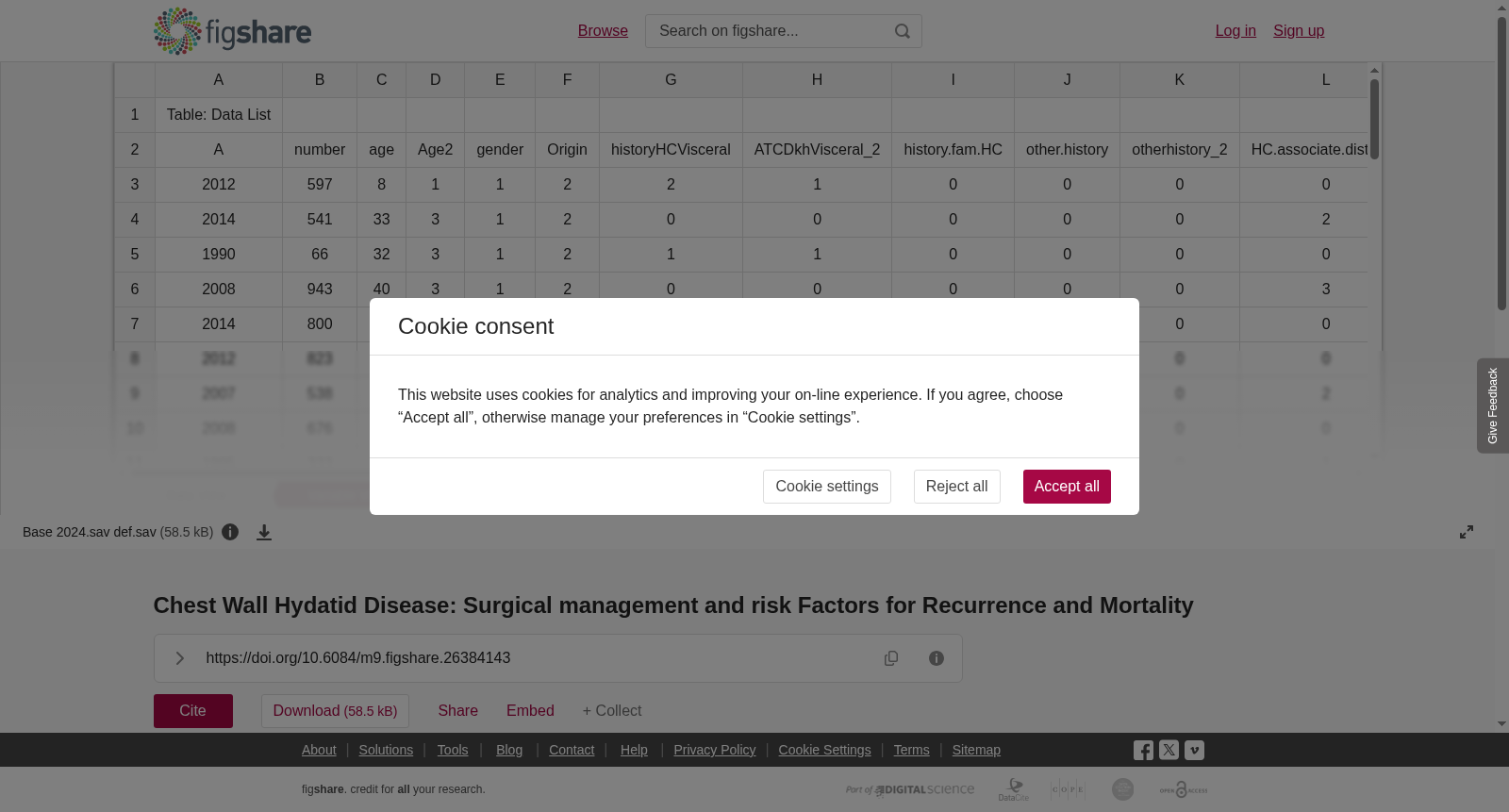
<b>Preoperative data: </b>For each patient, we collected information about epidemiological and anamnestic data: age, gender, geographical origin (rural or urban), the department of origin (thoracic surgery, orthopedics or neurosurgery), notion of hydatid contagion, family history of hydatid cyst (HC), personal history of visceral hydatid cyst. We consider a history of multiple visceral hydatidosis and hydatid involvement of more than three viscera. We also examined clinical parameters such as the time to consultation (the time from the onset of symptomatology to the date of consultation), time to treatment (the time between the onset of the symptomatology and the date of surgery), the circumstances of discovery, including incidental findings, chest pain, swelling of the soft tissues of the thoracic wall presenting as a parietal tumefaction of the posterior thoracic or paravertebral wall, neurological symptoms, and respiratory involvement. Additionally, we evaluated physical examination parameters such as general examination, thoracic floor assessment, and neurological and abdominal examinations.The radiological assessment included a chest X-ray, X-ray of the spine, coastal grid, thoracic, soft tissue, and abdominal ultrasound, CT-scan, Magnetic Resonance Imaging (MRI), and other radiological examinations such as medullary arteriography. Biological tests were carried out, including hydatid serology and a blood count to check for hypereosinophilia.<b>Operative data</b>: We specified the therapeutic management elements: anesthesia, surgical position, surgical approach, per-operative findings, and surgical procedure: which we have divided into three stages: surgical resection of part of the chest wall (including ribs, vertebrae, and/or muscles), surgical spinal stabilization: anterior by a bone marrow transplant or by osteosynthesis with a fixation material and conservative surgical procedure when the operation is performed only on the cystic lesion without ablating a part of the thoracic wall. We identified the used scolicidal solution (hydrogen peroxide, povidone-iodine, hypertonic saline), the protection of the operating field (use of soaked gauze in scolicidal solution to protect pleura and soft tissues for possible scolex dissemination), and we mentioned per-operative complications.<b>Postoperative data</b>: We recorded the duration of drainage and hospital stay, immediate postoperative course: simple or complicated, and late complications. Late course: was assessed by clinical examination (neurological by ASIA score to evaluate motor skills and sensitivity) and postoperative sequelae. During the follow-up period, every hydatid recurrence was recorded (time, treatment modalities, surgical treatment (approach, procedure, number of repeat surgeries, evolution after treatment of recurrences). Antiparasitic medical treatment was noted (molecule and length of treatment) and the pathological examination. We identified the mortality (frequency, causes, delay). We defined lost to follow-up patients as those who missed outpatient visits for more than three consecutive years.
**术前资料:**
针对每例受试患者,我们收集了其流行病学资料与病史信息:年龄、性别、籍贯(农村或城镇)、收治科室(胸外科、骨科或神经外科)、棘球蚴病接触史、棘球蚴囊肿(HC)家族史以及内脏棘球蚴囊肿个人史。我们将多内脏棘球蚴病以及累及3个以上内脏的棘球蚴感染纳入统计范畴。
此外,我们评估了多项临床参数:就诊延迟时长(从症状出现至首次就诊的时间间隔)、治疗延迟时长(从症状出现至手术的时间间隔)、疾病发现方式,包括偶然发现、胸痛、胸壁软组织肿胀(表现为胸后壁或椎旁壁的壁性肿物)、神经系统症状以及呼吸系统受累。同时,我们对体格检查指标进行了评估,涵盖一般体格检查、胸廓底部评估以及神经系统与腹部查体。
影像学评估项目包括胸部X线、脊柱X线、肋骨栅位摄片、胸部及软组织超声、腹部超声、计算机断层扫描(CT)、磁共振成像(Magnetic Resonance Imaging, MRI)以及脊髓动脉造影等其他影像学检查。实验室检查项目包括棘球蚴血清学检测与血常规检查,以排查嗜酸性粒细胞增多症。
**术中资料:**
我们明确了治疗相关操作要素:麻醉方式、手术体位、手术入路、术中所见以及手术方式。我们将手术方式分为三类:胸壁部分切除术(包括肋骨、椎体及/或肌肉切除)、脊柱前路固定术(采用骨髓移植或固定材料行骨合成术),以及仅针对囊性病灶操作、未切除胸壁组织的保守手术方式。我们记录了所用的杀头节剂(过氧化氢、聚维酮碘、高渗盐水)、手术野保护措施(使用浸有杀头节剂的纱布保护胸膜及软组织,以防头节播散),并记录了术中并发症情况。
**术后资料:**
我们记录了引流时长与住院时长、术后即刻病程(简单型或复杂型)以及术后晚期并发症。术后晚期病程通过临床检查进行评估:神经系统功能采用美国脊柱损伤协会(American Spinal Injury Association, ASIA)评分评估运动与感觉功能,同时记录术后后遗症。在随访期间,我们记录了所有棘球蚴复发情况,包括复发时间、治疗方式、手术治疗的入路、术式、再次手术次数以及复发治疗后的转归。我们记录了抗寄生虫药物治疗情况(药物种类与疗程)以及病理学检查结果。我们统计了患者死亡率,包括死亡发生频次、死因以及死亡发生时间节点。我们将失访患者定义为连续3年以上未复诊的患者。
提供机构:
figshare创建时间:
2024-07-26
搜集汇总
数据集介绍
背景与挑战
背景概述
该数据集专注于胸部壁包虫病的手术治疗及复发和死亡风险因素分析,包含术前患者流行病学和临床数据、术中手术管理细节以及术后随访信息,旨在评估手术策略对疾病预后的影响。数据集发布于2024年,属于疾病监测领域,提供了详细的临床和手术变量,适用于研究包虫病的治疗优化和风险预测。
以上内容由遇见数据集搜集并总结生成


