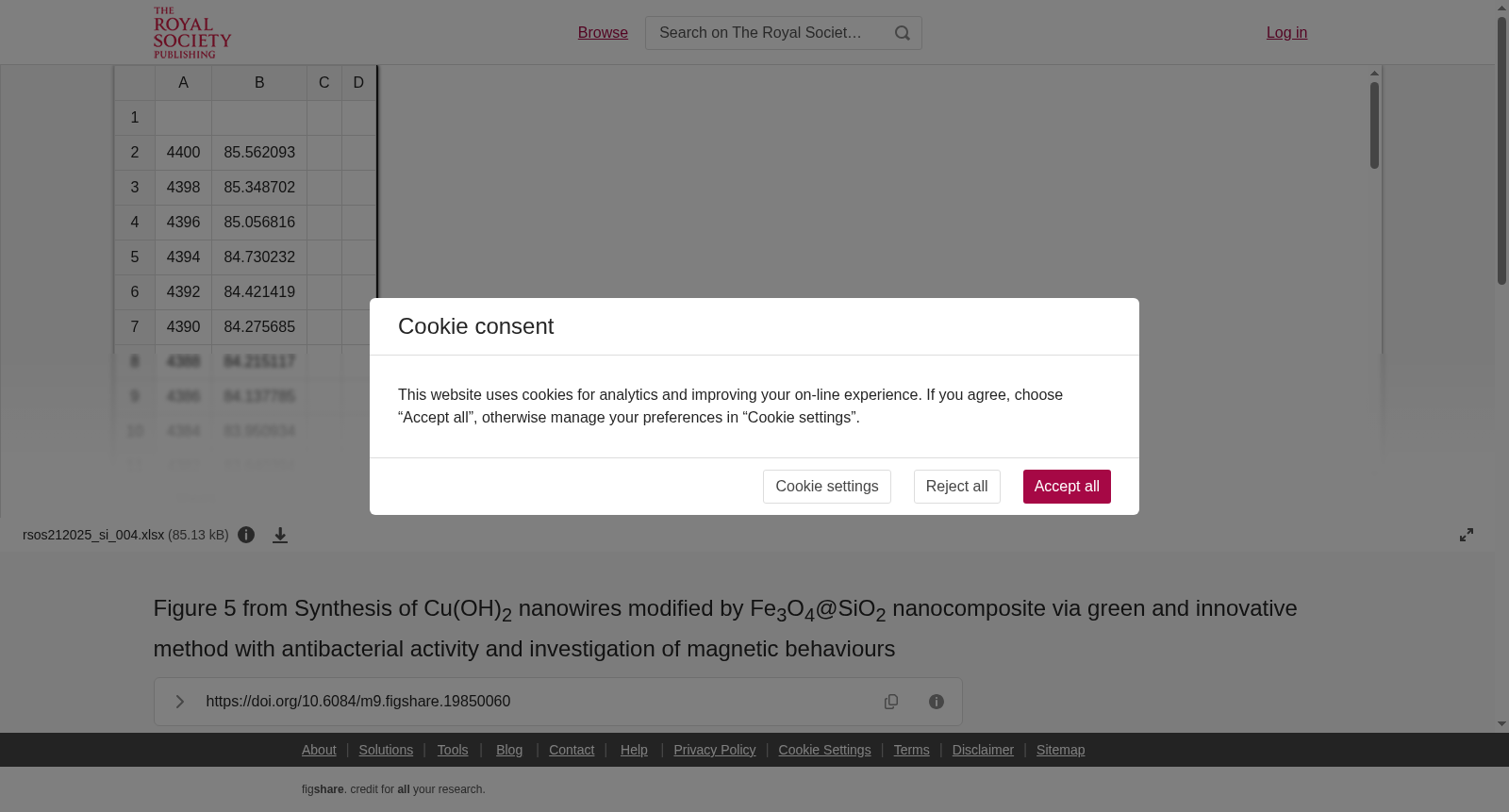
Figure 5 from Synthesis of Cu(OH)<sub>2</sub> nanowires modified by Fe<sub>3</sub>O<sub>4</sub>@SiO<sub>2</sub> nanocomposite via green and innovative method with antibacterial activity and investigation of magnetic behaviours
收藏资源简介:
In this study, green synthesis of modified Cu(OH)<sub>2</sub> nanowires by Fe<sub>3</sub>O<sub>4</sub>@SiO<sub>2</sub> core–shell nanospheres was easily performed via chemical reduction. In other words, the direct coating of Cu(OH)<sub>2</sub> on Fe<sub>3</sub>O<sub>4</sub>@SiO<sub>2</sub> was successfully realized without the extra complicated procedures. Various concentrations of synthesized nanocomposites were tested on pathogenic and nosocomial bacteria. In this study, the structural information and characterization of Fe<sub>3</sub>O<sub>4</sub>@SiO<sub>2</sub>/Cu(OH)<sub>2</sub> nanowires (FSCNWs) were obtained using FE-SEM, FT-IR, EDX and X-ray diffraction. This nanocomposite can effectively kill important infectious bacteria, including <i>S. aureus</i>, <i>E. coli Staphylococcus saprophyticus</i>, <i>Pseudomonas aeruginosa</i> and <i>Klebsiella pneumoniae</i>. Studies have shown that FSCNW nanocomposites affect common antibiotic-resistant bacteria. This result confirms the function of FSCNW as an effective, beneficial and environmentally friendly antibacterial agent that can used in a wide range of applications in medicine. FSCNWs can be separated conveniently from bacteria-containing solutions using a magnet. Compared to nanocomposites based on other metals such as silver and gold, the use of FSCNWs in water treatment has been recommended because of the precursor of copper for its low price and less toxicity. In addition to its special properties such as mild reaction conditions, green synthesis methods, admissible magnetic properties, easy separation, high antibacterial activity and beneficial efficiency.
本研究通过化学还原法,以四氧化三铁@二氧化硅(Fe₃O₄@SiO₂)核壳纳米球为模板,便捷实现了改性氢氧化铜(Cu(OH)₂)纳米线的绿色合成。换言之,本研究无需额外复杂操作步骤,即可成功实现氢氧化铜在Fe₃O₄@SiO₂表面的直接包覆。研究团队针对不同浓度的合成纳米复合材料开展了致病菌与医院获得性细菌的抗菌测试。本研究采用场发射扫描电子显微镜(FE-SEM)、傅里叶变换红外光谱(FT-IR)、能量色散X射线光谱(EDX)以及X射线衍射仪,获取了Fe₃O₄@SiO₂/氢氧化铜纳米线(FSCNWs)的结构信息与表征数据。该纳米复合材料可有效杀灭多种重要致病性细菌,包括金黄色葡萄球菌(S. aureus)、大肠杆菌(E. coli)、腐生葡萄球菌(Staphylococcus saprophyticus)、铜绿假单胞菌(Pseudomonas aeruginosa)以及肺炎克雷伯菌(Klebsiella pneumoniae)。研究表明,FSCNW纳米复合材料可作用于常见的抗生素耐药菌。该结果证实,FSCNW是一种高效、环保且性能优异的抗菌剂,可广泛应用于医药领域。借助磁铁即可便捷地从含菌溶液中分离FSCNWs。相较于银、金等其他金属基纳米复合材料,FSCNWs因铜前驱体价格低廉、毒性更低,被推荐用于水处理领域。此外,该材料还兼具反应条件温和、绿色合成工艺、良好磁学性能、易于分离、高抗菌活性及优异抑菌效率等独特特性。