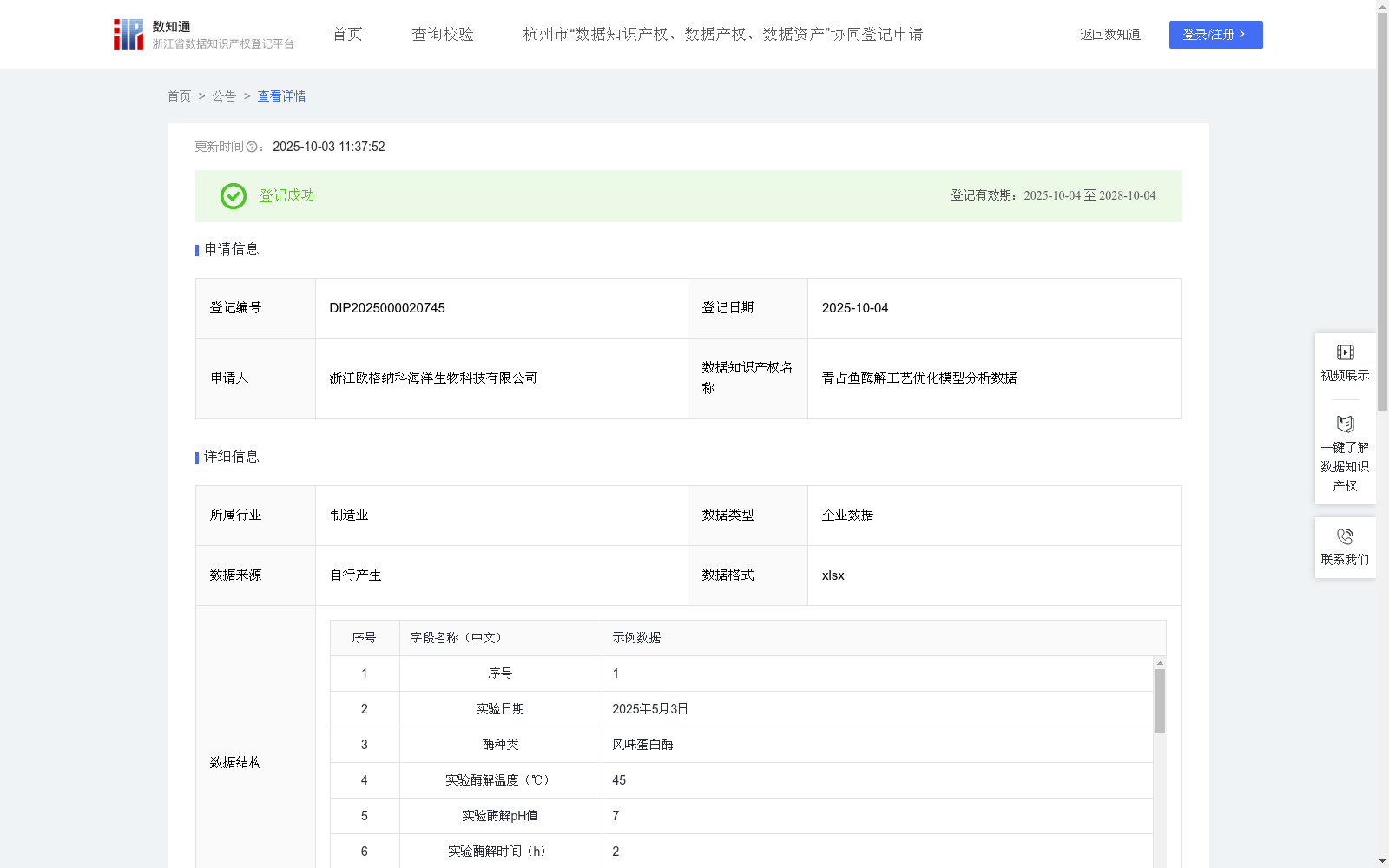
青占鱼酶解工艺优化模型分析数据
收藏资源简介:
一、适用条件与范围 适用于青占鱼等低值鱼类为原料,采用酶解工艺制备蛋白液肥的场景。 二、适用对象 生物肥料生产企业、水产加工企业、农业科技公司及科研机构。 三、解决的问题 替代传统试错实验,精准预测酶解水解度,解决工艺参数优化效率低、成本高、质量控制难的问题。 四、核心价值点 本模型将复杂生物酶解工艺参数优化过程数字化。通过精准数学模型,快速精准预测“水解度”,将传统“试错法”转为“预测-验证”模式。显著缩短研发周期,提升原料利用率与产品肥效,保障质量稳定,降低能耗与浪费。 五、外部复用价值 该模型方法论可超越青占鱼原料,复用于其他低值鱼或水产副产物蛋白提取工艺。模型结构可作为模板,适配不同酶制剂场景。还可集成化为工艺优化决策支持系统(DSS),为水产、宠物食品、氨基酸提取等行业提供数智化解决方案,推动行业技术升级。一、数据采集 基于响应面法(RSM)设计四因素三水平(温度、pH、时间、加酶量)的实验方案,进行青占鱼酶解实验。每组实验记录酶种类、实验酶解温度(℃)、实验酶解pH值、实验酶解时间(h)、实验加酶量(%),并测定实际水解度。 二、数据处理 对原始实验数据:实验酶解温度、实验酶解pH值、实验酶解时间、实验加酶量进行标准化处理,将实际值转换为编码值:温度X₁、pH值X₂、时间X₃、加酶量X₄; 生成交互项与平方项数据:温度-pH交互项X₁X₂、温度-时间交互项X₁X₃、温度-加酶量交互项X₁X₄、pH-时间交互项X₂X₃、pH-加酶量交互项X₂X₄、时间-加酶量交互项X₃X₄、温度平方项X₁²、pH平方项X₂²、时间平方项X₃²、加酶量平方项X₄²。 三、核心算法规则 根据响应面法分析因素及水平,将实际值转换为编码值,实际值与编码值的对应关系如下: 温度的水平:-1水平对应45℃,0水平对应50℃,+1水平对应55℃; pH的水平:-1水平对应6.5,0水平对应7.0,+1水平对应7.5; 时间的水平:-1水平对应2h,0水平对应3h,+1水平对应4h; 加酶量的水平:-1水平对应0.3%,0水平对应0.5%,+1水平对应0.7%。 编码值X与实际值Z的转换公式为X=(Z−Z₀)/Δ,Z₀是中心点(0水平)的实际值,Δ是水平间距(从-1到0或0到1的实际值差值)。 将实际值转换为编码值,代入交互项与平方项中后,将所有单项、交互项、平方项代入回归方程模型进行相加。 回归方程模型的公式如下: 预测水解度Y(%)=13.86+0.13X₁-0.17X₂+0.088X₃+0.20X₄+0.11X₁X₂-0.027X₁X₃+0.045X₁X₄+0.0075X₂X₃-0.11X₂X₄-0.030X₃X₄-0.22X₁²-0.30X₂²-0.22X₃²-0.18X₄² 计算出预测水解度Y(%)后,与实际水解度(%)进行对比,验证模型准确性 预测误差ΔY(%)=|预测水解度Y(%)-实际水解度(%)| 4、数据应用 以水解度为指标采用响应面试验对酶解条件进行优化,为后续低值鱼制备水产蛋白液肥料提供理论依据。
1. Scope and Application Conditions Applicable to scenarios where low-value fish such as chub mackerel are used as raw materials to produce protein liquid fertilizer via enzymatic hydrolysis process. 2. Target Applicants Biological fertilizer manufacturing enterprises, aquatic product processing enterprises, agricultural technology companies and scientific research institutions. 3. Problems Solved Replace traditional trial-and-error experiments, accurately predict the degree of hydrolysis, and address the issues of low efficiency, high cost and difficult quality control in process parameter optimization. 4. Core Value Propositions This model digitizes the optimization process of complex biological enzymatic hydrolysis parameters. Through an accurate mathematical model, it quickly and precisely predicts the "degree of hydrolysis", transforming the traditional "trial-and-error method" into a "prediction-verification" mode. It significantly shortens R&D cycles, improves raw material utilization and product fertilizer efficiency, ensures stable product quality, and reduces energy consumption and waste. 5. External Reusability Value The model methodology can be extended beyond chub mackerel raw materials, and reused for protein extraction processes of other low-value fish or aquatic by-products. The model structure can be used as a template to adapt to different enzyme preparation scenarios. It can also be integrated into a process optimization decision support system (DSS), providing intelligent digital solutions for industries such as aquatic products, pet food and amino acid extraction, and promoting industrial technological upgrading. 1. Data Collection Based on the four-factor three-level (temperature, pH, time, enzyme dosage) experimental design via Response Surface Methodology (RSM), enzymatic hydrolysis experiments on chub mackerel were conducted. For each group of experiments, the enzyme type, experimental enzymatic hydrolysis temperature (℃), experimental enzymatic hydrolysis pH value, experimental enzymatic hydrolysis time (h), experimental enzyme dosage (%) were recorded, and the actual degree of hydrolysis was measured. 2. Data Processing For the original experimental data: standardization was performed on the experimental enzymatic hydrolysis temperature, pH value, time and enzyme dosage, converting the actual values into coded values: temperature X₁, pH value X₂, time X₃, enzyme dosage X₄; Generate interaction term and squared term data: temperature-pH interaction term X₁X₂, temperature-time interaction term X₁X₃, temperature-enzyme dosage interaction term X₁X₄, pH-time interaction term X₂X₃, pH-enzyme dosage interaction term X₂X₄, time-enzyme dosage interaction term X₃X₄, temperature squared term X₁², pH squared term X₂², time squared term X₃², enzyme dosage squared term X₄². 3. Core Algorithm Rules According to the factors and levels analyzed by RSM, the actual values are converted into coded values. The corresponding relationship between actual values and coded values is as follows: Temperature levels: -1 level corresponds to 45℃, 0 level corresponds to 50℃, +1 level corresponds to 55℃; pH levels: -1 level corresponds to 6.5, 0 level corresponds to 7.0, +1 level corresponds to 7.5; Time levels: -1 level corresponds to 2h, 0 level corresponds to 3h, +1 level corresponds to 4h; Enzyme dosage levels: -1 level corresponds to 0.3%, 0 level corresponds to 0.5%, +1 level corresponds to 0.7%. The conversion formula between coded value X and actual value Z is X=(Z−Z₀)/Δ, where Z₀ is the actual value of the central point (0 level), and Δ is the level spacing (the difference in actual values from -1 to 0 or 0 to 1). Convert the actual values into coded values, substitute them into the interaction terms and squared terms, then substitute all single terms, interaction terms and squared terms into the regression equation model for summation. The formula of the regression equation model is as follows: Predicted degree of hydrolysis Y (%) = 13.86 + 0.13X₁ - 0.17X₂ + 0.088X₃ + 0.20X₄ + 0.11X₁X₂ - 0.027X₁X₃ + 0.045X₁X₄ + 0.0075X₂X₃ - 0.11X₂X₄ - 0.030X₃X₄ - 0.22X₁² - 0.30X₂² - 0.22X₃² - 0.18X₄². After calculating the predicted degree of hydrolysis Y (%), compare it with the actual degree of hydrolysis (%) to verify the accuracy of the model. Prediction error ΔY (%) = |Predicted degree of hydrolysis Y (%) - Actual degree of hydrolysis (%)|. 4. Data Application Optimize the enzymatic hydrolysis conditions using response surface experiments with the degree of hydrolysis as the indicator, providing a theoretical basis for the subsequent preparation of aquatic protein liquid fertilizer from low-value fish.