
<b>The Relationship Between Mindfulness and Depression: Examining the Chain Mediating Role of Shyness and Core Self-evaluation</b>
收藏DataCite Commons2025-06-01 更新2024-11-06 收录
下载链接:
https://figshare.com/articles/dataset/_b_The_Relationship_Between_Mindfulness_and_Depression_Examining_the_Chain_Mediating_Role_of_Shyness_and_Core_Self-evaluation_b_/27211653/1
下载链接
链接失效反馈官方服务:
资源简介:
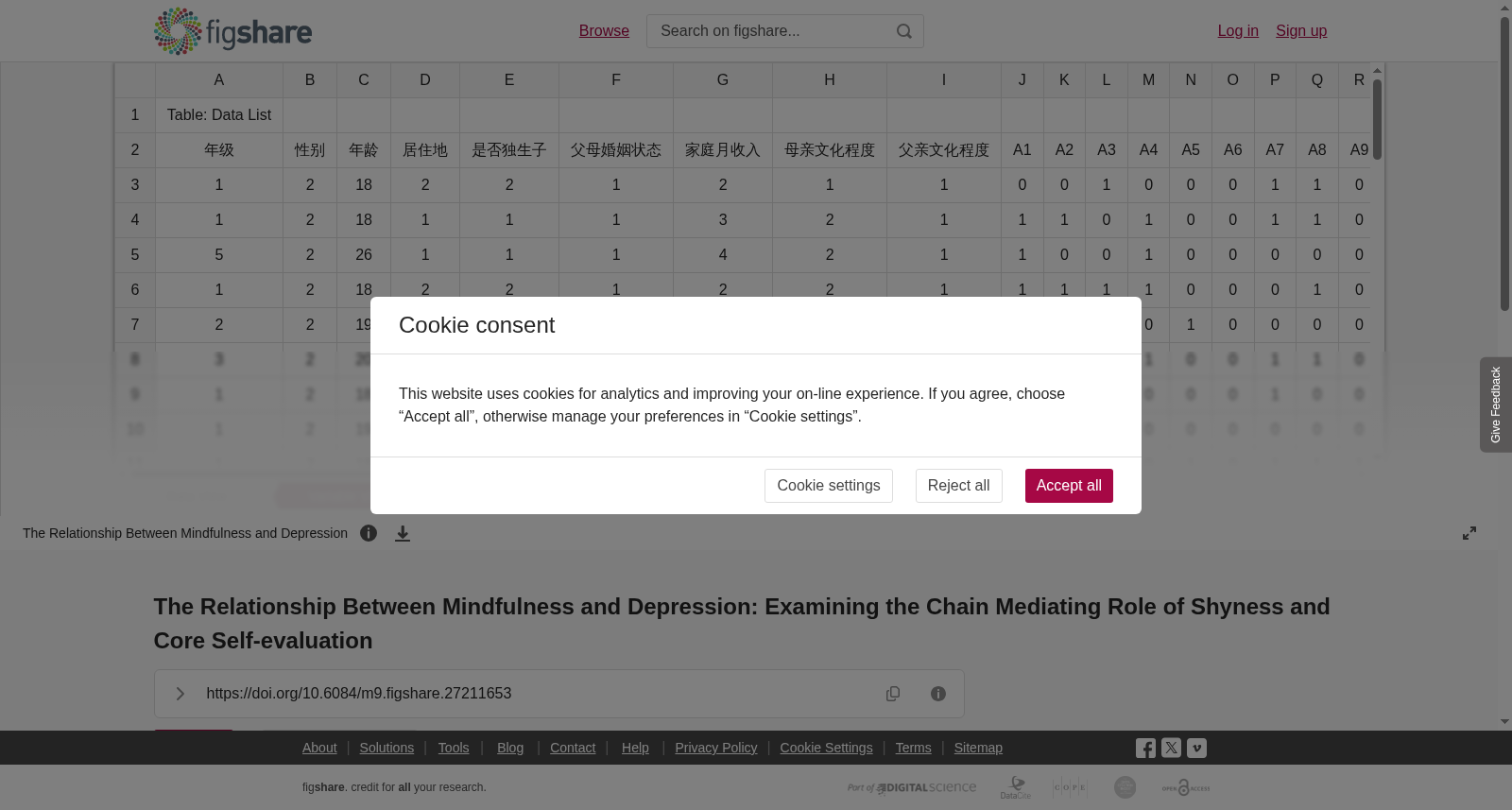
The dataset includes data from the following psychological measures:Chinese version of the Five Factor Mindfulness Scale The Chinese version of the Five Factor Mindfulness Scale (Deng, 2009) was used to assess college students’ mindfulness levels. The questionnaire consists of 39 items and includes five dimensions: Observing, Describing, Acting with awareness, Nonjudging of inner experience, and Nonreactivity to inner experience. Chinese Version of the Beck Depression Inventory-II (BDI-II-C) The BDI-II is a self-report scale of depressive symptoms developed by Beck et al. (1996). It consists of 21 items that cover the emotional and cognitive aspects of clinical depression. Respondents rate the severity of depressive symptoms over the past two weeks on a 5-point Likert scale. The version used in this study, translated by Yang et al. (2012).The Revised Cheek and Buss Shyness Scale The Revised Cheek and Buss Shyness Scale, developed by Cheek (1983), was revised by Xiang et al. (2018). This scale consists of 13 items scored on a 5-point Likert scale, with higher scores indicating higher levels of shyness. Core Self-Evaluations Scale (CSES) The Core Self-Evaluations Scale, developed by Judge et al. (2000), was translated and revised by Du et al. (2012). The revised scale consists of 10 terms, with 2 items removed for cultural compatibility. By calculating the mean score of all items, an individual’s level of core self-evaluation is determined. The dataset has been pre-processed to ensure high quality for analysis:Invalid questionnaires have been removed: ensuring that only complete and correctly filled questionnaires are included.Reverse scoring has been corrected: for items that require it, ensuring that all scores are correctly aligned and can be directly interpreted.Ready for analysis using mean scores: indicating that the data can be directly used for statistical analysis by calculating average scores for each scale or subscale.<br>
本数据集包含以下心理学测评工具的数据:
五因素正念量表(Five Factor Mindfulness Scale)中文修订版:本研究采用邓等人2009年编制的该量表中文版本,用于评估大学生的正念水平。该问卷共包含39个条目,涵盖5个维度:观察(Observing)、描述(Describing)、有意识地行动(Acting with awareness)、不评判内在体验(Nonjudging of inner experience)以及对内在体验无反应(Nonreactivity to inner experience)。
贝克抑郁量表第二版中文修订版(Chinese Version of the Beck Depression Inventory-II, BDI-II-C):该量表由Beck等人1996年编制,为抑郁症状自评量表,共包含21个条目,覆盖临床抑郁的情绪与认知维度。受访者需基于过去两周的抑郁症状严重程度,采用5点李克特(Likert)量表进行评分。本研究使用的版本由杨等人2012年翻译修订。
修订版Cheek与Buss羞怯量表(Revised Cheek and Buss Shyness Scale):该量表最初由Cheek于1983年编制,经向等人2018年修订,共包含13个条目,采用5点李克特量表计分,得分越高代表个体羞怯水平越高。
核心自我评价量表(Core Self-Evaluations Scale, CSES):该量表由Judge等人2000年编制,由杜等人2012年翻译修订。为适配文化语境,修订版移除了2个条目,最终包含10个条目。通过计算所有条目的平均分,可得到个体的核心自我评价水平。
本数据集已完成高质量预处理,以保障分析可靠性:
1. 剔除无效问卷:仅保留填写完整且正确作答的问卷;
2. 校正反向计分:针对需反向计分的条目调整计分规则,确保所有得分统一规范,可直接解读;
3. 适配平均分分析模式:数据可直接通过计算各量表或子量表的平均分开展统计分析。
提供机构:
figshare创建时间:
2024-10-11
搜集汇总
数据集介绍
以上内容由遇见数据集搜集并总结生成


