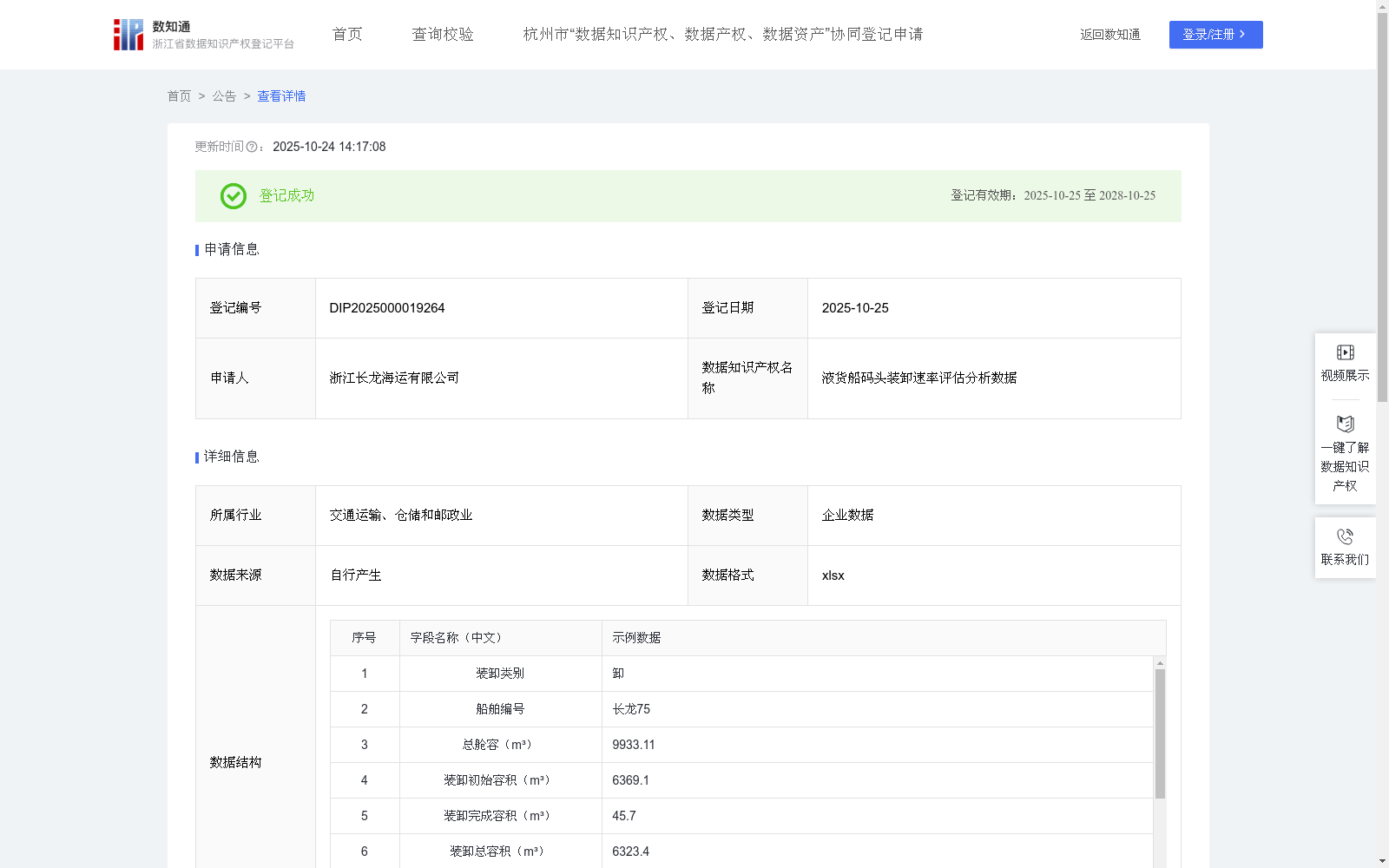
液货船码头装卸速率评估分析数据
收藏资源简介:
一、适用对象与条件 适用对象:配备高精度容积传感器的装载危险化学品的液货运输船。 适用条件:依赖5G/卫星通信实现数据实时传输的液货船码头装卸作业。 二、解决的问题 装卸起止时间判定偏差大:基于容积持续变化规则自动精准判定,耗时计算误差从±15分钟降至±1分钟; 装卸效率评估依赖人工经验:实时计算装卸速率并自动分级(高效/中效/低效),提升准确率; 低效故障发现滞后:动态监测装卸速率,异常即时告警,缩短故障响应时间。 三、主要价值 精准效率管理:人工记录无法实时捕获装卸速率波动,导致资源调配失准。此数据可指导优先检修低效货舱(如管线堵塞),提升码头月均作业效率。 港口调度优化:实时共享装卸效率数据,支持区域港口协同调度,减少船舶待泊时间,提升整体航道利用率; 货主供应链决策:为货主提供精准的装卸时间预测与滞期风险预警,优化物流成本核算与租船合约管理。1. 数据采集 通过货舱内的高精度传感器,每10秒采集一次各货舱的容积。所有数据均带有时间戳,并通过5G或卫星通信链路实时传输至岸基服务器,形成连续的时间序列数据流。 采集字段包括:装卸类别、船舶编号、总舱容(m³)、装卸初始容积(m³)、装卸完成容积(m³)、装卸作业开始时间、装卸作业结束时间、最大设计速率 2. 数据处理 为保证后续分析结果的准确性,需对采集到的原始数据进行清洗和标准化处理,具体步骤如下: 去空格与格式统一:去除字段中的非法字符,将数值字段统一为浮点型; 完整性校验:检查必填字段是否齐全(装卸类别、船舶编号、总舱容(m³)、装卸初始容积(m³)、装卸完成容积(m³)、装卸作业开始时间、装卸作业结束时间、最大设计速率),缺失任一字段即标记为异常数据; 异常值剔除:使用统计方法(3σ原则)识别并剔除明显超出合理范围的数值(如装卸初始容积或装卸完成容积超过总舱容); 数据聚合:在液货船码头装卸作业时间内,按装卸作业开始时间、装卸作业结束时间、船舶编号进行汇总,生成可用于分析的结构化数据表。 3. 核心算法规则 装卸总耗时判定逻辑: 以货舱容积变化为依据,设定“装卸作业开始时间”和“装卸作业结束时间”的判断条件: 当货舱容积变化大于阈值时(每分钟变化>0.1 m³)且持续超过5分钟时,判定为装卸作业开始; 当货舱容积变化(每分钟变化=0m³)且持续稳定超过10分钟后,判定为装卸作业结束,中间时间段即为装卸总耗时。 装卸总容积(m³)计算公式: 当装卸类别为“卸”时,装卸总容积=装卸初始容积-装卸完成容积; 当装卸类别为“装”时,装卸总容积=装卸完成容积-装卸初始容积; 装卸总耗时(分钟)=装卸作业结束时间-装卸作业开始时间,小时和分钟的转化为1/60。 装卸速率计算公式:装卸速率(m³/h)=装卸总容积/装卸总耗时 装卸速率等级: 设计最大速率为500m³/h IF 设计最大速率×0.6≤装卸速率≤设计最大装卸速率 → "高效" IF 设计最大速率×0.4≤装卸速率<设计最大装卸速率×0.6 → "中效" IF 装卸速率<设计最大装卸速率×0.4→ "低效"
I. Application Objects and Conditions Application Objects: Liquid cargo tankers loaded with hazardous chemicals and equipped with high-precision volume sensors. Application Conditions: Terminal loading and unloading operations of liquid cargo tankers that rely on 5G or satellite communication for real-time data transmission. II. Problems Solved 1. Large deviation in loading/unloading start/end time judgment: Automatically and accurately judge based on continuous volume change rules, reducing the time calculation error from ±15 minutes to ±1 minute; 2. Loading/unloading efficiency assessment relying on manual experience: Calculate the loading/unloading rate in real time and automatically grade it (high-efficiency/medium-efficiency/low-efficiency), improving accuracy; 3. Lagging detection of low-efficiency faults: Dynamically monitor the loading/unloading rate, issue immediate alarms for abnormalities, and shorten fault response time. III. Core Values 1. Accurate efficiency management: Manual records cannot capture real-time fluctuations in loading/unloading rates, leading to inaccurate resource allocation. This dataset can guide priority maintenance of low-efficiency tanks (such as pipeline blockages), improving the monthly average terminal operation efficiency. 2. Port scheduling optimization: Real-time sharing of loading/unloading efficiency data supports coordinated scheduling of regional ports, reducing ship berthing waiting time and improving overall channel utilization rate; 3. Cargo owner supply chain decision-making: Provide cargo owners with accurate loading/unloading time prediction and demurrage risk early warning, optimizing logistics cost accounting and charter party management. 1. Data Collection Collect the volume of each tank every 10 seconds through high-precision sensors installed inside the tanks. All data are time-stamped and transmitted to the onshore server in real time via 5G or satellite communication links, forming a continuous time-series data stream. Collected fields include: loading/unloading category, ship number, total tank capacity (m³), initial volume during loading/unloading (m³), final volume during loading/unloading (m³), loading/unloading operation start time, loading/unloading operation end time, maximum design rate. 2. Data Processing To ensure the accuracy of subsequent analysis results, the collected raw data need to be cleaned and standardized. The specific steps are as follows: - Remove spaces and unify formats: Remove illegal characters in fields, and unify numeric fields to floating-point type; - Integrity verification: Check whether the required fields are complete (loading/unloading category, ship number, total tank capacity (m³), initial volume during loading/unloading (m³), final volume during loading/unloading (m³), loading/unloading operation start time, loading/unloading operation end time, maximum design rate). Mark as abnormal data if any field is missing; - Outlier removal: Use statistical methods (3σ principle) to identify and eliminate values that obviously exceed the reasonable range (such as initial or final volume during loading/unloading exceeding the total tank capacity); - Data aggregation: Summarize according to loading/unloading operation start time, loading/unloading operation end time, and ship number during the terminal loading/unloading operation period of the liquid cargo tanker, generating structured data tables available for analysis. 3. Core Algorithm Rules Loading/Unloading Total Duration Judgment Logic: Based on tank volume changes, set the judgment conditions for "loading/unloading operation start time" and "loading/unloading operation end time": - When the tank volume change exceeds the threshold (>0.1 m³ per minute) and lasts for more than 5 minutes, it is determined as the start of loading/unloading operation; - When the tank volume change is 0 m³ per minute and remains stable for more than 10 minutes, it is determined as the end of loading/unloading operation, and the intermediate period is the total loading/unloading duration. Total Loading/Unloading Volume (m³) Calculation Formula: - When the loading/unloading category is "unload", total loading/unloading volume = initial volume during loading/unloading - final volume during loading/unloading; - When the loading/unloading category is "load", total loading/unloading volume = final volume during loading/unloading - initial volume during loading/unloading; Total loading/unloading duration (minutes) = loading/unloading operation end time - loading/unloading operation start time, converted to hours by dividing by 60. Loading Rate Calculation Formula: Loading rate (m³/h) = total loading/unloading volume / total loading/unloading duration. Loading Rate Grading: The maximum design rate is 500 m³/h - IF 0.6×maximum design rate ≤ loading rate ≤ maximum design loading/unloading rate → "High-efficiency" - IF 0.4×maximum design rate ≤ loading rate < 0.6×maximum design loading/unloading rate → "Medium-efficiency" - IF loading rate < 0.4×maximum design loading/unloading rate → "Low-efficiency"