
Unsteady surface pressure obtained based on amplitude-calibration-based nonembedded measurement method PartI-calibration
收藏Mendeley Data2022-11-10 更新2024-06-27 收录
下载链接:
https://www.doi.org/10.11922/sciencedb.01659
下载链接
链接失效反馈官方服务:
资源简介:
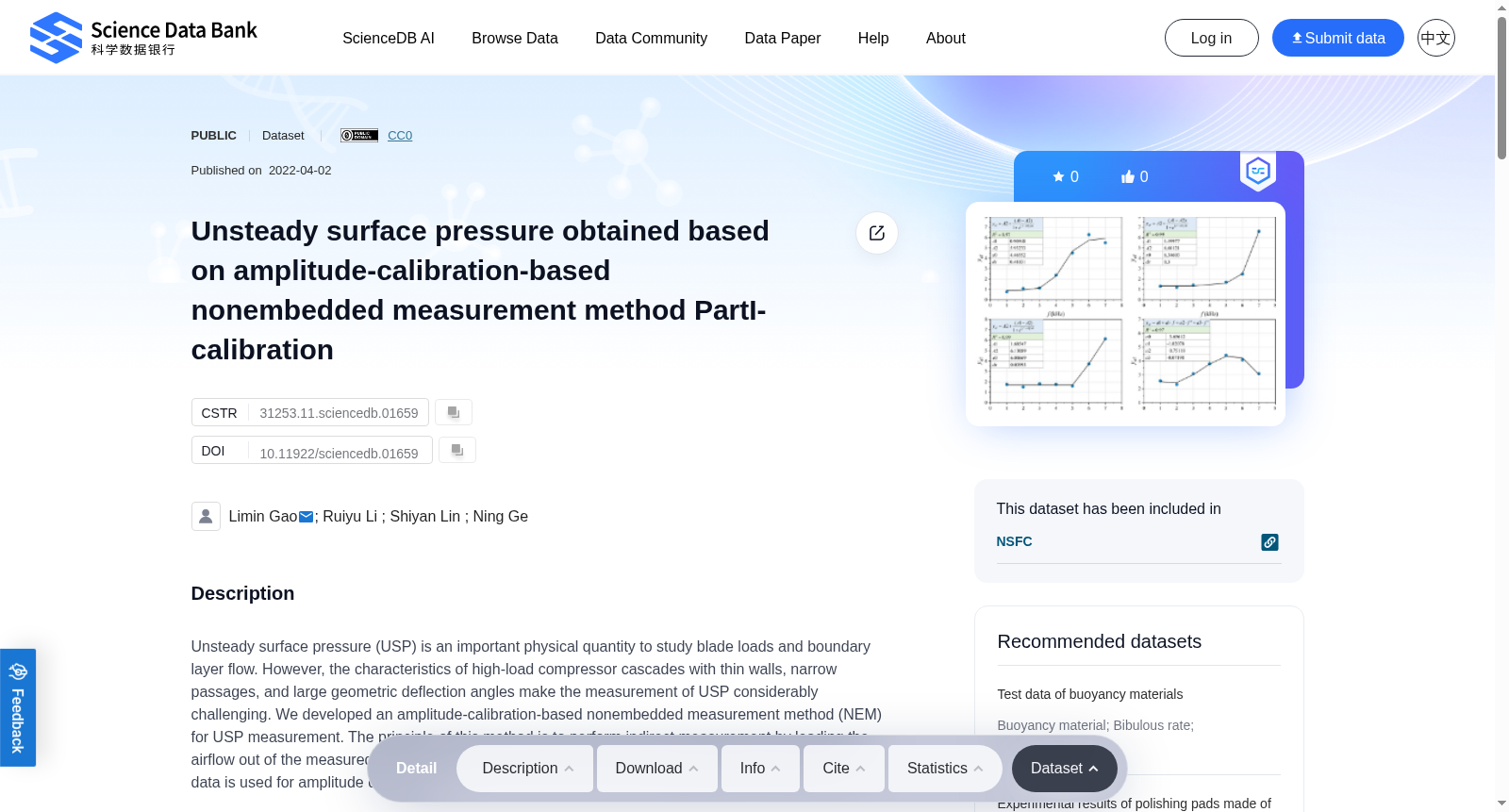
Unsteady surface pressure (USP) is an important physical quantity to study blade loads and boundary layer flow. However, the characteristics of high-load compressor cascades with thin walls, narrow passages, and large geometric deflection angles make the measurement of USP considerably challenging. We developed an amplitude-calibration-based nonembedded measurement method (NEM) for USP measurement. The principle of this method is to perform indirect measurement by leading the airflow out of the measured surface through an air tube and correct the amplitudes by calibration. The data is used for amplitude calibration.Amplitude calibration was performed with six tube lengths of 80, 55, 49, 39, 37, and 33 mm. The calibration frequency is limited to 1–7 kHz due to the following two reasons. First, the amplitude of the signal obtained from the speaker decreases with the increase in the frequency in the calibration device. Second, the amplitude of the pressure wave cannot be enhanced by its reflection because the end cap is removed from the tube. Calibration presents information obtained by both the direct (reference) and NEM (measured) measurements of the frequency and amplitude. The calibration setup is shown in the figure attached. The pressure fluctuation signal is generated with the speaker. The blade with the hydrostatic pores is placed at the end of the dynamic calibration chamber with the end cap removed. A thin line pressure transducer (R, which represents reference signal, type: Kulite LQ-062-5D) is pasted close to the hydrostatic pore to measure the unsteady pressure directly, and a micro pressure transducer (M, which denotes measured signal, type: Kulite XCQ-080-5G) is connected to the hydrostatic pore with a soft connection.
非定常表面压力(Unsteady Surface Pressure, USP)是研究叶片载荷与边界层流动的重要物理量。然而,高负荷薄壁压气机叶栅具备通道狭窄、几何偏转角大的特性,使得非定常表面压力的测量工作颇具挑战性。我们开发了一种基于幅值校准的非嵌入式测量方法(Non-embedded Measurement Method, NEM)用于非定常表面压力的测量。该方法的原理为:通过导气管将气流从被测表面引出以实现间接测量,并通过校准流程对幅值进行修正,相关实验数据用于幅值校准。本次幅值校准实验采用了6种不同长度的导气管,分别为80 mm、55 mm、49 mm、39 mm、37 mm与33 mm。由于以下两点原因,本次校准的有效频率范围被限定为1~7 kHz:其一,校准装置中扬声器输出的信号幅值随频率升高而衰减;其二,由于导气管端部的端盖已被移除,压力波无法通过反射实现幅值增强。本次校准涵盖了直接测量(参考,reference)与非嵌入式测量方法(NEM,measured)所获得的频率与幅值信息。校准装置的结构如附图所示。压力波动信号由扬声器产生。带有静压孔的叶片被安置在移除了端盖的动态校准腔端部。紧贴静压孔粘贴了细线型压力传感器(R,代表参考信号,型号:Kulite LQ-062-5D)以直接测量非定常压力;同时通过软连接将微型压力传感器(M,代表被测信号,型号:Kulite XCQ-080-5G)连接至该静压孔。
创建时间:
2022-04-03
搜集汇总
数据集介绍
背景与挑战
背景概述
该数据集是一个关于非定常表面压力测量的校准数据集,用于研究压气机叶片的非定常表面压力(USP)。数据集基于幅度校准的非嵌入式测量方法(NEM),通过将气流引导出测量表面进行间接测量,并校正幅度,校准涉及六个不同管长(80至33毫米)和1-7 kHz的频率范围。数据由西北工业大学和西安交通大学的研究团队提供,旨在支持高负荷压气机叶栅的USP测量研究。
以上内容由遇见数据集搜集并总结生成


