
Fisher English Training Speech Part 1 Transcripts
收藏Mendeley Data2024-01-31 更新2024-06-27 收录
下载链接:
https://catalog.ldc.upenn.edu/LDC2004T19
下载链接
链接失效反馈官方服务:
资源简介:
Introduction Fisher English Training Speech Part 1 Transcripts represents the first half of a collection of conversational telephone speech (CTS) that was created at LDC in 2003. It contains time-aligned transcript data for 5,850 complete conversations, each lasting up to 10 minutes. In addition to the transcriptions, which are found under the trans directory, there is a complete set of tables describing the speakers, the properties of the telephone calls, and the set of topics that were used to initiate the conversations. The corresponding speech files are contained in Fisher English Training Speech Part 1 Speech (LDC2004S13). The Fisher telephone conversation collection protocol was created at LDC to address a critical need of developers trying to build robust automatic speech recognition (ASR) systems. Previous collection protocols, such as CALLFRIEND and Switchboard-II and the resulting corpora, have been adapted for ASR research but were in fact developed for language and speaker identification respectively. Although the CALLHOME protocol and corpora were developed to support ASR technology, they feature small numbers of speakers making telephone calls of relatively long duration with narrow vocabulary across the collection. CALLHOME conversations are challengingly natural and intimate. Under the Fisher protocol, a large number of participants each calls an other participant, whom they typically do not know, for a short short period of time to discuss the assigned topics. This maximizes inter-speaker variation and vocabulary breath while also increasing formality. Previous protocols such as CALLHOME, CALLFRIEND and Switchboard relied upon participant activity to drive the collection. Fisher is unique in being platform driven rather than participant driven. Participants who wish to initiate a call may do so, however, the collection platform initiates the majority of calls. Participants need only answer their phones at the times they specified when registering for the study. To encourage a broad range of vocabulary, Fisher participants are asked to speak about an assigned topic chosen from a randomly generated list that changes every 24 hours. All participants that day will be assigned subjects from that list. Some topics are inherited or refined from previous Switchboard studies while others were developed specifically for the Fisher protocol. Data Overall, about 12% of the conversations were transcribed at LDC, and the rest were transcribed by BBN and WordWave using a significantly different approach to the task. A central goal in both sets was to maximize the speed and economy of the transcription process. This in turn involved certain aspects of mark-up detail and quality control that may have been common in previous, smaller corpora. The LDC transcripts were based on automatic segmentation of the audio data, to identify the utterance end-points on both channels of each conversation. Given these time stamps, manual transcription was simply a matter of typing in the words for each segment and doing a rudimentary spell-check. No attempt was made to modify the segmentation boundaries manually, or to locate utterances that the segmenter might have missed. Portions of speech where the transcriber could not be sure exactly what was said were marked with double parentheses -- (( ... )) -- and the transcriber could hazard a guess as to what was said, or leave the region between parentheses blank. The LDC transcription process yields one plain-text transcript file per conversation, in which the first two lines show the call-ID and the fact that the transcript was developed at LDC. The remainder of the file contains one utterance per line (with blank lines separating the utterances), with the start-time, end-time, speaker/channel-ID and utterance text. Data collection and transcription were sponsored by DARPA and the U.S. Department of Defense, as part of the EARS project for research and development in automatic speech recognition. Samples Please examine this sample to see an example of the data in this corpus. Updates As of 6/14/2017, 'fe_03_p1_calldata.tbl' was updated to correct mislabeled topics for some calls. All downloads made after this date will have the corrected file. © 2003-2004 Trustees of the University of Pennsylvania
### 简介
Fisher英语训练语音第一部分转录文本系2003年由语言数据联盟(Linguistic Data Consortium, LDC)打造的会话电话语音(Conversational Telephone Speech, CTS)语料库集合的前半部分。本数据集包含5850段完整对话的时间对齐转录数据,单段对话时长最长可达10分钟。除存放在trans目录下的转录文本外,本数据集还包含一套完整的元数据表,用于描述对话参与者、电话呼叫属性以及发起对话所用的主题集合。对应语音文件收录于《Fisher英语训练语音第一部分语音》(LDC2004S13)中。
Fisher电话对话采集协议由LDC开发,旨在满足研发人员构建高性能鲁棒自动语音识别(Automatic Speech Recognition, ASR)系统的迫切需求。此前的采集协议如CALLFRIEND、Switchboard-II及其衍生语料库虽已适配ASR研究,但最初分别为语言识别与说话人识别任务开发。尽管CALLHOME协议及语料库专为支持ASR技术开发,但其存在样本量有限的局限:参与对话的说话人数量较少,通话时长相对较长,且全语料库的词汇覆盖范围较窄。CALLHOME语料库中的对话极具自然性与私密性,对模型训练颇具挑战。
在Fisher协议框架下,大量参与者将致电通常互不相识的其他参与者,开展时长较短的对话以讨论指定主题。此举可最大化说话人差异与词汇覆盖广度,同时提升对话的正式程度。此前的采集协议如CALLHOME、CALLFRIEND与Switchboard均依赖参与者主动发起活动来推动数据采集,而Fisher语料库的独特之处在于采用平台驱动模式,而非参与者驱动模式。虽允许有意发起通话的参与者自主操作,但绝大多数通话均由采集平台主动发起,参与者仅需在注册研究时指定的时段接听电话即可。
为鼓励丰富的词汇使用,Fisher语料库的参与者需围绕随机生成的指定主题展开对话,该主题列表每24小时更新一次,当日所有参与者均将从当日主题列表中分配到对话话题。部分话题继承自此前的Switchboard研究并经优化,其余则专为Fisher协议开发。
### 转录说明
整体而言,约12%的对话由LDC完成转录,其余对话则由BBN与WordWave采用截然不同的转录方案完成。两类转录工作的核心目标均为最大化转录流程的效率与经济性,这也使得转录过程中的标注细节与质量控制环节,沿用了此前小型语料库中常见的部分标准。
LDC的转录工作基于音频数据的自动分段:先识别每段对话双声道的语句端点。基于上述时间戳,人工转录仅需为每个分段输入文本并完成基础拼写检查即可,转录过程中不会手动调整分段边界,也不会补全自动分段器可能遗漏的语句。当转录者无法准确辨识语音内容时,将用双层括号((...))标记该区域,转录者可尝试猜测内容填写,或留空括号内的区域。
LDC的转录流程为每段对话生成一个纯文本转录文件,文件前两行依次标注通话ID以及本转录文件由LDC开发的说明。文件剩余部分每行对应一条语句(语句间以空行分隔),内容包含起始时间、结束时间、说话人/声道ID以及语句文本。
本数据集的采集与转录工作由美国国防高级研究计划局(Defense Advanced Research Projects Agency, DARPA)与美国国防部资助,系面向自动语音识别研发的EARS项目的组成部分。
### 样例
请查看以下样例,以了解本语料库的数据格式。
### 更新记录
截至2017年6月14日,本数据集已更新'fe_03_p1_calldata.tbl'文件,以修正部分通话的主题标注错误。该日期之后的所有下载版本均包含修正后的文件。
© 2003-2004 宾夕法尼亚大学托管委员会
创建时间:
2024-01-31
搜集汇总
数据集介绍
背景与挑战
背景概述
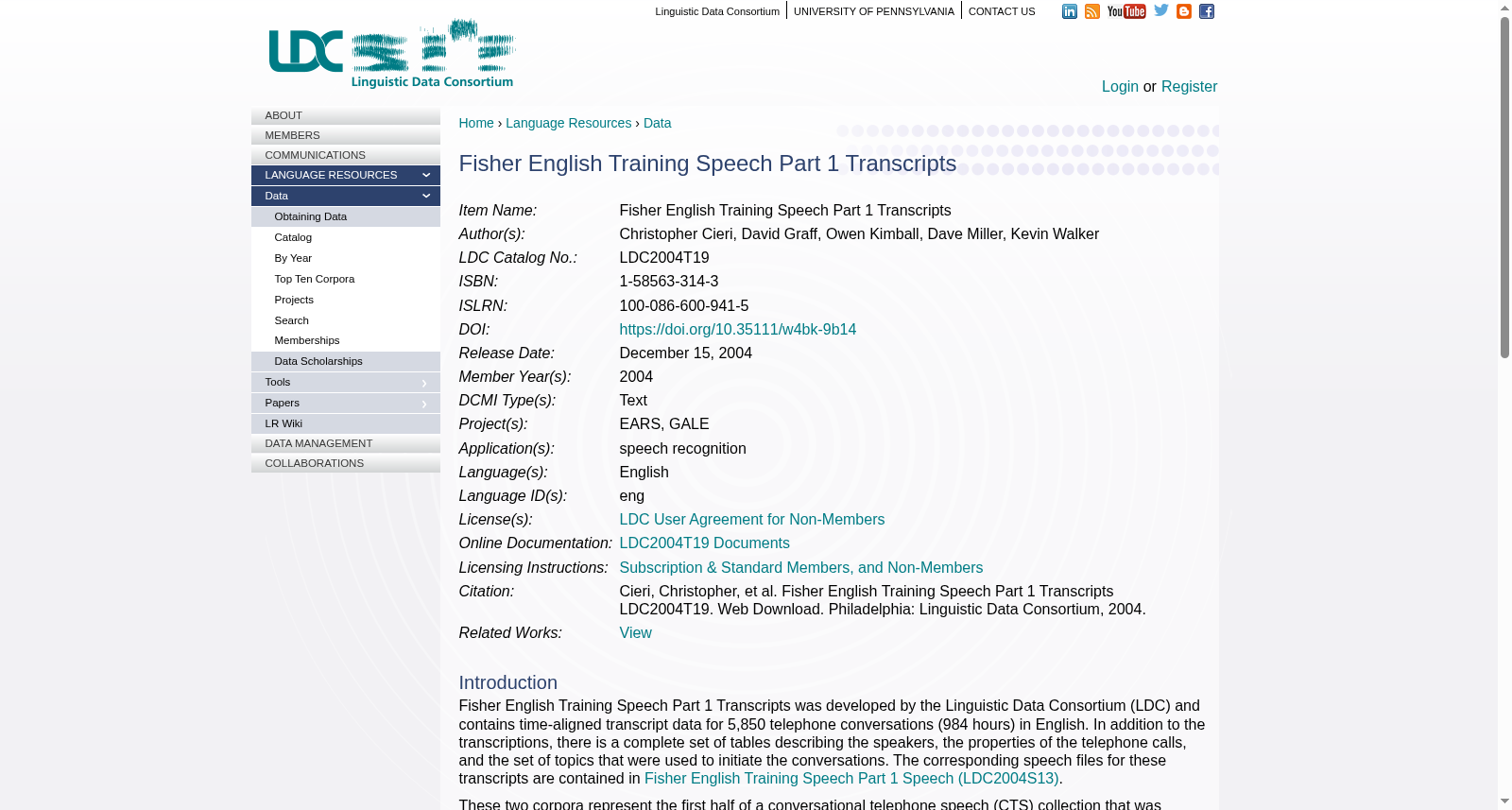
Fisher English Training Speech Part 1 Transcripts是由Linguistic Data Consortium开发的英语电话对话转录数据集,包含5,850个电话对话(984小时)的时间对齐转录数据,以及关于说话者、电话呼叫属性和话题的详细表格。该数据集主要用于自动语音识别(ASR)研究,特点是参与者数量多、词汇范围广,且采用平台驱动的收集协议。
以上内容由遇见数据集搜集并总结生成


