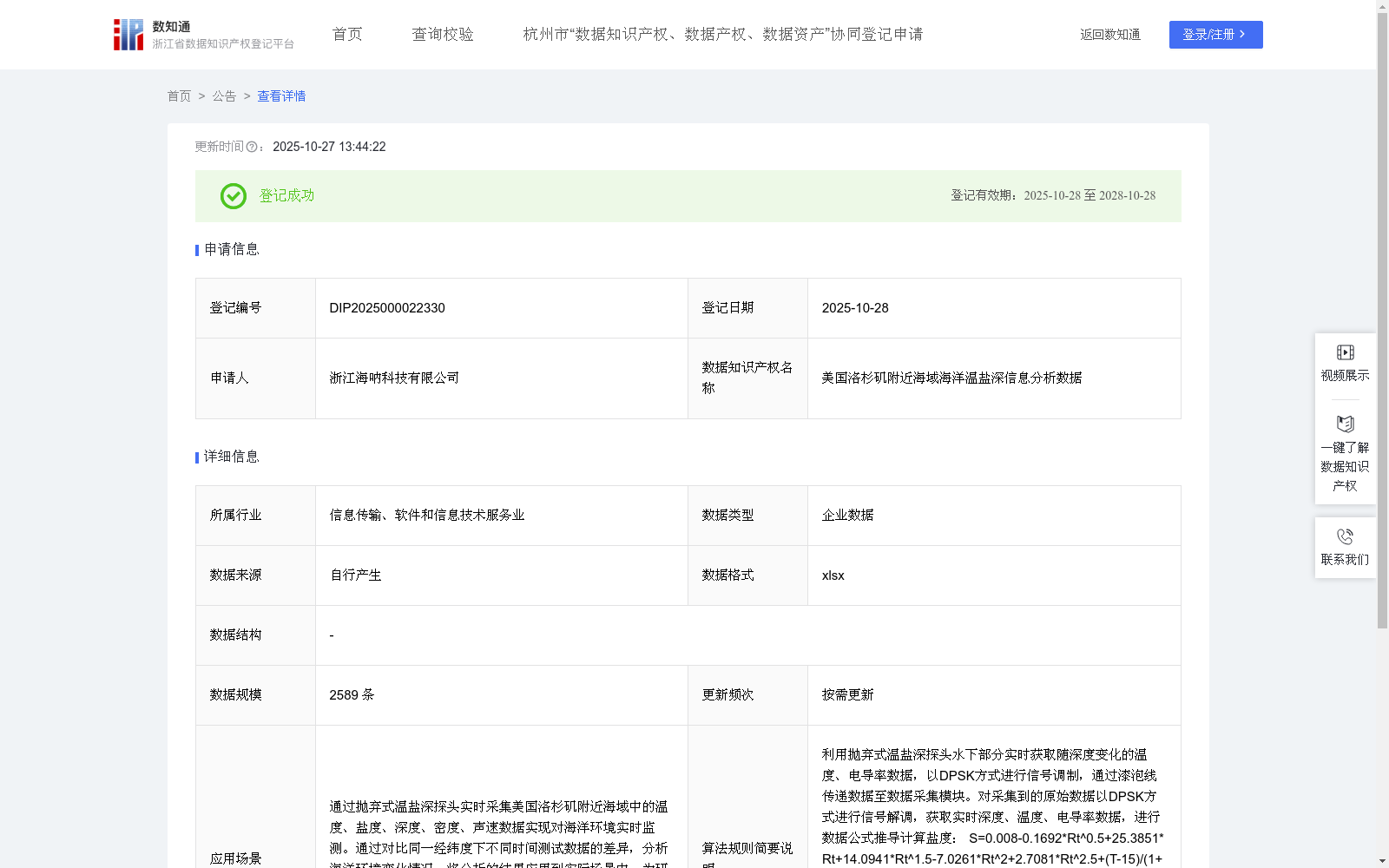
美国洛杉矶附近海域海洋温盐深信息分析数据
收藏资源简介:
通过抛弃式温盐深探头实时采集美国洛杉矶附近海域中的温度、盐度、深度、密度、声速数据实现对海洋环境实时监测。通过对比同一经纬度下不同时间测试数据的差异,分析海洋环境变化情况。将分析的结果应用到实际场景中,为研究海洋物理学、声纳等海域探测设备、船舰等海洋运输作战工具提供数据支撑。利用抛弃式温盐深探头水下部分实时获取随深度变化的温度、电导率数据,以DPSK方式进行信号调制,通过漆泡线传递数据至数据采集模块。对采集到的原始数据以DPSK方式进行信号解调,获取实时深度、温度、电导率数据,进行数据公式推导计算盐度: S=0.008-0.1692*Rt^0.5+25.3851*Rt+14.0941*Rt^1.5-7.0261*Rt^2+2.7081*Rt^2.5+(T-15)/(1+0.0162*(T-15))*0.0005-0.0056*Rt^0.5-0.0066*Rt-0.0375*Rt^1.5+0.0636*Rt^2-0.0144*Rt^2.5; 计算声速: V=1449.2+4.6*T-0.055*T^2+0.00029*T^3+(1.34-0.01*T)*(S-35)+1.6*0.01*D 计算密度: ρ=ds0/(1-(P*10/Kstp)); 其中,T:温度,S:盐度,P:压力,D:深度,V:声速,ρ:密度,Rt:电导率比值。
Real-time marine environmental monitoring is implemented by collecting temperature, salinity, depth, density and sound speed data in the coastal waters near Los Angeles, USA, using expendable conductivity-temperature-depth (XCTD) probes. Marine environmental changes are analyzed by comparing differences between test datasets collected at the same longitude and latitude at different time points. The analyzed results are applied to practical scenarios, providing data support for research in marine physics, marine detection equipment such as sonar, and marine transportation and combat tools including vessels. The underwater section of the XCTD probe acquires real-time temperature and conductivity data that vary with depth. The signals are modulated via differential phase shift keying (DPSK) and transmitted to the data acquisition module through lacquer-coated wire. The collected raw data are demodulated using DPSK to obtain real-time depth, temperature and conductivity data. Salinity is calculated via the following derived formula: S=0.008-0.1692*Rt^0.5+25.3851*Rt+14.0941*Rt^1.5-7.0261*Rt^2+2.7081*Rt^2.5+(T-15)/(1+0.0162*(T-15))*0.0005-0.0056*Rt^0.5-0.0066*Rt-0.0375*Rt^1.5+0.0636*Rt^2-0.0144*Rt^2.5; Sound speed is calculated using: V=1449.2+4.6*T-0.055*T^2+0.00029*T^3+(1.34-0.01*T)*(S-35)+1.6*0.01*D Density is calculated using: ρ=ds0/(1-(P*10/Kstp)); Where T: temperature, S: salinity, P: pressure, D: depth, V: sound speed, ρ: density, and Rt: conductivity ratio.