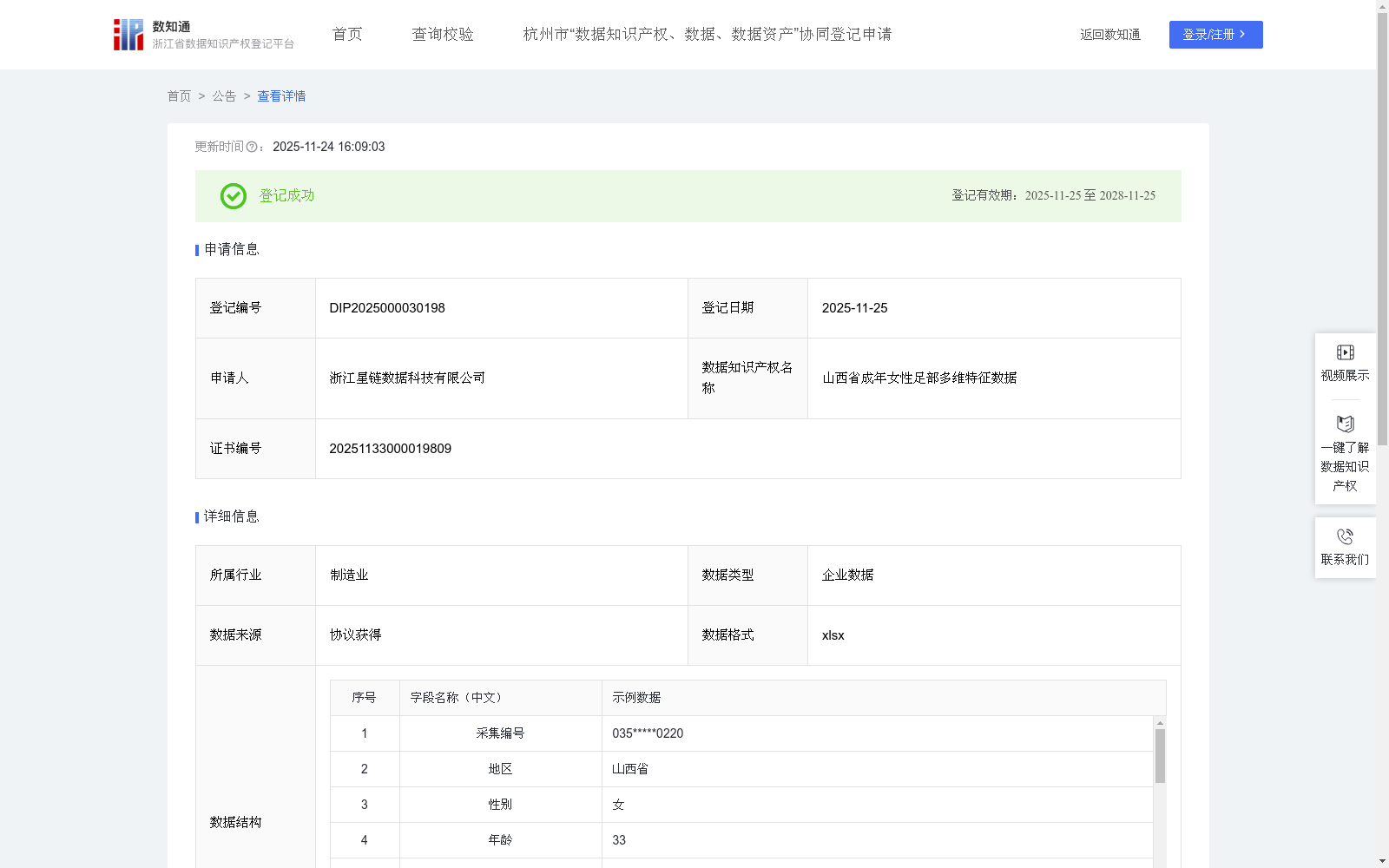
山西省成年女性足部多维特征数据
收藏资源简介:
鞋类设计与定制:为鞋企提供区域性足型数据库,支持鞋楦设计、鞋码标准化、个性化定制;利用脚长与鞋码偏差数据,优化现有鞋码分段,基于足长、足宽、足弓高、后跟间隙等指标,建立分龄、分码鞋楦模板库,供鞋企直接调用,减少打版试错成本;为运动品牌、工装鞋、康复鞋等提供足型特征数据,支持开发适合不同场景的功能性鞋款。1、数据分析和采集:本数据来源于山西省区域的成年女性的足部数据,包括脚长、足弓高低、足后跟间隙距离、足部分踵夹角、足部拇趾外突点长、足部第二趾端点长、足部拇指翻转角度等数据,利用这些数据分析出“鞋码推荐、足弓评测、足跟内外翻评测、足型评测、拇指内外翻评测”5个维度的结论。 2、算法说明:(1)鞋码推荐算法:根据脚长采用国家标准GB/T 3293-2017《中国鞋楦系列》的鞋码尺寸计算方式,基于脚长+10mm(放量)转换为欧码标准,左右脚独立计算,支持不对称脚型,推荐鞋码=ROUND((脚长(mm) + 10 - 12) / 5 - 10, 0);(2)足弓评测:使用LOOKUP函数,实测足弓高低按9段阈值自动分型,足弓评测= LOOKUP(足弓高, {0,1.5,2.5,3.5,4.5,5.5,6.5,7.5,8.5}, {"9型重度扁平","8型中度扁平","7型轻度扁平","6型常态足","5型正常足","4型常态足","3型轻度高弓","2型中度高弓","1型重度高弓"});(3)足跟内外翻评测:θ = 分踵夹角 + 1.1×后跟间隙距离;按 ±10°、±15°、±20° 分段得1-9型;(4)足型评测:Δ=第二趾端点长−拇趾外突点长;Δ>5 mm希腊脚(第二趾最长),Δ<−5 mm埃及脚(拇趾最长),其余罗马脚(1-2趾几乎平齐);(5)足部拇指内外翻评测:拇指翻转角度 0-9° 正常、10-15° 轻度、16-20° 中度、≥21° 重度。
Footwear Design and Customization: Provides regional foot shape databases for footwear enterprises, supporting last design, shoe size standardization and personalized customization; uses deviation data between foot length and shoe size to optimize existing shoe size segments, and establishes age- and size-specific last template libraries based on metrics including foot length, foot width, arch height and heel gap. These templates can be directly accessed by footwear enterprises to reduce the costs of pattern making and trial and error; provides foot shape feature data for sports brands, work shoes, rehabilitation shoes and other footwear categories, to support the development of functional footwear tailored for different application scenarios. 1. Data Analysis and Collection: This dataset is sourced from foot measurement data of adult females residing in Shanxi Province, including metrics such as foot length, arch height, heel gap distance, foot heel split angle, length of the hallux valgus prominence point, length of the second toe tip, and hallux valgus angle. These measurement data are used to generate evaluation conclusions across 5 dimensions: "shoe size recommendation, arch evaluation, heel varus/valgus evaluation, foot shape evaluation and hallux valgus/varus evaluation". 2. Algorithm Description: (1) Shoe Size Recommendation Algorithm: The shoe size calculation method specified in the national standard GB/T 3293-2017 *China Last Series* is adopted based on foot length, converts to European shoe size standards based on foot length plus 10mm of wearing allowance, and calculations are performed independently for the left and right feet to accommodate asymmetric foot shapes. The recommended shoe size = ROUND((foot length (mm) + 10 - 12) / 5 - 10, 0); (2) Arch Evaluation: The LOOKUP function is utilized to automatically classify the measured arch height into 9 segments based on predefined thresholds, and the arch evaluation result = LOOKUP(arch height, {0,1.5,2.5,3.5,4.5,5.5,6.5,7.5,8.5}, {"Type 9 Severe Flatfoot", "Type 8 Moderate Flatfoot", "Type 7 Mild Flatfoot", "Type 6 Normal Arch Foot", "Type 5 Normal Arch Foot", "Type 4 Normal Arch Foot", "Type 3 Mild High Arch Foot", "Type 2 Moderate High Arch Foot", "Type 1 Severe High Arch Foot"}); (3) Heel Varus/Valgus Evaluation: θ = heel split angle + 1.1 × heel gap distance; the value is classified into 9 types (1 to 9) based on threshold segments of ±10°, ±15°, and ±20°; (4) Foot Shape Evaluation: Δ = length of the second toe tip - length of the hallux valgus prominence point; A Δ value greater than 5 mm indicates a Greek foot (longest second toe), a Δ value less than -5 mm indicates an Egyptian foot (longest hallux), and all remaining cases are classified as Roman feet (first and second toes nearly flush); (5) Hallux Valgus/Varus Evaluation: A hallux valgus angle of 0-9° is classified as normal, 10-15° as mild, 16-20° as moderate, and 21° or above as severe.