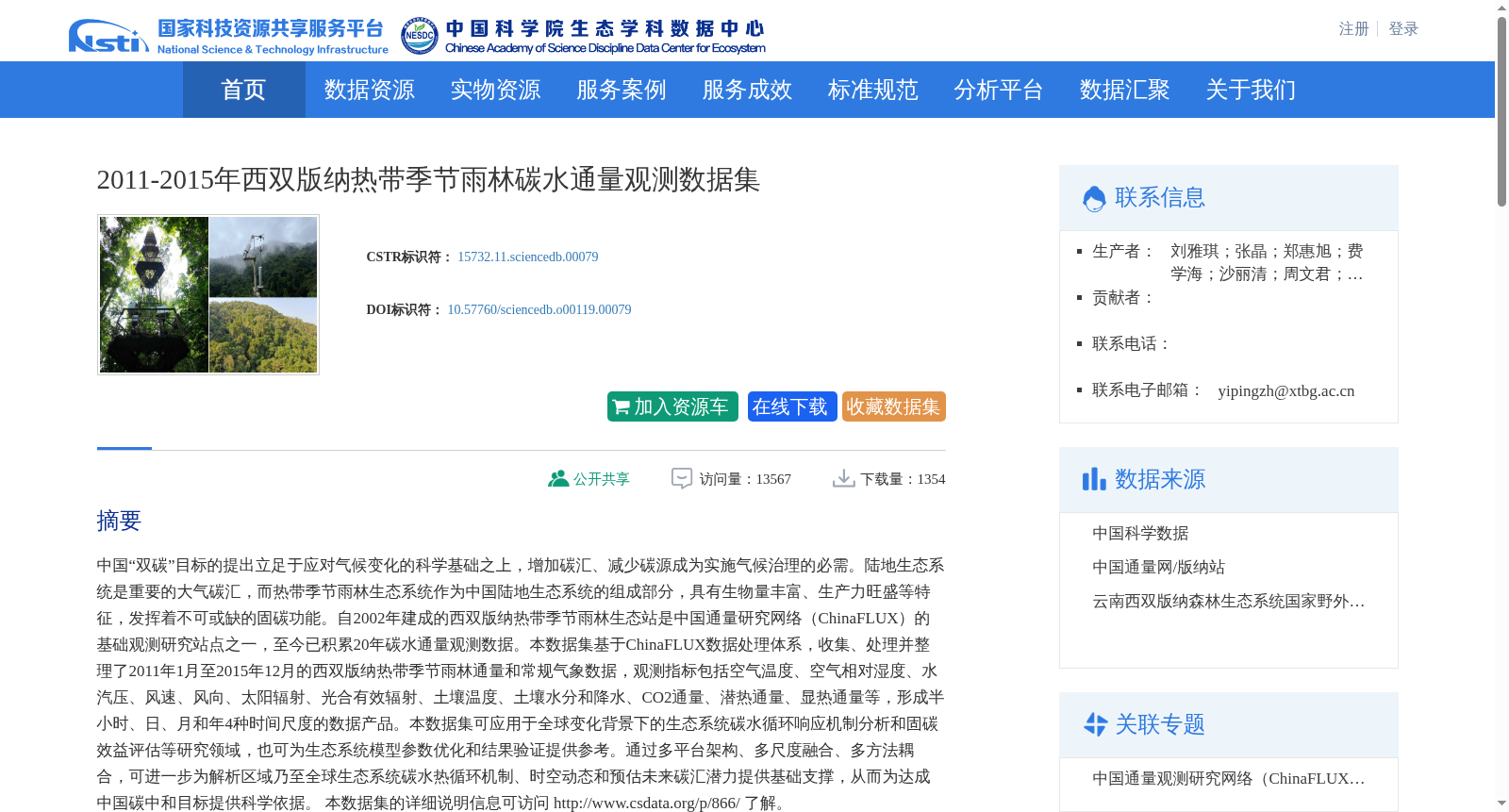
2011-2015年西双版纳热带季节雨林碳水通量观测数据集
收藏资源简介:
中国“双碳”目标的提出立足于应对气候变化的科学基础之上,增加碳汇、减少碳源成为实施气候治理的必需。陆地生态系统是重要的大气碳汇,而热带季节雨林生态系统作为中国陆地生态系统的组成部分,具有生物量丰富、生产力旺盛等特征,发挥着不可或缺的固碳功能。自2002年建成的西双版纳热带季节雨林生态站是中国通量研究网络(ChinaFLUX)的基础观测研究站点之一,至今已积累20年碳水通量观测数据。本数据集基于ChinaFLUX数据处理体系,收集、处理并整理了2011年1月至2015年12月的西双版纳热带季节雨林通量和常规气象数据,观测指标包括空气温度、空气相对湿度、水汽压、风速、风向、太阳辐射、光合有效辐射、土壤温度、土壤水分和降水、CO2通量、潜热通量、显热通量等,形成半小时、日、月和年4种时间尺度的数据产品。本数据集可应用于全球变化背景下的生态系统碳水循环响应机制分析和固碳效益评估等研究领域,也可为生态系统模型参数优化和结果验证提供参考。通过多平台架构、多尺度融合、多方法耦合,可进一步为解析区域乃至全球生态系统碳水热循环机制、时空动态和预估未来碳汇潜力提供基础支撑,从而为达成中国碳中和目标提供科学依据。 本数据集的详细说明信息可访问 http://www.csdata.org/p/866/ 了解。
The proposal of China's "Dual Carbon" goals is rooted in the scientific basis for addressing climate change, and increasing carbon sinks and reducing carbon sources have become indispensable for implementing climate governance. Terrestrial ecosystems are important atmospheric carbon sinks, and the tropical seasonal rainforest ecosystem, as a component of China's terrestrial ecosystems, is characterized by rich biomass and high productivity, playing an irreplaceable role in carbon sequestration. The Xishuangbanna Tropical Seasonal Rainforest Ecological Station, established in 2002, is one of the foundational observational and research stations of the China Flux Research Network (ChinaFLUX), and has accumulated 20 years of water and carbon flux observation data to date. This dataset is developed based on the ChinaFLUX data processing system, collecting, processing and organizing the flux and routine meteorological data of the Xishuangbanna tropical seasonal rainforest from January 2011 to December 2015. The observation indicators include air temperature, air relative humidity, water vapor pressure, wind speed, wind direction, solar radiation, photosynthetically active radiation (PAR), soil temperature, soil moisture, precipitation, CO₂ flux, latent heat flux, sensible heat flux, etc., generating four types of data products at temporal scales of half-hour, daily, monthly and annual. This dataset can be applied to research areas including the analysis of ecosystem water-carbon cycle response mechanisms and the assessment of carbon sequestration benefits under the context of global change, and can also provide references for parameter optimization and result verification of ecosystem models. Through multi-platform architecture, multi-scale fusion and multi-method coupling, it can further provide fundamental support for analyzing the water-carbon-heat cycle mechanisms, spatiotemporal dynamics of regional and even global ecosystems, and projecting future carbon sink potential, thereby providing scientific support for achieving China's carbon neutrality target. Detailed information of this dataset can be accessed at http://www.csdata.org/p/866/ for further reference.