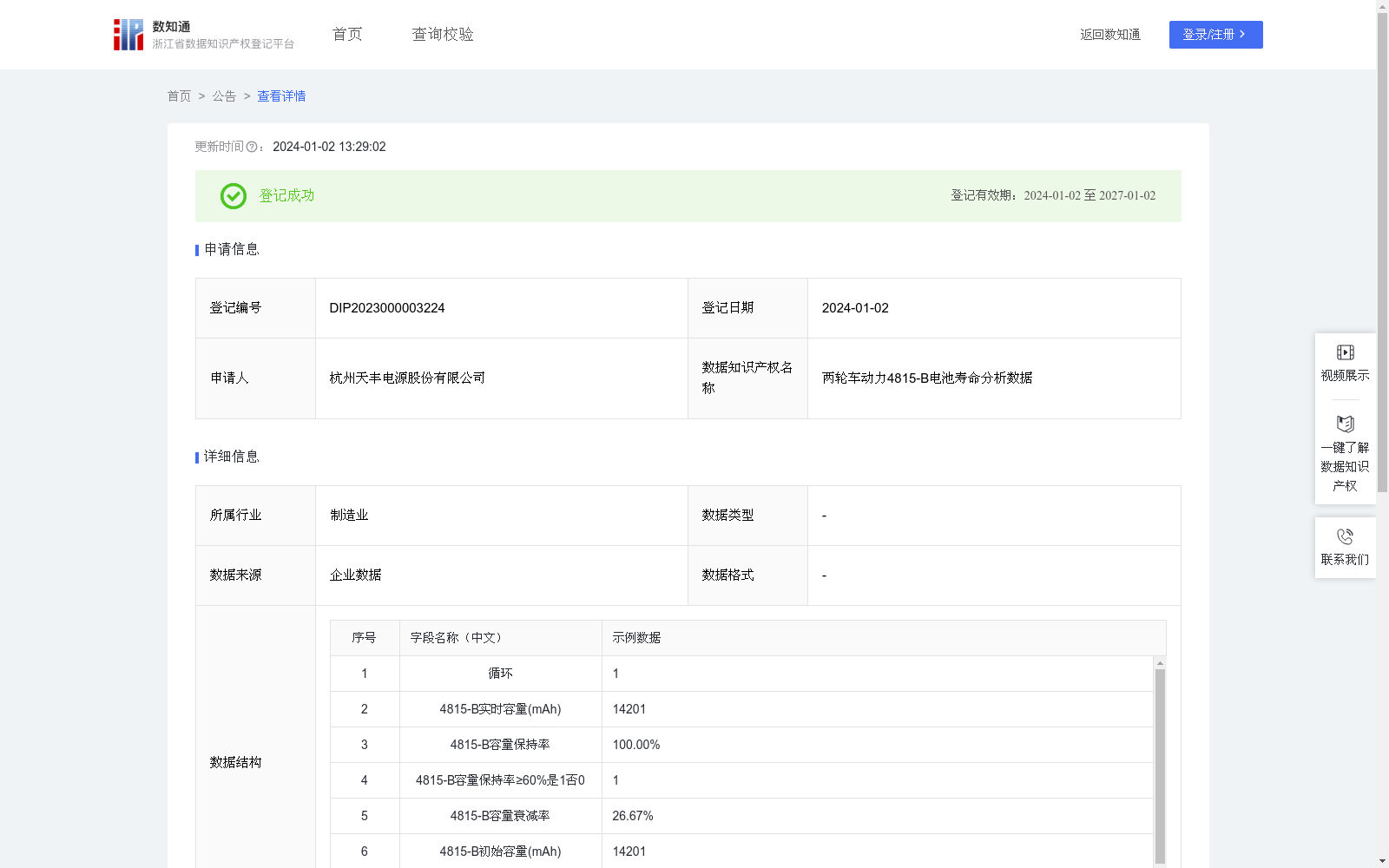
两轮车动力4815-B电池寿命分析数据
收藏资源简介:
在规定的循环寿命测试制度下,分析电动两轮车动力电池的容量保持率、放电容量衰减情况对以及应容量的变化率,用于评估该类型电池在长时间循环放电情况下的性能衰减情况、电池性能稳定性分析以及电池使用寿命预测。1.数据来源 在规定的循环寿命测试制度下,循环记录电动两轮车锂离子4815-B动力电池800次的实时容量数据。 2.数据处理 2.1实时预警 基于电动两轮车锂离子动力电池放电寿命要求,通过设置监测阈值并实现智能预警,当测试结束时,若循环记录600次中均没有预警,则继续循环至800次,容量保持率取800次的数据;若实时容量低于初始容量60%时,循环过程中有进行预警,则采用预警时的数据作为终止容量,结束循环; 2.2性能衰减变化率 采用以下公式计算电池性能变化相关的参数: (1)容量保持率=实时容量/初始容量*100%; (2)容量衰减率=(初始容量-终止容量)/初始容量*100%; (3)容量变化率=(终止容量-实时容量)/终止容量; 3.数据应用 通过分析两轮车动力电池的容量保持率、放电容量衰减情况对以及应容量的变化率,用于评估该类型电池在长时间循环放电情况下的性能衰减情况、电池性能稳定性分析以及电池使用寿命预测。
Under a standardized cycle life test protocol, this dataset analyzes the capacity retention rate, discharge capacity decay, and capacity change rate of power batteries for electric two-wheelers, aiming to evaluate the performance degradation, battery performance stability, and service life prediction of this type of battery under long-term cyclic discharge conditions. 1. Data Source Real-time capacity data of 800 cycles were cyclically recorded for Li-ion 4815-B power batteries for electric two-wheelers under the prescribed cycle life test protocol. 2. Data Processing 2.1 Real-time Early Warning Based on the discharge lifespan requirements of Li-ion power batteries for electric two-wheelers, monitoring thresholds were set to enable intelligent early warning. During the test: - If no early warning was triggered throughout the first 600 cycles of cyclic recording, the test was continued until 800 cycles, and the capacity retention rate was calculated using the data from the 800th cycle; - If early warning was triggered during the cyclic process when the real-time capacity dropped below 60% of the initial capacity, the data at the time of early warning was used as the termination capacity to end the test. 2.2 Performance Degradation Change Rate Parameters related to battery performance changes were calculated using the following formulas: (1) Capacity Retention Rate = (Real-time Capacity / Initial Capacity) × 100%; (2) Capacity Decay Rate = [(Initial Capacity - Termination Capacity) / Initial Capacity] × 100%; (3) Capacity Change Rate = (Termination Capacity - Real-time Capacity) / Termination Capacity; 3. Data Application By analyzing the capacity retention rate, discharge capacity decay, and capacity change rate of power batteries for electric two-wheelers, this dataset can be used to evaluate the performance degradation, battery performance stability, and service life prediction of this type of battery under long-term cyclic discharge conditions.