
Spacecraft With Masks (SwiM)
收藏资源简介:
SwiM数据集由莱斯大学计算机科学系、NASA和莱斯大学数据知识实验室共同创建,包含近6.4万张带有注释的航天器图像。数据集采用真实航天器模型,叠加在NASA的TTALOS流水线生成的真实和合成背景上。为模拟真实世界图像采集中的相机失真和噪声,数据集还添加了不同类型的噪声和失真。该数据集旨在为在轨自主检查系统提供标准化的性能评估,并满足在飞行计算机上进行实时航天器分割的硬件和推理时间限制。
The SwiM dataset was co-created by the Department of Computer Science at Rice University, NASA, and the Rice University Data Knowledge Lab. It consists of nearly 64,000 annotated spacecraft images. Real spacecraft models are overlaid onto real and synthetic backgrounds generated by NASA's TTALOS pipeline. To simulate camera distortions and noise in real-world image acquisition, various types of noise and distortions are also added to the dataset. This dataset aims to provide standardized performance evaluation for on-orbit autonomous inspection systems, while meeting the hardware and inference time constraints for real-time spacecraft segmentation on flight computers.
SWiM 数据集概述
项目简介
- 项目名称:Spacecraft With Masks (SWiM) Dataset
- 合作机构:NASA - Rice University D2K Lab
- 目标:创建用于太空航天器检查的大型航天器图像数据集,包含分割掩码和性能基准
- 应用领域:自主检查、航天器导航、姿态估计和结构分析
数据集内容
- 数据集版本:dataset-v1、dataset-v2
- 数据集下载地址:https://drive.google.com/drive/folders/1-vd2KWqrl9Z3fpG7iS_r1L7bfjOlIzFt?usp=drive_link
- 模型下载地址:https://drive.google.com/drive/folders/1WxbuNpZJu50HF27rXzarGAWMtwsZDdTc?usp=drive_link
基准模型
- 模型类型:YOLOv8 nano、YOLO v11 nano
- 优化目标:资源受限硬件上的运行效率
软件依赖
训练依赖
- Python 3.11+
- CUDA v12.1
- 关键库:numpy、opencv-python、pillow、torch、torchvision、ultralytics等
推理依赖
- 关键库:numpy、opencv-python、pillow、torch、onnx、onnxruntime等
硬件配置
- 基准训练配置:
- GPU:NVIDIA GeForce RTX 4060 Laptop GPU (8GB)
- CPU:13th Gen Intel(R) Core(TM) i9-13900H (2.60 GHz)
- RAM:16.0 GB
目录结构
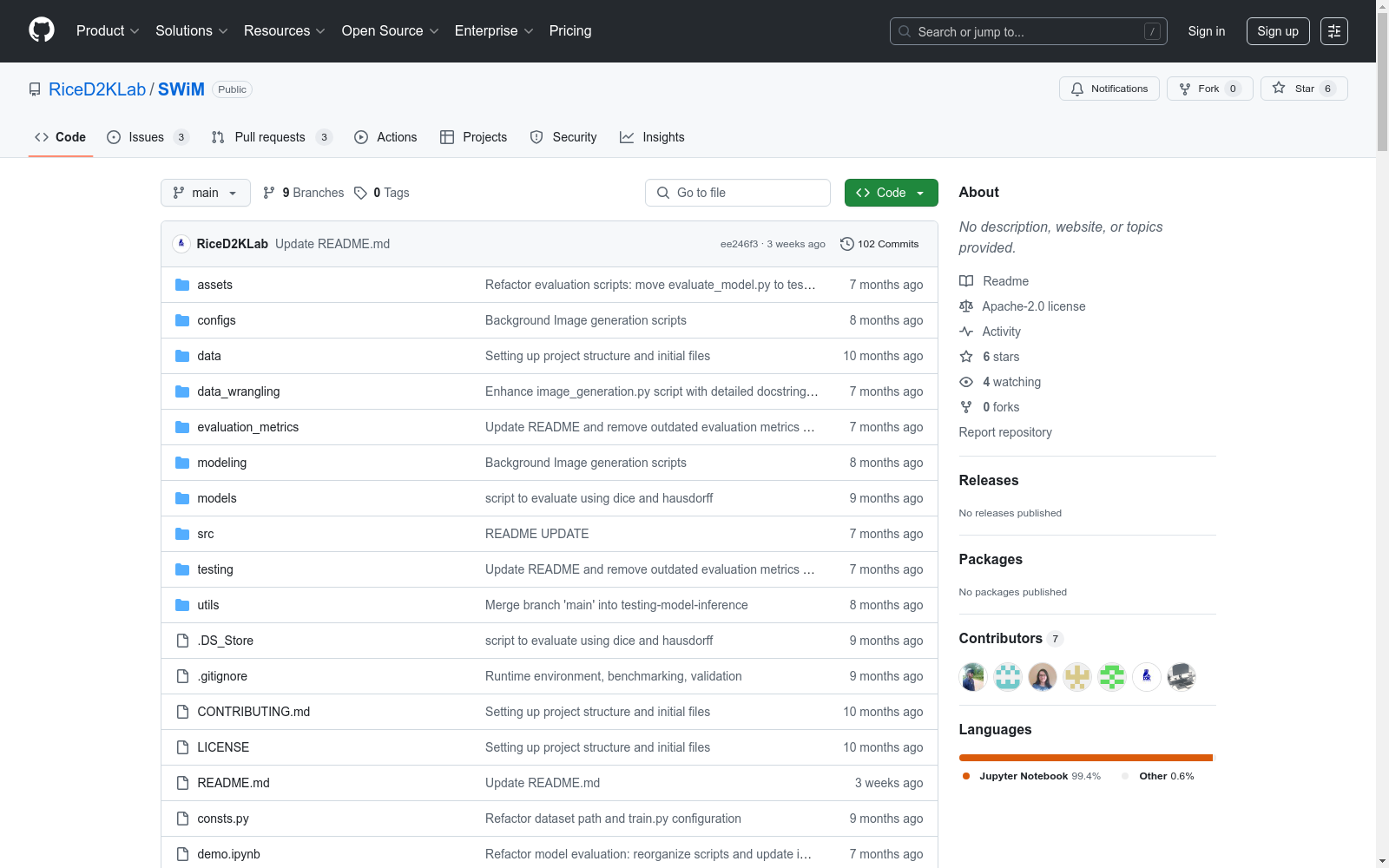
sh /NASA_segmentation_F24/ ├── data_wrangling/ ├── modeling/ ├── testing/ ├── utils/ ├── data/ ├── configs/ ├── requirements.txt ├── LICENSE ├── CONTRIBUTING └── README.md
示例输出
- 包含分割掩码和边界框
- 显示航天器组件的识别结果
日志记录
- 支持Weights & Biases (WandB)日志记录
- 需配置API密钥
许可证
- APACHE License
- 1A New Dataset and Performance Benchmark for Real-time Spacecraft Segmentation in Onboard Flight Computers美国莱斯大学计算机科学系、NASA、莱斯大学数据知识实验室 · 2025年


