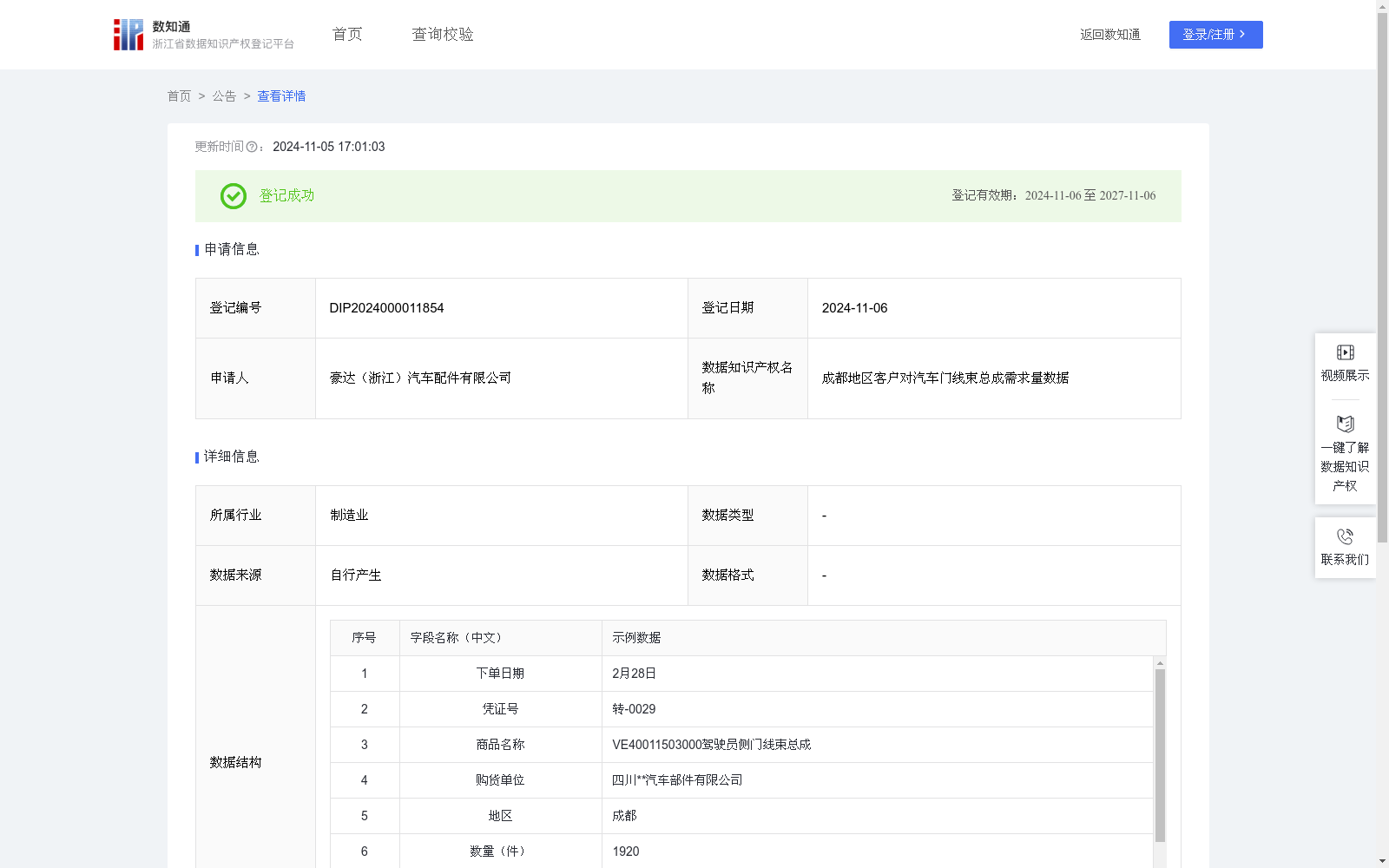
成都地区客户对汽车门线束总成需求量数据
收藏资源简介:
通过收集和分析成都地区客户对汽车门线束总成消费相关数据,了解客户对汽车门线束总成的购买力水平和消费偏好,从而了解该产品是否畅销,从而为本行业的所有企业制定生产策略,更好地为用户提供个性化的商品和服务。1、算法加工:用户消费数量占用户消费总数量的比例=用户消费数量/用户消费总数量*100%;2、数据分类分级:根据计算出的需求量水平,将客户等级划分为“高、中、低”不同的类别和级别,对占比大于等于1以上的,给予“高等级消费”分层;占比大于等于0.5%到小于1以下的,则给予“中等级消费”分层;占比0.5%以下的,则给予“低等级消费”分层。帮助公司更好地了解客户,从而制定更精准的生产营销策略。
This dataset is developed by collecting and analyzing consumer data related to automotive door harness assemblies from customers in the Chengdu region. Its core objectives are to understand the purchasing power and consumption preferences of customers for automotive door harness assemblies, assess the market popularity of this product, and provide references for all enterprises in the industry to formulate production strategies and deliver more personalized products and services to end users. 1. Algorithm Processing: The proportion of a single user's consumption volume in the total user consumption volume is calculated as: (user's consumption volume / total user consumption volume) * 100%. 2. Data Classification and Grading: Based on the calculated demand level, customers are categorized into three tiers: "High-level Consumption", "Medium-level Consumption", and "Low-level Consumption". Specifically, users with a consumption proportion ≥ 1% are classified as "High-level Consumption"; those with a proportion ≥ 0.5% but < 1% are classified as "Medium-level Consumption"; and those with a proportion < 0.5% are classified as "Low-level Consumption". This methodology enables enterprises to gain deeper insights into their customer base, thereby formulating more precise production and marketing strategies.